

Key Takeaways
Metabolic Adaptation
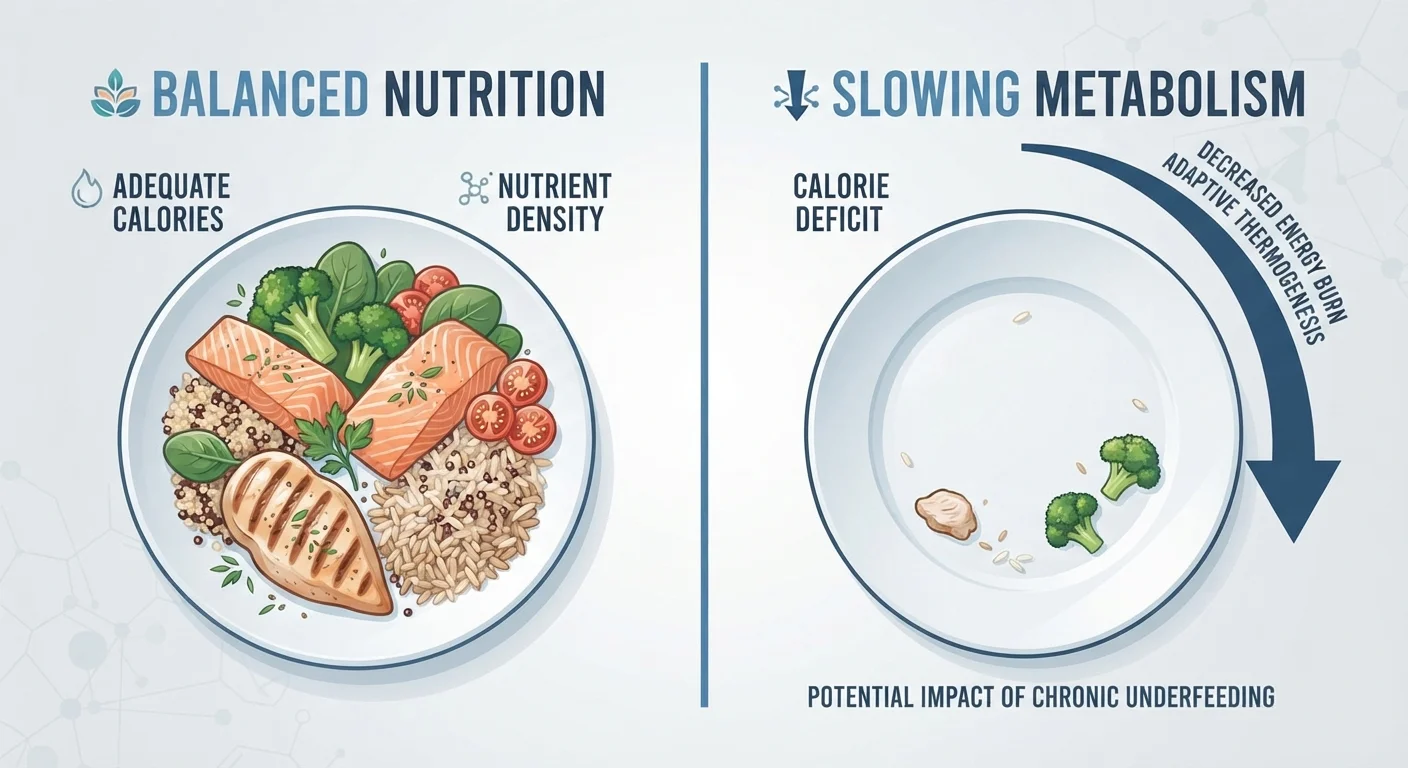
Metabolic adaptation is the body's natural response to a significant reduction in calorie intake, during which it lowers the number of calories it burns at rest. This is a built-in survival mechanism - the body interprets a sharp drop in food as a threat and becomes more energy-efficient to conserve resources. The result is that the same calorie deficit produces fewer results over time.
Researchers sometimes call this "adaptive thermogenesis" - a measurable reduction in resting energy expenditure beyond what would be expected from changes in body weight or composition alone.
What Crash Dieting Actually Does to Your Metabolism
When people dramatically slash their calorie intake - often in pursuit of rapid weight loss - the body does not simply burn through stored fat at an accelerating pace. Instead, it detects a substantial energy shortfall and activates a cascade of physiological responses designed to protect it from what it perceives as a period of scarcity.
The core mechanism is a reduction in resting metabolic rate (RMR) - the calories your body burns just to sustain basic functions like breathing, circulation, and cell repair. This slowdown is called adaptive thermogenesis, and it is well-documented in the scientific literature. It means that over time, the same calorie intake that initially produced a deficit may no longer be sufficient to continue losing weight, because the body has recalibrated its energy needs downward.
This is not a willpower failure or a metabolic myth - it is a measurable biological response. Understanding it is the first step toward making more sustainable choices around food and energy intake.
~15-30%
Additional metabolic rate reduction beyond weight loss alone
Research, including the well-known Minnesota Starvation Experiment and subsequent studies, has shown that adaptive thermogenesis can account for a significant drop in energy expenditure beyond what body composition changes alone would predict.
Up to 25%
Portion of weight lost that can be lean mass during severe restriction
Studies on very low calorie diets indicate that without adequate protein and resistance training, a substantial share of weight lost may come from lean tissue rather than fat.
6-12 months+
Duration metabolic adaptation may persist after dieting ends
Follow-up research on participants in prolonged calorie restriction studies suggests that reduced resting energy expenditure and altered hunger hormones can persist well after active dieting has stopped.
The Role of Hormones and Lean Muscle Loss
Metabolic adaptation is not a single switch - it involves multiple hormonal and body-composition changes that compound one another.
Leptin, a hormone produced by fat cells, plays a central signaling role. When body fat and calorie intake drop sharply, leptin levels fall, which the brain interprets as a threat. This triggers increased hunger, reduced energy expenditure, and a drive to restore body weight - effects that can persist even after eating resumes. At the same time, active thyroid hormones, which regulate how fast the body runs its metabolic engine, also decline during prolonged restriction.
Equally important is what happens to lean muscle tissue. In a severe deficit, the body does not rely exclusively on stored fat for energy. It breaks down muscle protein as well. Since muscle is metabolically active - meaning it burns calories even at rest - losing it directly lowers RMR. This creates a self-reinforcing cycle: the lower the muscle mass, the fewer calories the body requires, making it progressively harder to sustain a deficit without cutting intake further.
This dynamic also helps explain why crash dieters often regain weight quickly. Their bodies are now running on a lower metabolic set point, while hunger-driving hormones remain elevated. Just as eliminating entire food groups can intensify cravings and metabolic stress, severe calorie cuts set off biological feedback loops that work against long-term goals.
What the Evidence Supports Instead
The research points consistently toward a more measured approach to calorie reduction. Moderate deficits - generally in the range that produces gradual, steady change rather than rapid loss - are associated with better preservation of lean mass, smaller reductions in metabolic rate, and improved long-term weight maintenance. These deficits should be determined with the guidance of a qualified healthcare provider or registered dietitian, as appropriate calorie levels vary significantly by individual.
Adequate dietary protein plays a key supporting role. Higher protein intakes during a calorie deficit have been shown to help preserve lean muscle tissue, which in turn limits the metabolic rate reduction that would otherwise accompany weight loss.
Resistance training is another well-supported strategy. By providing a stimulus for muscle maintenance or growth, it counteracts some of the lean mass loss that occurs during calorie restriction and helps sustain a higher metabolic rate over time.
The goal, from a physiological standpoint, is to create a manageable energy deficit that the body can sustain without triggering a full-scale adaptive response. Extreme approaches may produce faster initial results, but the body's adaptation mechanisms make them increasingly ineffective - and harder to maintain - as time goes on.
This article is for general informational and educational purposes only and does not constitute medical or dietary advice. If you are considering significant changes to your diet or calorie intake, please consult a qualified healthcare professional or registered dietitian.