

| Primary sleep-pressure chemical | Adenosine |
| Melatonin production trigger | Onset of darkness detected by the eyes |
| Peak cortisol timing | Approximately 30–45 minutes after waking (Research literature on the cortisol awakening response) |
| How caffeine works | Blocks adenosine receptors, temporarily masking sleep pressure |
| Melatonin's role | Sleep timing signal, not a sedative |
| Cortisol's evening pattern | Reaches its daily low point near sleep onset |
Two Systems That Work Together
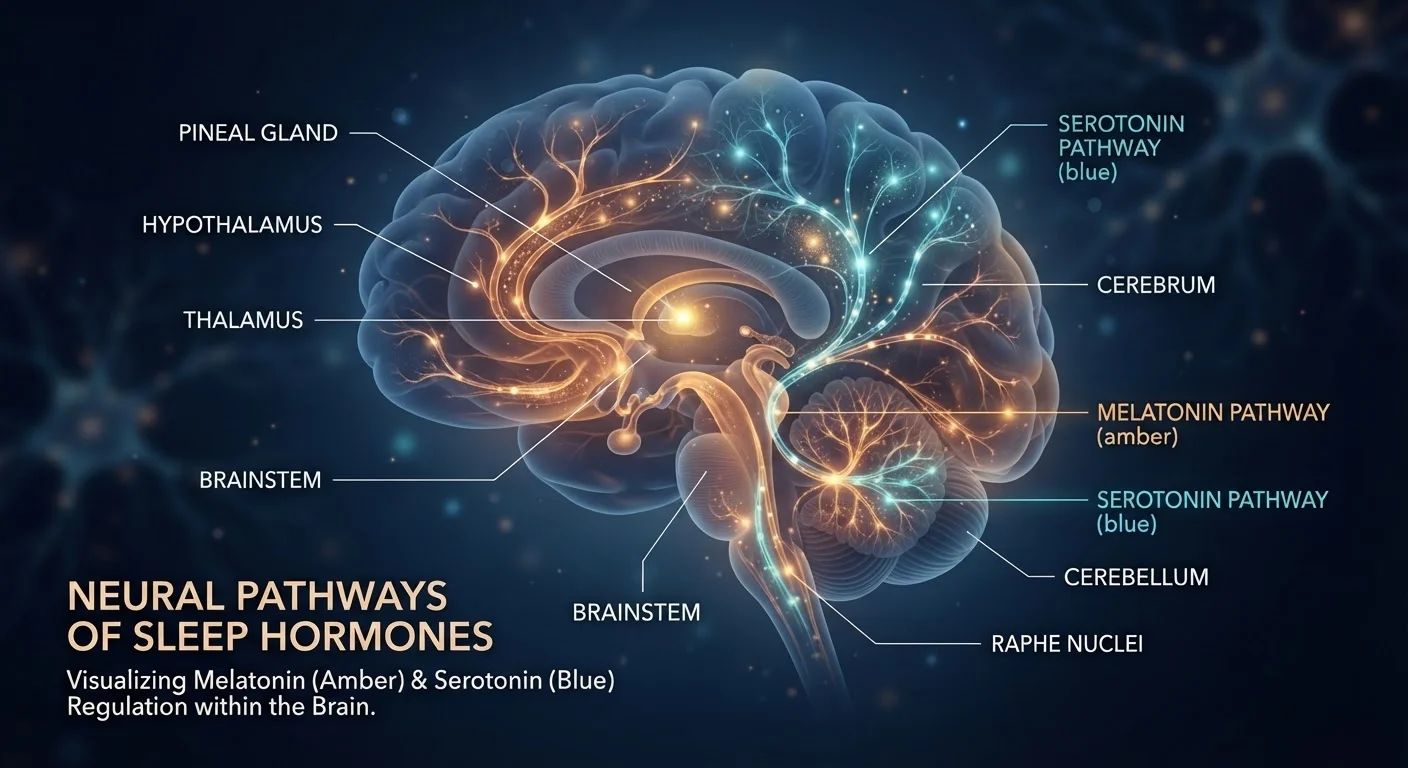
Your body uses two overlapping biological systems to manage sleep and wakefulness. The first is the homeostatic sleep drive — a pressure that builds the longer you stay awake. The second is your circadian rhythm, an internal 24-hour clock that cues alertness and sleepiness at predictable times regardless of how tired you feel. Three chemicals — adenosine, melatonin, and cortisol — are the primary molecular messengers these systems rely on.
Understanding how each one works, and how they interact, helps explain why sleep timing matters as much as sleep duration. It also clarifies why disrupting one signal — through shift work, irregular schedules, or excessive artificial light — can unravel the whole system.
This Is General Health Information
This article explains normal sleep physiology for educational purposes. If you experience persistent difficulty sleeping, excessive daytime sleepiness, or other sleep concerns, consult a qualified healthcare professional. Do not adjust medications, supplements, or treatments based on this content alone.
Adenosine: The Sleep Pressure Molecule
Every hour you spend awake, neurons in your brain produce adenosine as a byproduct of activity. As adenosine accumulates, it binds to receptors that progressively suppress arousal circuits, generating the sensation of mounting tiredness. After roughly 16 hours of wakefulness in most adults, this pressure becomes difficult to ignore.
Sleep clears adenosine. During slow-wave (deep) sleep in particular, adenosine levels fall, which is why waking after sufficient sleep feels genuinely restorative rather than just a pause in fatigue. Caffeine works by temporarily blocking adenosine receptors — not by reducing adenosine itself — which is why the tired feeling returns once caffeine is metabolized.
For a broader look at how sleep stages facilitate this clearing process, see The Architecture of a Night's Sleep.
| Primary sleep-pressure chemical | Adenosine |
| Melatonin production trigger | Onset of darkness detected by the eyes |
| Peak cortisol timing | Approximately 30–45 minutes after waking (Research literature on the cortisol awakening response) |
| How caffeine works | Blocks adenosine receptors, temporarily masking sleep pressure |
| Melatonin's role | Sleep timing signal, not a sedative |
| Cortisol's evening pattern | Reaches its daily low point near sleep onset |
Melatonin: The Darkness Signal
Melatonin is produced by the pineal gland, a small structure in the brain that receives input from a master clock region called the suprachiasmatic nucleus (SCN). When light levels drop in the evening, the SCN signals the pineal gland to begin releasing melatonin — typically about two hours before your habitual sleep time.
A common misconception is that melatonin causes sleep the way a sedative does. It does not. Melatonin is primarily a timing signal: it tells the brain and body that night has arrived and that conditions are appropriate for sleep. Core body temperature drops, arousal decreases, and the nervous system shifts toward a restorative state. Melatonin levels remain elevated through the night and fall in the early morning as light returns.
Because light is the dominant regulator of melatonin, exposure to bright or blue-spectrum light in the evening suppresses its release and delays sleep onset. How Light Exposure Shapes Your Sleep Biology covers this physiology in detail.
Cortisol: The Waking Signal
Cortisol is best known as a stress hormone, but it also has a precisely timed daily rhythm that is essential to healthy waking. Driven by the same circadian clock that governs melatonin, cortisol begins rising in the early morning hours — well before you open your eyes. It peaks approximately 30–45 minutes after waking, a pattern researchers call the cortisol awakening response (CAR).
This morning surge does several things: it raises blood sugar to fuel early-day activity, sharpens cognitive alertness, and signals cells throughout the body that daytime has begun. By evening, cortisol falls to its lowest daily level, allowing melatonin and sleep pressure to dominate — a handoff that requires both systems to be well-calibrated. Chronically elevated evening cortisol, often associated with psychological stress, can significantly delay sleep onset and reduce sleep quality.
Cortisol is also one of several hormones involved in metabolic regulation. Hormones That Govern Your Metabolism provides broader context on how it interacts with thyroid and insulin signaling.
How These Three Work in Concert
Adenosine, melatonin, and cortisol do not operate in isolation. They are part of an interconnected system where each chemical's pattern reinforces the others. A regular sleep-wake schedule — with consistent wake times and light exposure — keeps all three synchronized. Irregular schedules, late artificial light, chronic stress, or insufficient sleep disrupt this coordination, often making it harder to fall asleep, stay asleep, and feel alert the next day.
Practical habits that support these pathways include maintaining a consistent wake time (which anchors the cortisol awakening response and the circadian rhythm), getting morning light exposure (which reinforces melatonin timing), and limiting bright light in the evening. Morning Sunlight, Evening Darkness, and Your Sleep Drive explores the light-management side of this picture in depth.
This article is for general informational and educational purposes only and is not a substitute for professional medical advice, diagnosis, or treatment. If you have concerns about your sleep or hormone health, speak with a qualified healthcare provider.