

Key Takeaways
Sleep Architecture
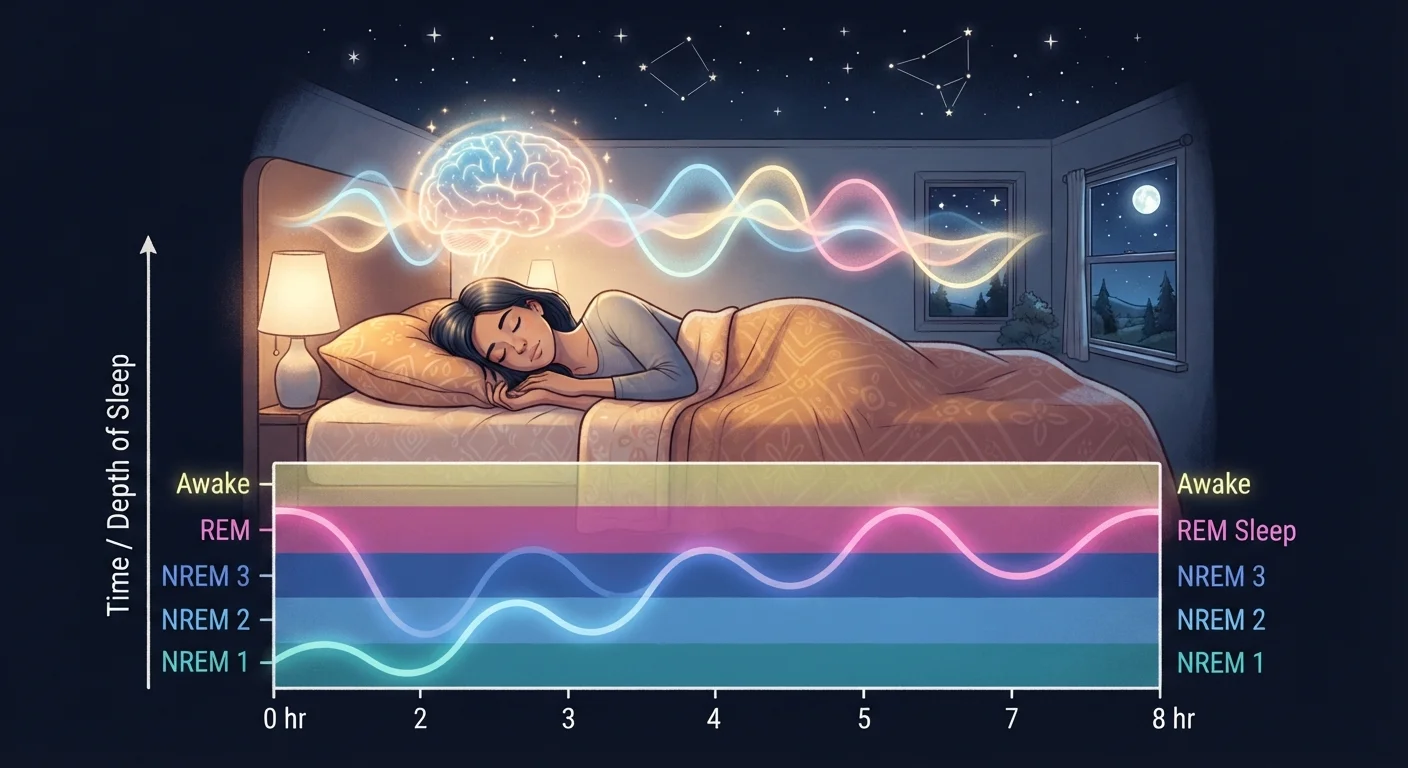
Sleep architecture refers to the organized pattern of sleep stages your brain and body cycle through each night. Rather than a uniform state of unconsciousness, sleep is divided into distinct phases — each with unique biological activity. These phases repeat in cycles throughout the night, and the specific sequence and proportion of each stage determines the overall quality of your rest.
Sleep architecture is measured clinically via polysomnography (PSG), which records brain electrical activity, eye movements, and muscle tone to identify and quantify each sleep stage.
The Four Stages of Sleep
Sleep is not a single, passive state. Each night, your brain methodically moves through four distinct stages — three classified as non-REM (NREM) sleep and one as REM (rapid eye movement) sleep. Understanding what distinguishes these stages is the first step toward appreciating why sleep quality, not just duration, matters so much.
Stage 1 (NREM 1) is the lightest phase, lasting just one to seven minutes as you first drift off. Muscle activity slows, and you may experience hypnic jerks — those sudden twitches that occasionally wake people at the edge of sleep.
Stage 2 (NREM 2) accounts for roughly half of total sleep time in healthy adults. Body temperature drops, heart rate slows, and the brain produces brief bursts of oscillating electrical activity called sleep spindles and K-complexes — both associated with memory processing and protection against waking stimuli.
Stage 3 (NREM 3), often called slow-wave sleep or deep sleep, is characterized by high-amplitude, low-frequency brain waves called delta waves. This is the stage most critical for physical restoration. Growth hormone secretion peaks here, tissue repair accelerates, and immune function is reinforced.
REM sleep follows NREM sleep in each cycle. Brain activity during REM closely resembles the waking state, yet voluntary muscles are temporarily paralyzed — a protective mechanism that prevents you from physically acting out dreams. REM is deeply tied to emotional regulation and memory consolidation. See what your brain does during sleep for a closer look at the neuroscience behind this activity.
How Cycles Are Structured Across a Night
Sleep stages do not simply repeat in equal measure throughout the night. The proportion of each stage shifts across cycles in a predictable pattern — one that has important implications for how restorative your sleep actually is.
Early in the night, cycles are dominated by deep slow-wave sleep (Stage 3). This front-loading of restorative NREM sleep is thought to be the brain's priority response to accumulated sleep pressure — the biological drive to sleep that builds during waking hours. As the night progresses, Stage 3 shrinks significantly, and REM periods grow longer and more intense. By the final cycles before waking, REM may account for the majority of a 90-minute cycle.
~90 min
Average length of one complete sleep cycle
According to sleep physiology research, a single NREM-to-REM cycle lasts approximately 90 minutes, though cycle length varies across the night and between individuals.
20–25%
Proportion of total sleep spent in REM
In healthy adults, REM sleep accounts for roughly 20–25% of total sleep time, based on polysomnography data reported in sleep medicine literature.
13–23%
Proportion of sleep spent in slow-wave deep sleep
Slow-wave sleep typically comprises 13–23% of total sleep time in young adults, with this proportion declining significantly with age, per established sleep research.
This architecture means that cutting sleep short — whether by an early alarm or a late bedtime — disproportionately robs you of REM sleep, since it clusters in the second half of the night. Conversely, going to bed very late after a long day may compress the deep sleep your body needs most urgently. The full picture of nightly physiology is explored in what happens in your body during a full night of sleep.
Why Each Stage Has a Distinct Biological Role
Each sleep stage is not simply a background state — it is an active, purposeful phase of biological maintenance. Treating all sleep as equivalent misses the orchestrated complexity that makes recovery possible.
During NREM Stage 2, the brain's hippocampus replays recent experiences and transfers them toward longer-term cortical storage — a process called memory consolidation. The sleep spindles characteristic of this stage appear to play a gating role, protecting the sleeping brain from disruptive sensory input while this processing occurs.
In slow-wave sleep, the glymphatic system — a waste-clearance network in the brain — becomes significantly more active. Cerebrospinal fluid moves more freely between brain cells, flushing out metabolic byproducts including proteins linked to neurodegenerative conditions. This process underscores why consistently poor sleep has been associated with long-term cognitive health concerns in population research.
During REM sleep, the brain processes emotionally charged memories with reduced levels of the stress neurochemical norepinephrine — a neurochemical environment that may allow emotional experiences to be re-processed with less distress. This mechanism is widely studied in the context of mood regulation and psychological resilience.
For a broader view of how architecture evolves over a lifetime, see how sleep architecture shifts from infancy to old age.
This article is for general informational and educational purposes only and does not constitute medical advice. If you have concerns about your sleep or health, please consult a qualified healthcare professional.