

Key Takeaways
Why Exercise Type Matters, Not Just Exercise Amount
Most people think about exercise in terms of time or calories. A more useful framework is exercise type - what a given activity actually does for your body systems. Cardiorespiratory exercise trains your heart, lungs, and circulatory system to deliver oxygen more efficiently. Resistance training (strength work) builds or preserves muscle tissue and supports bone density. Flexibility and mobility work maintains the range of motion your joints need to move safely under load. Recovery - including sleep and rest days - is when your body actually integrates all of those adaptations.
Leaving any one of these categories out creates an imbalance. A schedule built entirely on running, for example, can neglect upper-body strength and joint mobility. A plan focused only on weightlifting without cardiovascular work leaves a critical pillar unaddressed. The goal of a well-rounded weekly plan is not to maximize any one variable but to give every system enough stimulus to improve - and enough rest to recover.
If you are completely new to structured movement, the guide to starting a balanced exercise routine with no fitness background offers a grounding introduction before you map out a full week.
Flexibility Work Is Often the First to Go
When schedules get tight, stretching and mobility sessions are typically the first thing people cut. Over time, this leads to reduced range of motion that can limit strength gains and increase injury risk. Even 10 minutes of post-workout stretching on two days per week meaningfully supports joint health. Treat it as non-negotiable, not optional.
What a Balanced Week Actually Looks Like
General physical activity guidelines from public health authorities recommend at least 150 minutes of moderate-intensity aerobic activity per week, combined with two or more days of muscle-strengthening activity targeting major muscle groups. Flexibility work is commonly underemphasized in guidelines but is consistently recommended by exercise scientists and physical therapists as a complement to both.
A practical three-to-five-day structure might look like this:
- Day 1 - Strength (lower body): Squats, lunges, hip hinges. Targets legs, glutes, and core stability.
- Day 2 - Cardio (moderate intensity): Brisk walking, cycling, swimming, or jogging for 30-45 minutes.
- Day 3 - Rest or active recovery: Light stretching, a slow walk, or gentle yoga.
- Day 4 - Strength (upper body and core): Push movements, pull movements, and trunk stability work.
- Day 5 - Cardio plus flexibility: A 20-30 minute aerobic session followed by 10-15 minutes of static stretching.
This template is not a prescription - it is a structural example. The specific days you assign to each category should reflect your actual schedule. For a deeper look at how different weekly frequencies compare, see how two-day, three-day, and five-day training splits compare.
Step-by-Step: Building Your Own Weekly Plan
Use the steps below to move from a blank calendar to a functional weekly structure. The process takes most people 15 to 30 minutes and should be revisited every four to six weeks as your fitness level changes.
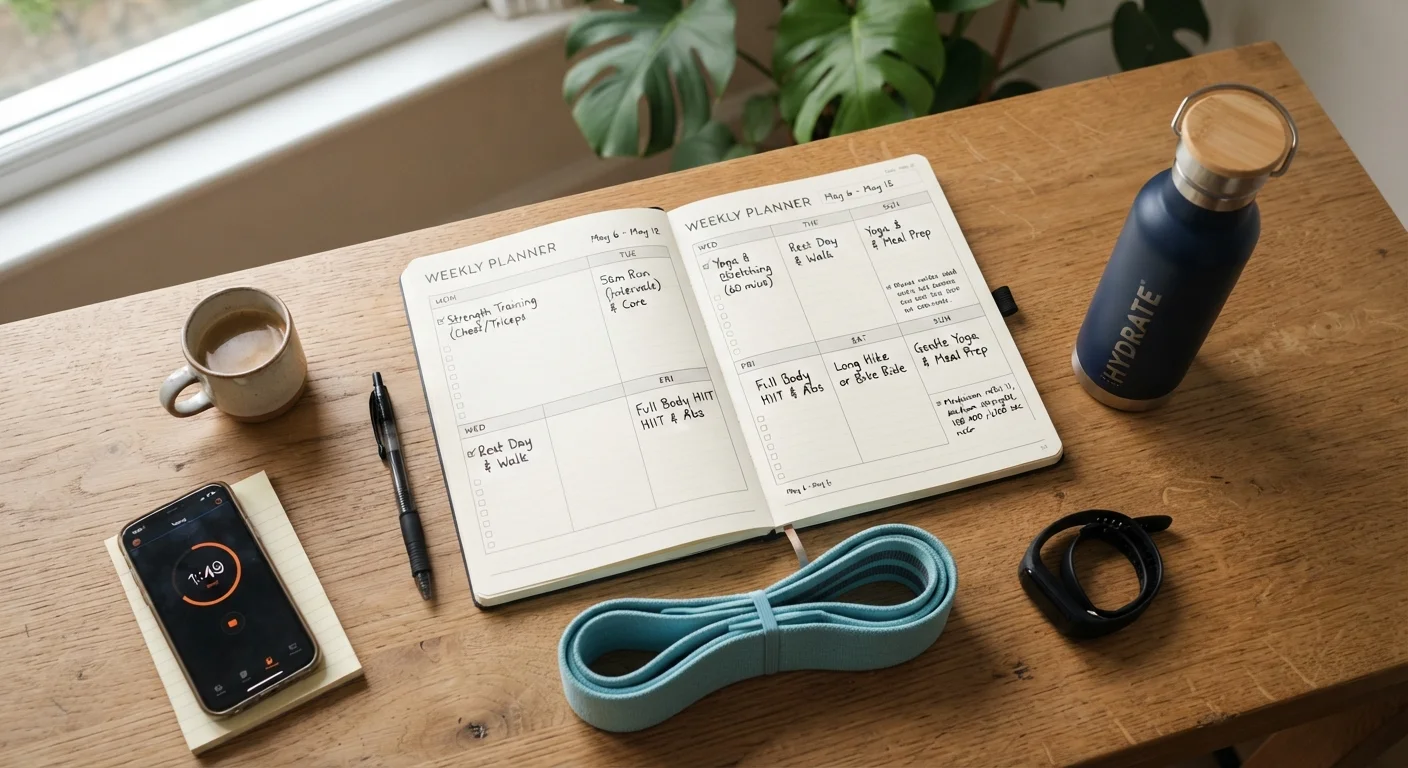
What you will need
Count your available active days
Look at your actual week - not an ideal week - and identify how many days you can realistically set aside for structured movement. Even 20-30 minutes counts. Three days is a solid starting point; five days gives you more room to balance all exercise types without crowding any single session.
Assign a primary exercise type to each active day
Label each active day with its primary category: cardiovascular, strength (lower body), strength (upper body/core), or flexibility/mobility. Avoid scheduling two heavy strength days back-to-back for the same muscle groups - muscles need 48 hours of recovery between intense sessions targeting the same area. Alternate or separate them with a cardio or flexibility day.
Set realistic session lengths
Assign a time duration to each session based on what you can actually sustain. A 25-minute strength session performed consistently every week produces better results than a 90-minute session attempted once. Cardio sessions in the 20-45 minute range cover the aerobic stimulus most adults need. Flexibility work can be as short as 10 minutes appended to another session.
Protect at least one full rest day
Mark at least one day - ideally two if you are training four or more days - as a rest or active recovery day. Rest does not mean being sedentary all day; a slow walk or gentle movement is fine. What rest means is no structured, high-effort training. This is when muscle repair, hormonal recovery, and nervous system restoration happen.
Write out week one and commit to it as-is
Resist the urge to optimize before you begin. Write out your first week exactly as planned and follow it without modification. The purpose of week one is to collect real data about what works and what does not - not to perform perfectly. Note which sessions felt too long, too short, or poorly timed. Use that information to refine week two.
For a broader checklist of what to think through before you start, see the pre-start planning guide covering schedule readiness, equipment, and goal-setting.
Review and adjust after four weeks
After four consistent weeks, revisit your plan with fresh eyes. Are you regularly skipping a certain day? That slot likely does not fit your life and needs to move. Feeling undertrained? You may be ready to add a session or increase session intensity. A good plan is a living document, not a fixed contract. For a comprehensive look at structuring routines that evolve with you, the complete structural guide to building a fitness routine covers goal-setting, sequencing, and long-term progression in depth.
This article is for general informational and educational purposes only and is not medical advice. Consult a qualified healthcare professional before beginning a new exercise program, particularly if you have a pre-existing health condition, are pregnant, or have been sedentary for an extended period.