

Key Takeaways
The Four Exercise Types
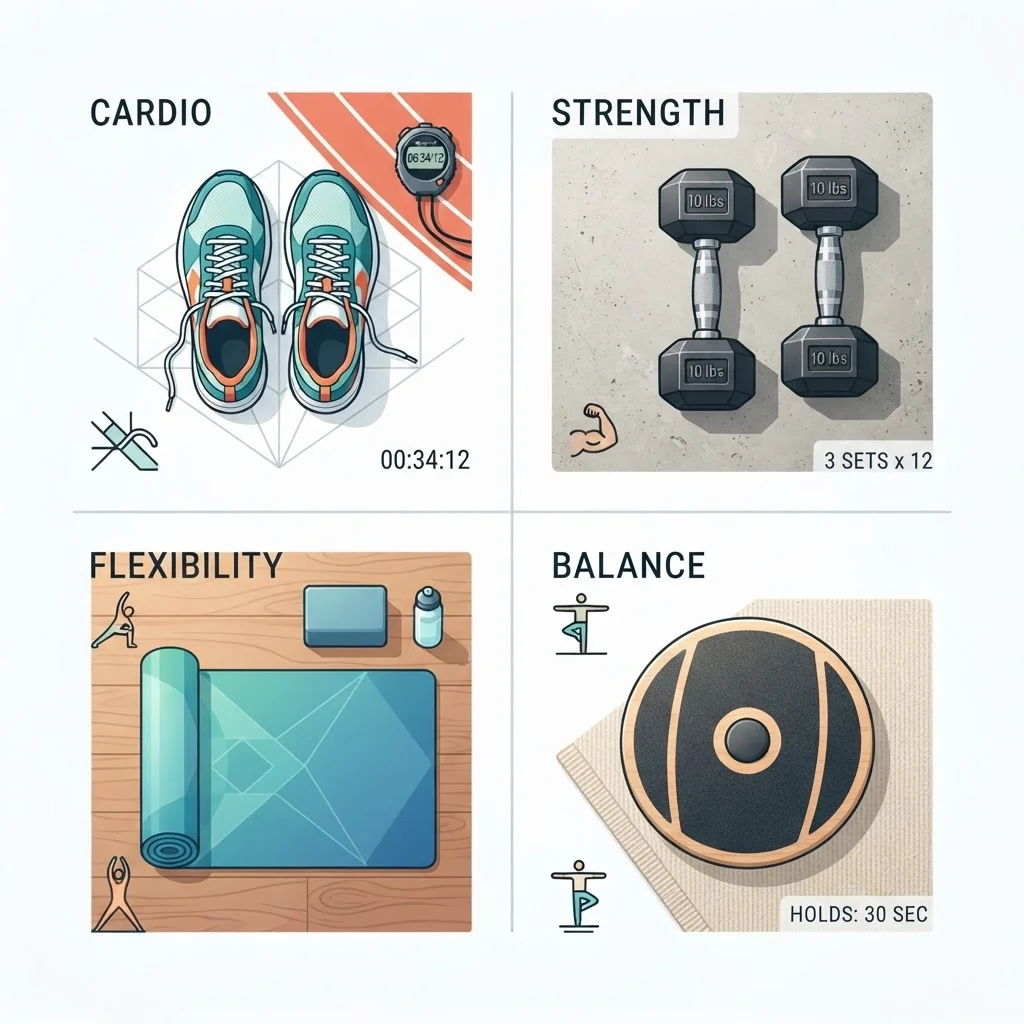
Exercise science broadly organizes physical activity into four categories: cardiovascular (cardio), strength, flexibility, and balance. Each type targets a different aspect of physical fitness and produces its own set of adaptations in the body. A well-rounded routine typically draws from all four rather than relying on just one.
These categories align with the physical fitness components recognized by the U.S. Department of Health and Human Services in its Physical Activity Guidelines for Americans.
Why Exercise Is Divided Into Categories
Not all movement does the same thing. A brisk walk, a set of squats, a long hamstring stretch, and a single-leg stance each challenge your body in fundamentally different ways - and produce different results. Exercise science groups these demands into four broad categories: cardiovascular endurance, muscular strength, flexibility, and balance.
Understanding what each category actually trains helps you make more intentional choices about how you move. It also clarifies why fitness guidelines consistently recommend variety. For a broader look at how these categories fit into a complete picture, see The Full Spectrum of Exercise.
150 min
Recommended weekly moderate-intensity cardio
Per the U.S. Department of Health and Human Services Physical Activity Guidelines for Americans.
2x/week
Minimum strength training frequency recommended
The Physical Activity Guidelines advise muscle-strengthening activity on at least two days per week for adults.
36 million
Falls among older adults each year in the U.S.
According to the CDC, fall injuries are a leading cause of emergency department visits among adults 65 and older - underscoring the importance of balance training.
Cardiovascular Exercise: Training Your Heart and Lungs
Cardio - short for cardiovascular exercise - refers to any sustained activity that elevates your heart rate and increases your breathing over an extended period. Walking, running, cycling, swimming, and dancing all qualify. The defining feature is continuous effort that challenges the heart and lungs to deliver oxygen to working muscles.
Over time, regular cardio improves aerobic capacity (how efficiently your body uses oxygen), lowers resting heart rate, supports healthy blood pressure, and reduces the risk of cardiovascular disease. It also plays a role in managing blood sugar and supporting mood through endorphin release.
Cardio is typically described by intensity - light, moderate, or vigorous - and duration. A moderate effort means you can talk but not sing; vigorous means speaking in full sentences becomes difficult.
Strength Training: Building Muscle and Protecting Bone
Strength training - also called resistance training - involves working muscles against an opposing force. That force can come from free weights, resistance bands, weight machines, or your own bodyweight. The goal is to challenge muscles beyond their comfortable limit, prompting them to rebuild stronger.
The benefits extend well beyond aesthetics. Consistent strength work increases muscle mass, supports bone mineral density (reducing osteoporosis risk), improves metabolic function, and makes everyday tasks - lifting, carrying, climbing stairs - easier and safer. It also contributes to body composition by increasing lean tissue relative to fat tissue.
Muscles adapt through a process called progressive overload: gradually increasing the challenge - weight, reps, or difficulty - over time to keep driving adaptation.
Flexibility: Expanding What Your Body Can Do
Flexibility refers to the ability of a muscle or muscle group to lengthen through a joint's available range of motion. Stretching is the primary method for developing it. Static stretching (holding a position), dynamic stretching (moving through a range), and assisted stretching all fall under this umbrella.
Good flexibility supports posture, reduces the likelihood of muscle strains, and helps maintain functional movement as you age. It's worth knowing that flexibility and mobility are related but distinct - mobility refers to active control through a range of motion, while flexibility is more passive. The differences between flexibility, mobility, and stretching are worth understanding if you want to train smarter.
Stretch When Muscles Are Warm
Flexibility work tends to be more effective - and more comfortable - after your muscles are already warm, such as at the end of a workout. Static stretching on cold muscles can cause discomfort and may be less productive. A short warm-up walk or light movement before stretching is a simple, practical habit.
Balance Training: Coordination and Stability
Balance training targets your body's ability to control its center of mass - staying upright and stable whether you're standing still or moving. It challenges the neuromuscular system: the coordination between your nervous system and muscles that allows rapid, automatic adjustments to body position.
Simple examples include standing on one foot, walking heel-to-toe, or using a balance board. Practices like tai chi incorporate balance as a central element alongside flexibility and gentle strength work.
Balance tends to decline with age, making this category especially important for older adults. Research consistently shows that balance training reduces fall risk - a leading cause of injury-related hospitalization among adults 65 and older. But it benefits people of all ages by improving athletic performance, posture, and body awareness.
For practical strategies to weave more of all four exercise types into daily life, explore Staying Active Daily. And if you're curious why skipping any single category creates gaps, see Why Doing Only One Type of Exercise Falls Short.
This article is for general informational purposes only and is not a substitute for professional medical or fitness advice. Consult a qualified healthcare provider before beginning any new exercise program, especially if you have existing health conditions.