

Key Takeaways
Post-Sitting Stiffness
Post-sitting stiffness is the tightness, achiness, or reduced range of motion you notice in your joints and muscles after staying in one position for an extended period. It happens because prolonged stillness slows circulation, reduces joint lubrication, and allows soft tissues to temporarily adapt to a shortened position. The discomfort is your body's signal that it needs movement to restore normal function.
In exercise science, this phenomenon is partly explained by thixotropy - the property of connective tissue and muscle fascia to become more gel-like and viscous when still, and more fluid when warmed through movement.
What's Actually Happening Inside Your Body
When you sit still for an extended stretch, several physical processes slow down simultaneously. Blood circulation - which delivers oxygen and nutrients to muscles while removing waste products - becomes less efficient in areas that aren't actively contracting. The muscles around your hips, lower back, and shoulders, which are working to hold your posture, begin to fatigue quietly without you noticing.
Your joints also change. Synovial fluid, the natural lubricant inside joints like your knees and hips, circulates best through movement. When you're stationary, this fluid distribution becomes uneven, which can leave joints feeling creaky or resistant when you first try to move them.
Finally, your fascia - the web of connective tissue surrounding muscles and organs - gradually stiffens in held positions. This is the thixotropic effect mentioned above: fascia behaves more like a thick gel at rest and becomes more pliable with warmth and motion. The good news is that all of these processes are reversible with movement.
Stiffness vs. Pain: Know the Difference
Mild stiffness that fades quickly with movement is a normal physiological response. Persistent pain, sharp or shooting sensations, joint swelling, or stiffness that doesn't improve with light activity are different - and worth evaluating by a healthcare provider. This article addresses typical post-sitting tightness, not pain conditions.
The Muscle Groups Most Affected by Prolonged Sitting
Not all muscles are equally affected. A typical seated position places specific demands on certain areas:
- Hip flexors: These muscles, which connect your thighs to your lower spine, remain in a shortened position while seated. Over time, they can feel tight and pull on the lower back when you stand.
- Gluteal muscles: Your glutes are largely inactive while sitting. Prolonged inactivity can reduce their ability to activate properly - a pattern sometimes called gluteal amnesia in rehabilitation contexts.
- Thoracic spine: The mid-back tends to round forward in seated postures, limiting mobility and contributing to shoulder and neck tension.
- Calf muscles: With minimal contraction, blood can pool in the lower legs, contributing to that heavy or achy feeling in your feet and calves.
Knowing which areas are most affected helps you target your movement breaks more effectively.
Practical Habits That Actually Help
The most effective strategy is also the simplest: move more often throughout the day, in small doses. You don't need to overhaul your schedule or add a long workout. Research consistently supports the value of frequent, brief movement breaks over extended sitting periods, even when total daily exercise time remains the same.
Here are evidence-grounded habits worth building:
- Set a movement reminder. Use a phone alarm, wearable device, or app to prompt you to stand or move every 45-60 minutes. Consistency matters more than duration.
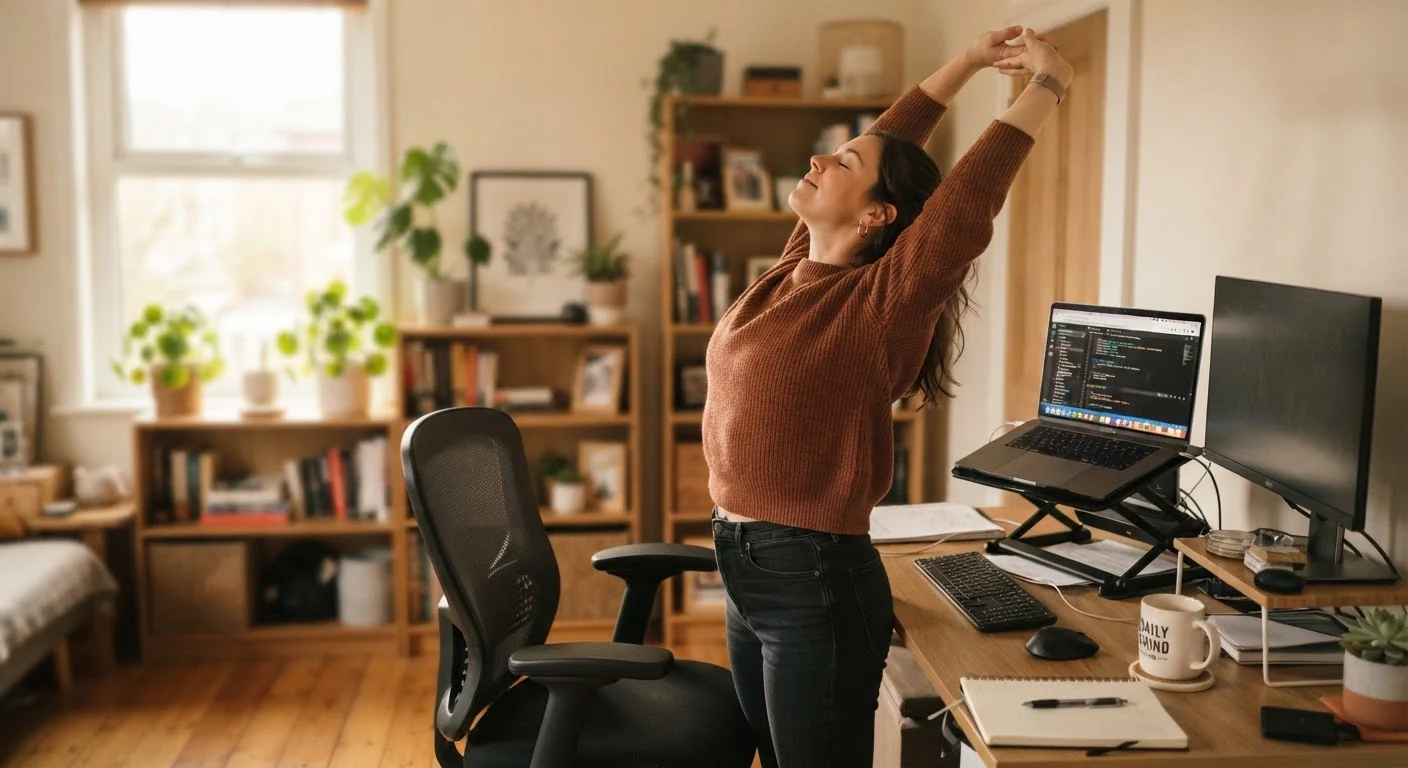
- Stretch the primary stiff zones. Focus on a standing hip flexor stretch, a gentle seated spinal rotation, and shoulder rolls. Hold each position for 20-30 seconds to allow tissue to respond.
- Take walking breaks, not just standing breaks. Even two to three minutes of light walking is more effective than simply standing still, because muscle contractions help pump circulation back to working levels.
- Vary your sitting position. If your work setup allows, alternate between different seated postures during long sessions. Micro-variation reduces the sustained load on any single set of tissues.
Make Movement Breaks Automatic
The biggest barrier to movement breaks is simply forgetting to take them. Link a stretch or short walk to something you already do regularly - brewing coffee, finishing a meeting, or finishing a document. Habit-stacking like this removes the need for willpower and makes breaks feel natural rather than disruptive.
This article provides general health information and is not a substitute for advice from a qualified healthcare or physical therapy professional. If you experience persistent pain or stiffness, please consult a professional.