

Key Takeaways
Social Jetlag
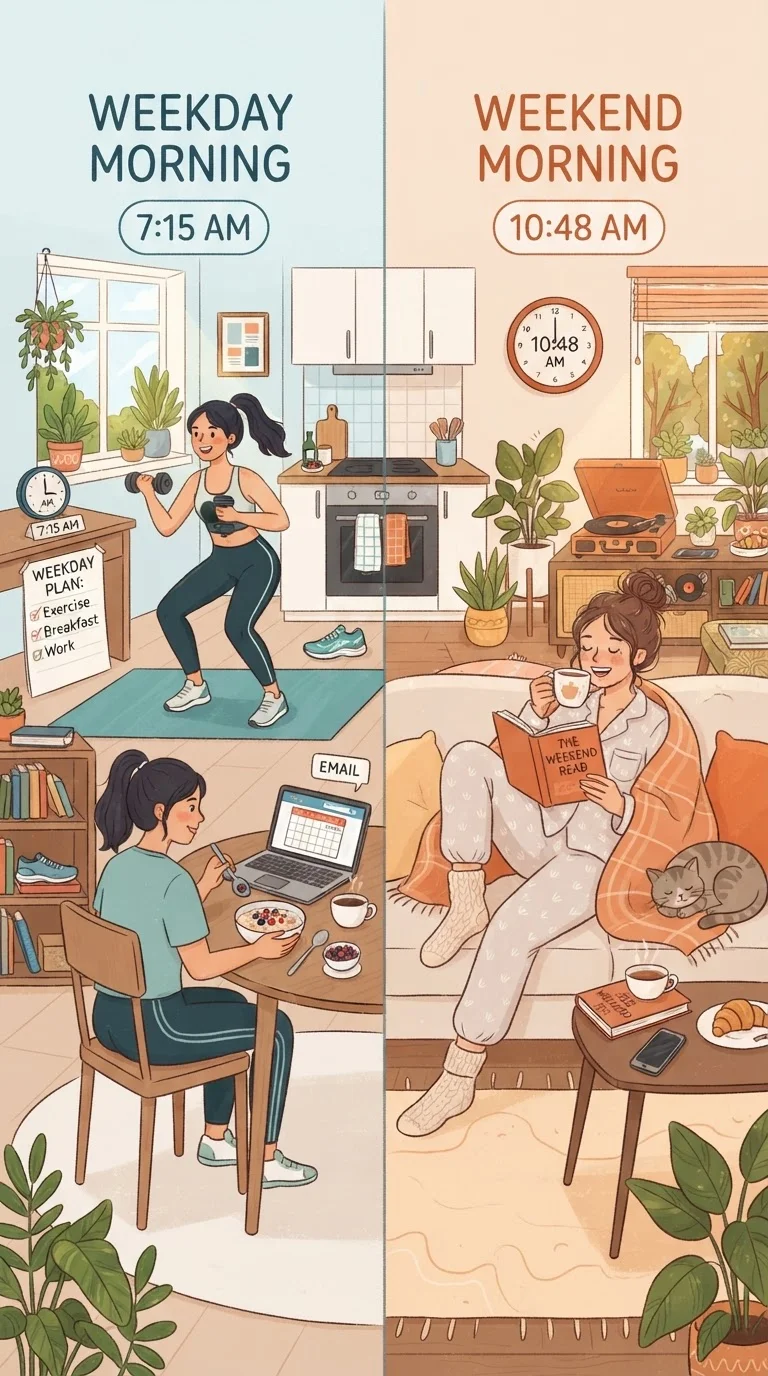
Social jetlag describes the mismatch between your body's internal clock (circadian rhythm) and the sleep-wake schedule you actually follow on weekends. When you stay up later and sleep in on Saturday and Sunday, your biological clock shifts - similar to flying across time zones without leaving home. This misalignment can make Monday feel like a recovery day rather than the start of a productive week.
Coined by chronobiologist Till Roenneberg, social jetlag is quantified as the difference in sleep midpoint between work days and free days, and is associated with metabolic, cardiovascular, and cognitive health markers in research literature.
Why Two Days Off Can Undo Five Days of Progress
Building a healthy weekday routine takes deliberate effort - consistent sleep times, structured meals, regular exercise. Yet for millions of Americans, the weekend quietly dismantles that structure. Late nights, sleeping in, skipped workouts, and irregular eating aren't just harmless decompression. They can shift your body's internal clock enough that Monday genuinely feels like starting over.
This isn't a discipline failure. It's a biological one. Your circadian system - the internal timing mechanism governing sleep, hunger, hormone release, and alertness - is sensitive to behavioral cues. When those cues shift dramatically between Friday night and Sunday morning, your clock follows. The result is a phenomenon researchers call social jetlag: a state of internal misalignment that can dull focus, disrupt metabolism, and make re-entering a weekday routine feel effortful rather than automatic.
Understanding the mechanism is the first step to addressing it. The weekend doesn't have to be the enemy of your habits - but leaving it completely unanchored often makes it one. For a broader look at why routines break down in the early stages, see why new routines fall apart so quickly.
The Biology Behind the Weekend Slide
Your circadian rhythm operates on roughly a 24-hour cycle and is primarily set by light exposure and behavioral timing - especially when you sleep, wake, and eat. During the workweek, external obligations (alarm clocks, commutes, scheduled meetings) act as powerful zeitgebers, or time-givers, that keep your internal clock synchronized with your environment.
On weekends, those external anchors disappear. Without a structured wake time, many people sleep one to two hours later than usual. Without a morning alarm, light exposure is delayed. Without a breakfast window, hunger signals shift. Each of these changes nudges the internal clock later - a process called phase delay. Research published in journals including Current Biology has linked greater social jetlag to markers of poorer metabolic health, increased fatigue, and reduced cognitive performance, even in people who get adequate total sleep across the week.
The habit layer compounds the biological one. Behavioral habits are maintained through consistent cue-routine-reward cycles. When the weekend removes the cues - the morning alarm that precedes your workout, the routine lunchtime that follows your healthy breakfast - the habit loop weakens. Miss that cue repeatedly, and the behavior requires conscious effort again rather than running automatically.
~69%
Adults reporting irregular weekend sleep schedules
Analysis of large population sleep surveys suggests that the majority of working adults sleep meaningfully later on weekends than on workdays, with the gap averaging one to two hours.
1-2 hrs
Average circadian phase shift from weekend sleep extension
Research published in sleep and chronobiology journals estimates that a typical American adult's sleep midpoint shifts approximately one to two hours later over a standard weekend.
2x
Increased likelihood of Monday fatigue with high social jetlag
Studies on social jetlag find that individuals with greater weekend-weekday sleep timing mismatches report substantially higher rates of Monday morning fatigue and reduced morning alertness.
Anchor Habits: The Practical Fix
The solution is not to schedule every weekend hour. It's to identify two or three anchor habits - small, consistent behaviors that preserve your biological and behavioral rhythm without eliminating rest or spontaneity.
The most effective anchors tend to cluster around three areas:
- Sleep timing: Keeping your wake time within 60-90 minutes of your weekday schedule limits circadian phase shift significantly. You don't need to set the same alarm - just avoid dramatically sleeping in. Your sleep habits hub covers practical strategies for protecting sleep quality while still enjoying weekend rest.
- Eating window: A consistent first meal - even if later than a weekday breakfast - helps anchor hunger hormones and energy rhythms. Skipping meals entirely or eating at wildly different times disrupts metabolic cues that interact with sleep regulation.
- Movement: One brief, lower-intensity workout or active outing on at least one weekend day maintains the exercise habit loop without demanding full weekday effort. Building sustainable workout routines is about frequency of cues as much as frequency of sessions.
These three anchors don't require perfection. They require enough consistency to keep your biological clock from drifting and your habit loops from fully dissolving. For guidance on building routines that survive real-world variability, the principles in sustainable habit stacking are directly applicable here.
Flexible Structure, Not Rigid Scheduling
A common mistake is treating weekends as an all-or-nothing proposition: either follow the weekday schedule exactly, or abandon structure entirely. Neither extreme serves long-term habit health well. Research on habit maintenance consistently shows that flexible consistency - maintaining the underlying behavior while allowing variation in timing, duration, or intensity - is more durable than rigid adherence.
This means your Saturday workout doesn't need to be the same length or format as Tuesday's. Your weekend breakfast doesn't need to be the same meal. What matters is that both happen within a range close enough to your weekday pattern that your body and brain recognize them as part of the same routine. For a deeper look at how rigid versus flexible approaches compare in real-world conditions, see structured days versus flexible schedules.
It's also worth separating intentional rest from unstructured drift. Deliberately choosing to sleep an extra 45 minutes on Saturday morning is different from unconsciously staying up until 2 a.m. and losing your entire Sunday rhythm as a result. Intentional recovery supports your routine; passive drift erodes it.
This article is for general informational and educational purposes only and does not constitute medical advice. For personal health concerns, always consult a qualified healthcare professional.