

Key Takeaways
Sleep Architecture
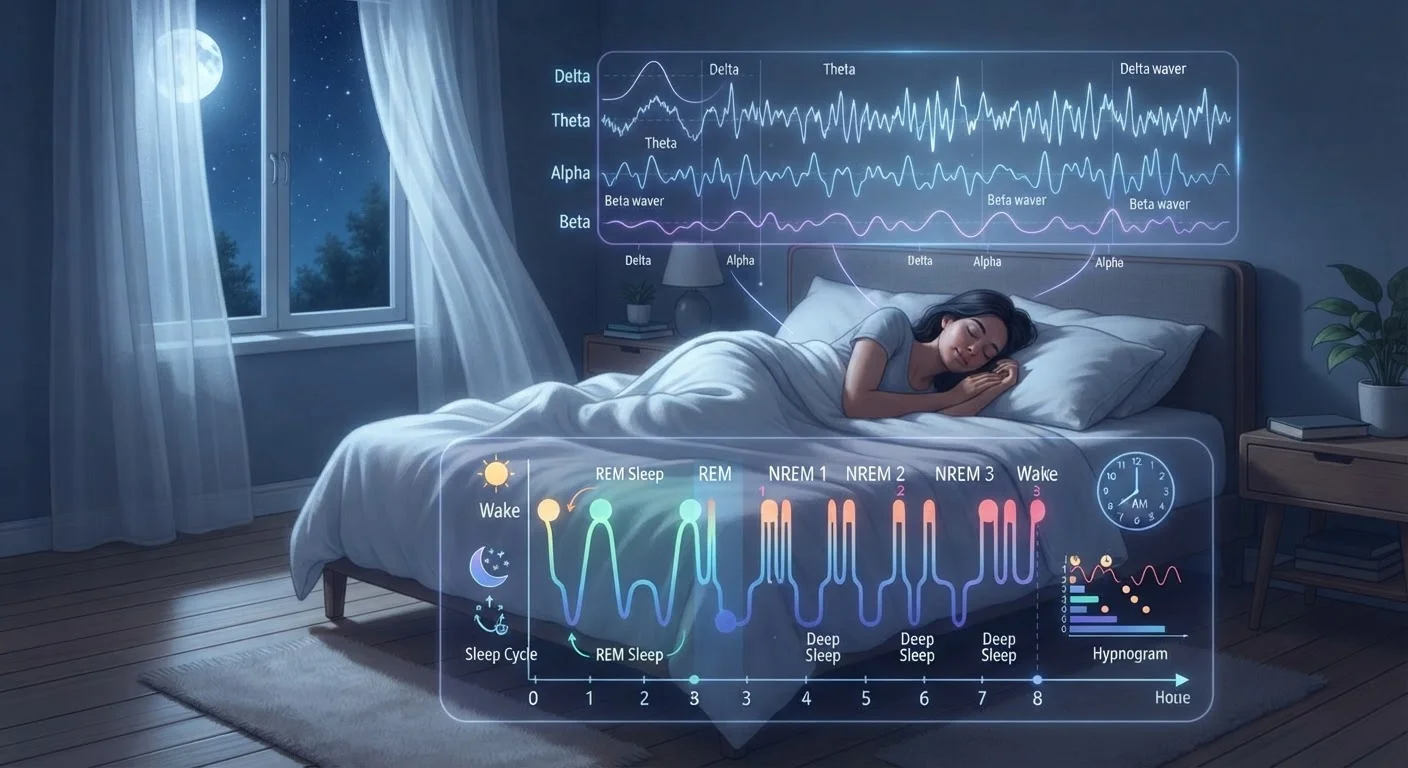
Sleep architecture refers to the structural pattern of sleep stages your body cycles through each night. Rather than a single uniform state, sleep is organized into repeating cycles of light sleep, deep sleep, and REM (rapid eye movement) sleep. Each stage has distinct brain activity, hormone patterns, and physiological functions that contribute to recovery, memory, and overall health.
Sleep architecture is typically measured using polysomnography (PSG), which records brain waves (EEG), eye movements, and muscle activity to classify sleep into NREM stages 1-3 and REM sleep.
The Four Stages of Sleep
Each night, your brain guides your body through a structured sequence of sleep stages. These stages fall into two broad categories: NREM (non-rapid eye movement) sleep and REM (rapid eye movement) sleep. NREM itself contains three distinct stages, giving us four stages in total.
- NREM Stage 1 (Light Sleep): This transitional stage lasts just a few minutes. Brain activity slows, muscles begin to relax, and you can be easily awakened. Eye movements are slow and irregular.
- NREM Stage 2 (Stable Sleep): Your body temperature drops, heart rate slows, and the brain begins producing bursts of activity called sleep spindles. This stage accounts for roughly 45-55% of total sleep in healthy adults, according to research reviewed by the American Academy of Sleep Medicine.
- NREM Stage 3 (Deep Sleep / Slow-Wave Sleep): The most physically restorative stage. Brain waves slow dramatically, and it becomes much harder to wake the sleeper. Growth hormone is released, tissues are repaired, and the immune system is reinforced.
- REM Sleep: Brain activity surges close to waking levels, eyes move rapidly beneath closed lids, and most vivid dreaming occurs. Muscle activity is largely suppressed - a protective mechanism. REM is central to neural activity that supports memory and learning.
These four stages combine into one sleep cycle. A full cycle takes approximately 90 minutes, and a healthy adult completes four to six cycles per night.
How Cycles Shift Across the Night
Sleep architecture isn't static from cycle to cycle - its composition changes meaningfully as the night progresses. Understanding this pattern helps explain why both the duration and timing of sleep matter.
In the first half of the night, cycles are weighted heavily toward NREM Stage 3 (deep sleep). This is when the body prioritizes physical repair: muscle recovery, cellular regeneration, and hormonal regulation. Missing out on early sleep hours disproportionately reduces this restorative deep sleep.
In the second half of the night, deep sleep decreases and REM sleep extends. By the final cycle before waking, REM periods may last 30-60 minutes. This is when memory consolidation, emotional processing, and cognitive restoration are most active. Cutting sleep short in the morning - even by an hour or two - can sharply reduce total REM time.
~90 min
Average length of one full sleep cycle
Research reviewed by the American Academy of Sleep Medicine indicates most adults cycle through all four sleep stages approximately every 90 minutes.
20-25%
Proportion of sleep spent in REM in healthy adults
According to sleep stage data cited by the National Sleep Foundation, healthy adults typically spend roughly one-fifth of their total sleep time in REM.
13-23%
Proportion of sleep spent in deep (slow-wave) sleep
Slow-wave sleep, the most physically restorative stage, typically accounts for 13-23% of total sleep time in young to middle-aged adults.
For a broader look at the physiological events running alongside these cycles, see what happens in your body during a full night of sleep.
Why Disrupted Architecture Has Real Consequences
When sleep architecture is consistently disrupted - by lifestyle habits, environmental factors, or underlying conditions - specific stages get shortchanged. The effects are measurable and well-documented.
Reduced deep sleep is linked to impaired immune response, slower muscle recovery, and disrupted regulation of hormones including cortisol and insulin. Reduced REM sleep is associated with difficulty managing emotions, weakened memory retention, and impaired problem-solving. Research summarized by the National Sleep Foundation supports a connection between chronic REM deficits and elevated risk of mood disturbances.
Common disruptors include:
- Alcohol: While it can speed sleep onset, alcohol suppresses REM sleep, particularly in the first half of the night.
- Inconsistent sleep timing: Irregular bedtimes confuse the circadian rhythm, reducing the efficiency of each stage.
- Light and screen exposure: Blue-spectrum light before bed delays melatonin release, postponing sleep onset and compressing early NREM stages.
- Caffeine consumed too late: Adenosine - the chemical that builds sleep pressure - is blocked by caffeine, making it harder to reach and sustain deep sleep.
For practical strategies to protect your nightly architecture, the principles of sleep hygiene offer a research-grounded starting point. Explore more routines at the Better Sleep Habits hub.
This article is for general informational and educational purposes only and is not a substitute for professional medical advice. If you have concerns about your sleep quality or a possible sleep disorder, consult a qualified healthcare provider.