

Key Takeaways
Option A
Cognitive Reframing
The evidence-based tool for shifting perspective.
Best for: People seeking to process difficult emotions and genuinely change how they interpret challenging situations.
Option B
Positive Thinking
The popular but often misapplied motivational approach.
Best for: Building general optimism and motivation when circumstances are genuinely favorable or neutral.
If you're navigating a genuinely stressful or painful situation
Cognitive Reframing
Reframing helps you examine and adjust unhelpful thought patterns without dismissing real pain, making it more effective when emotions are intense or complex.
If you need a quick motivational boost before a low-stakes challenge
Positive Thinking
In neutral or favorable circumstances, cultivating an optimistic outlook can genuinely support performance and mood without the risk of emotional suppression.
If you struggle with persistent negative self-talk or anxiety
Cognitive Reframing
Structured reframing, especially guided by a therapist, directly targets cognitive distortions - the root cause of many anxiety and mood challenges.
If you want to build a general habit of mental resilience over time
Cognitive Reframing
Learning to interrogate and reshape your interpretations of events builds durable resilience, whereas positive thinking alone doesn't teach this transferable skill.
Two Strategies, Two Very Different Mechanisms
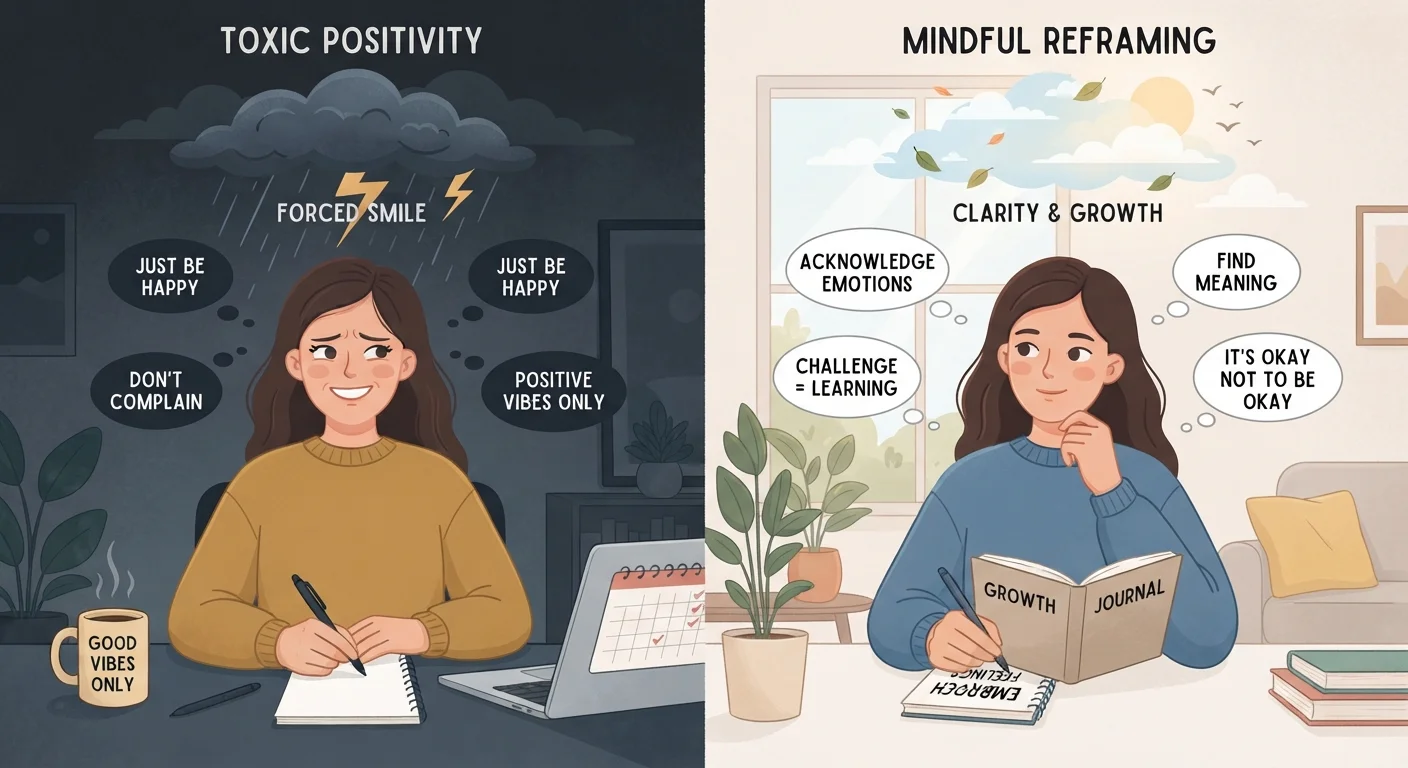
Tell someone who is anxious or grieving to "look on the bright side," and you'll likely sense why positive thinking has its critics. It's not that optimism is harmful - it's that forced optimism applied without nuance can invalidate real emotional experience and leave the underlying thought patterns entirely untouched.
Cognitive reframing, by contrast, is a structured technique drawn from cognitive behavioral therapy (CBT), one of the most rigorously studied approaches in clinical psychology. It doesn't ask you to feel happy about a difficult situation. Instead, it asks you to examine how you are interpreting that situation - and whether that interpretation is accurate, balanced, or skewed by a cognitive distortion.
A cognitive distortion is an automatic, biased pattern of thinking - for example, catastrophizing ("This will ruin everything"), all-or-nothing thinking ("If it's not perfect, it's a failure"), or mind-reading ("They must think I'm incompetent"). Reframing targets these patterns directly, replacing them not with cheerful alternatives but with more realistic and flexible ones. That distinction matters enormously.
| Criterion | Cognitive Reframing | Positive Thinking |
|---|---|---|
| Origin | Cognitive behavioral therapy (CBT) | Motivational psychology and self-help |
| Core mechanism | Examines and restructures thought patterns | Replaces negative thoughts with positive ones |
| Handles negative emotions | Acknowledges and processes them | Often minimizes or bypasses them |
| Evidence base | Strong - extensively studied in clinical settings | Mixed - helpful in some contexts, harmful in others |
| Risk of backfire | Low when practiced correctly | Higher - can produce emotional inauthenticity |
| Skill developed | Cognitive flexibility and self-awareness | Optimistic outlook and motivation |
| Best suited to | Distorted thinking, anxiety, mood regulation | General motivation in favorable circumstances |
Where Positive Thinking Falls Short
Positive thinking, in its popular form, operates on the premise that deliberately focusing on good outcomes or affirming positive beliefs will improve your emotional state and performance. And in low-stakes, genuinely favorable circumstances, research does support a link between optimistic outlook and improved wellbeing.
The trouble emerges when positivity is applied as a blanket strategy regardless of context. Studies in psychology - including work by researchers examining emotional suppression - suggest that telling yourself to feel positive when you don't actually feel that way can widen the gap between your stated emotions and your experienced ones. This gap, sometimes called emotional inauthenticity, is associated with increased stress, not reduced stress.
There is also the concern of what some researchers call "toxic positivity" - the cultural pressure to maintain an upbeat attitude that inadvertently shames people for experiencing valid negative emotions like grief, anger, or fear. Emotions aren't problems to be overwritten; they carry information about our needs, values, and circumstances.
~70-80%
CBT response rate for anxiety disorders
Meta-analyses of cognitive behavioral therapy, which includes reframing techniques, consistently show significant symptom reduction in the majority of participants with anxiety disorders.
3x
More likely to suppress emotions under positivity pressure
Research in social and personality psychology suggests people exposed to strong positivity norms are significantly more likely to suppress rather than process negative emotions.
How Cognitive Reframing Actually Works
Reframing begins with awareness - noticing an automatic thought and pausing to examine it rather than accepting it as objective truth. A simple framework used in CBT involves three steps: identify the thought, evaluate the evidence for and against it, and generate a more balanced alternative.
For example, if a work project doesn't go well and your automatic thought is "I'm terrible at my job," reframing doesn't replace that with "I'm amazing at everything." Instead, it might produce: "This project had challenges, but I've also handled others successfully. What can I learn from this one?" The result is neither falsely positive nor catastrophically negative - it's grounded.
This process builds what psychologists call cognitive flexibility - the ability to consider multiple interpretations of the same event. Over time, people who practice reframing tend to develop more adaptive emotional responses to stress, according to findings published in journals focused on clinical and cognitive psychology.
If you're interested in exploring how related mental practices differ in mechanism and application, our piece on meditation, mindfulness, and relaxation offers a similarly useful comparison.
This article is for general informational and educational purposes only and does not constitute medical or mental health advice. If you are experiencing persistent emotional distress, please consult a qualified mental health professional.