

Key Takeaways
Our Verdict
For clinical precision, DEXA scanning leads the field. For everyday accessibility, bioelectrical impedance analysis or skinfold measurements provide reasonable estimates when used consistently. The right choice depends on your purpose, budget, and access to facilities - and all methods are most meaningful when interpreted alongside other health indicators rather than in isolation.
| Best for | Recommended |
|---|---|
| Those seeking the highest clinical accuracy | DEXA Scan |
| Those wanting affordable, at-home tracking | Bioelectrical Impedance Analysis (BIA) |
| Those working with a fitness professional | Skinfold Calipers |
| Those needing a quick, no-equipment estimate | Circumference Measurements / BMI |
What Body Composition Measurement Actually Captures
Body composition refers to the proportional breakdown of the body into its primary components: fat mass, lean mass (muscle, organs, connective tissue), bone, and water. Unlike body weight alone, these ratios offer a more nuanced picture of physical health. As covered in our explainer on what fat, muscle, and bone reveal about health, weight on a scale tells you very little about how those pounds are distributed.
Measurement methods vary widely in their underlying technology, cost, and degree of precision. Understanding what each approach actually measures - and where it falls short - helps you evaluate results in an appropriately calibrated way.
The Main Methods Compared
The four most commonly encountered methods in clinical and fitness settings are DEXA scanning, bioelectrical impedance analysis (BIA), skinfold calipers, and circumference-based or BMI calculations. Each operates on a different principle and produces a different type of data.
| DEXA Scan | BIA Device | Skinfold Calipers | BMI / Circumference | |
|---|---|---|---|---|
| Accuracy | Very high (clinical reference) | Moderate (hydration-sensitive) | Moderate (operator-dependent) | Low for body comp; useful for screening |
| Cost | $50-$150 per session | $20-$200 for device | $10-$50 for calipers | Free or near-free |
| Accessibility | Clinic or medical facility required | At-home or gym | Requires trained technician | Self-administered anywhere |
| What it measures | Fat, lean mass, bone density by region | Estimated fat % via impedance | Subcutaneous fat at specific sites | Weight-to-height ratio; girth |
| Tracks change over time | Excellent | Fair (use same conditions) | Good with same technician | Limited for body composition |
| Identifies visceral fat | Yes | Some advanced devices estimate it | No | Waist circumference partially |
It's worth noting that all indirect methods - which includes everything except direct chemical analysis of cadaveric tissue - involve mathematical assumptions about tissue density and hydration. This means individual variation can affect accuracy in ways that are hard to fully control for.
DEXA, BIA, and Skinfolds: What the Science Says
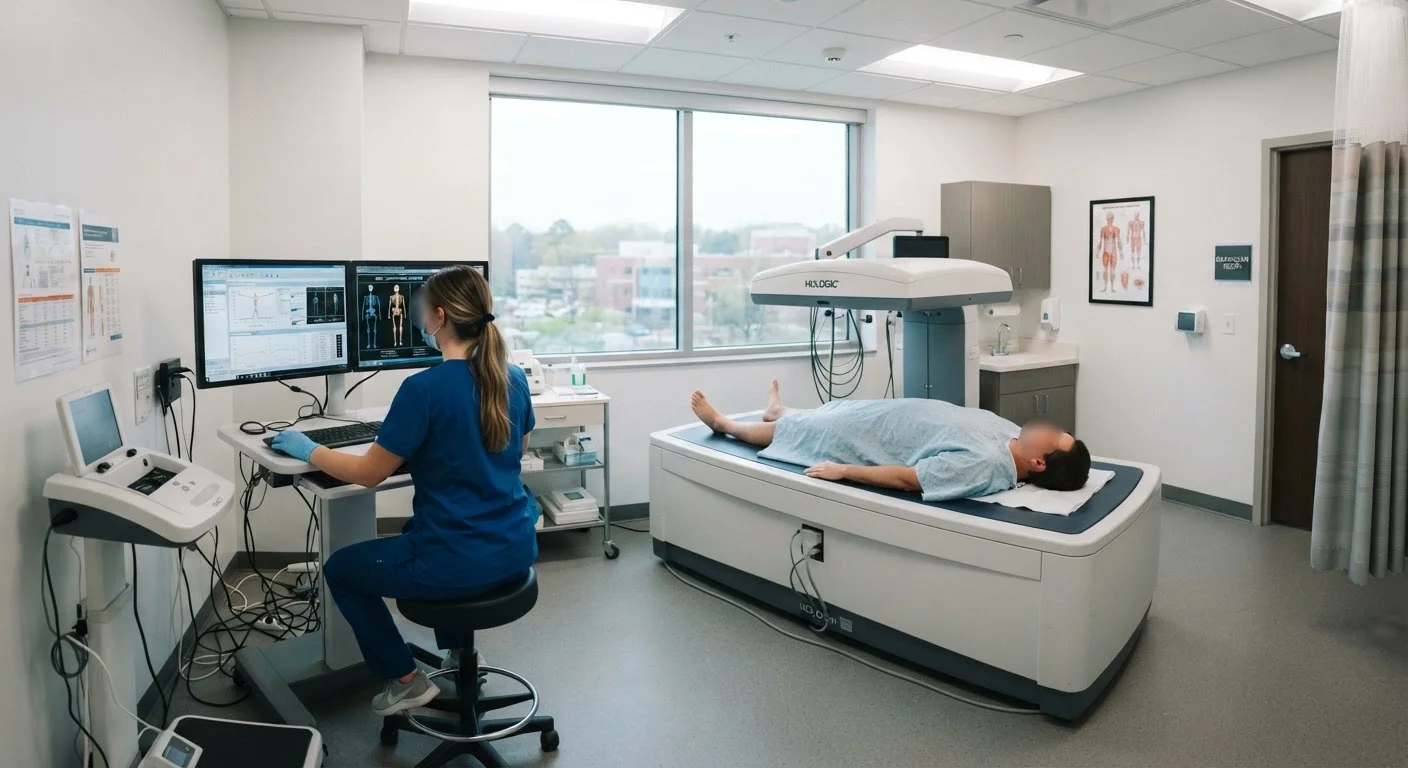
DEXA (Dual-Energy X-ray Absorptiometry) uses two low-dose X-ray beams to differentiate fat, lean, and bone mineral density across the whole body. It's widely regarded as the clinical reference standard for body composition in research settings. It can identify regional fat distribution - including visceral fat around the abdominal organs - which carries distinct metabolic implications. Limitations include cost (typically $50-$150 per scan without insurance coverage), radiation exposure (though minimal), and the need for a medical or clinical facility.
Bioelectrical Impedance Analysis (BIA) passes a low-level electrical current through the body; fat tissue resists the current more than lean tissue, and this resistance (impedance) is used to estimate fat percentage via population-based equations. Consumer-grade BIA scales and hand-grip devices are widely available, but results are highly sensitive to hydration, recent food intake, exercise, and even skin temperature. Research shows within-day variability can be substantial enough to misrepresent real changes.
Skinfold calipers measure the thickness of subcutaneous (under-skin) fat at standardized anatomical sites - typically 3, 4, or 7 sites. Accuracy depends heavily on the technician's training and consistency. When performed reliably, they can track relative changes over time reasonably well, though they tend to underestimate body fat in individuals with higher adiposity.
BMI and Circumference Measures: Useful Proxies, Not Substitutes
Body Mass Index (BMI), calculated as weight divided by height squared, is commonly used in population health research and clinical screenings. It does not measure body composition directly and is known to misclassify individuals with high muscle mass as overweight, and to miss elevated fat in individuals with low muscle mass - sometimes called "normal weight obesity." Its utility is most meaningful at the population level rather than for individual assessment.
Waist circumference and waist-to-hip ratio are simple circumference-based tools that correlate meaningfully with visceral fat accumulation - the fat stored around internal organs that is more metabolically active than subcutaneous fat. These require no equipment beyond a flexible measuring tape and provide a useful screening signal, though they don't quantify fat percentage.
For a comprehensive breakdown of how all these components interact, see our full-picture guide to body composition components.
Interpreting Results Thoughtfully
Whatever method you use, body composition data is most meaningful when tracked consistently over time with the same method, rather than comparing across different tools. A single measurement is a snapshot with built-in error margins; a pattern across multiple consistent readings is more informative.
It's also worth reflecting on how you engage with these numbers. Our body-neutral framework for interpreting composition data explores how to use these metrics as useful health information rather than a source of judgment - and when frequent tracking can become counterproductive is worth reading if monitoring starts to feel distressing.
If you're using measurements to inform health decisions, consulting with a physician, registered dietitian, or certified exercise physiologist ensures results are interpreted in the context of your full health picture.
This article is for general informational and educational purposes only and does not constitute medical advice. Always consult a qualified healthcare professional before making decisions based on body composition data.