

Key Takeaways
What Body Composition Actually Means
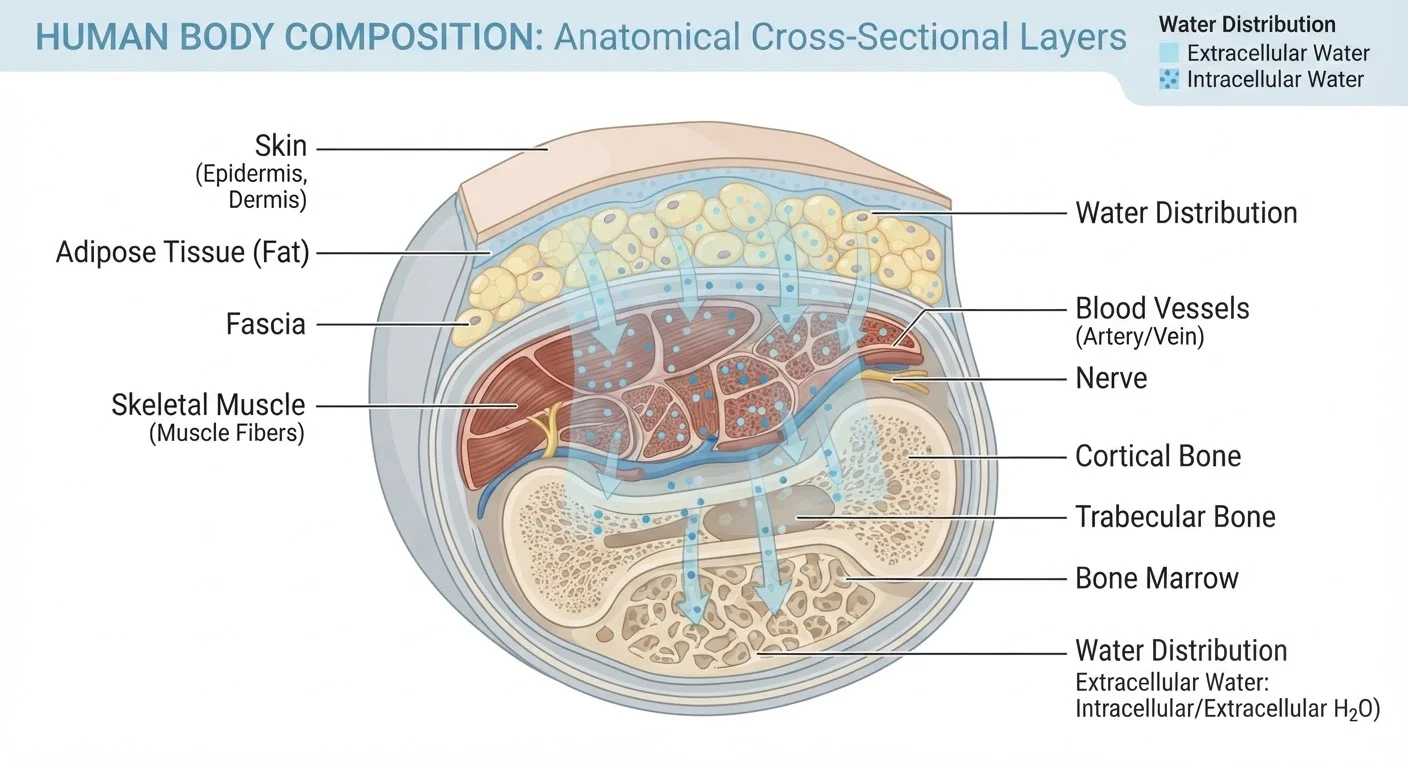
Body weight is a single number. Body composition is the story behind it. Rather than measuring how much you weigh, body composition describes what your body is made of - the relative proportions of fat tissue, skeletal muscle, bone, and water that together account for your total mass.
Two people of identical height and weight can have dramatically different health profiles depending on these proportions. As explored in our guide to body composition vs. body weight, the scale alone cannot distinguish between a pound of muscle and a pound of fat - yet those tissues behave very differently in the body.
If you're approaching this topic for the first time, our starter guide to body composition provides a useful foundation. This article goes deeper into each component, how they interact, and what current evidence says about their health implications.
This article is for general health education and is not a substitute for personalized medical advice. Consult a qualified healthcare provider for guidance specific to your health situation.
Fat Mass: Types, Function, and Health Context
Fat tissue - technically called adipose tissue - is not inert storage. It plays active roles in hormone production, immune signaling, and energy regulation. Understanding fat requires distinguishing between its types.
- Subcutaneous fat sits beneath the skin and accounts for the majority of total body fat in most people. It tends to be metabolically less active than other types.
- Visceral fat surrounds internal organs in the abdominal cavity. Excess visceral fat is associated in research with elevated cardiometabolic risk, including insulin resistance and systemic inflammation.
- Essential fat is the minimum fat required for normal physiological function - it is found in the brain, nerves, bone marrow, and organs. This fraction is non-negotiable for health.
Research consistently shows that where fat is stored matters as much as how much there is. For context on how different dietary fats contribute to these tissue types, see our plain-language reference on dietary fat types.
When interpreting body fat percentage, consider the location of fat accumulation - particularly the waist-to-hip ratio - as a more clinically meaningful signal than the percentage alone.
Research consistently shows visceral fat, reflected by central adiposity measures, carries stronger associations with metabolic risk than subcutaneous fat at equivalent total percentages.
If using a BIA scale at home, weigh yourself at the same time each day - ideally in the morning before eating or drinking - to minimize hydration-driven variability in readings.
BIA measures the speed of an electrical signal through body tissues; hydration status significantly alters conductivity, making same-condition testing essential for meaningful trend tracking.
It's also worth noting that body fat percentage ranges considered "healthy" vary by sex, age, and individual context. Engaging with these numbers in a way that informs rather than defines you is a key principle covered in our body-neutral framework for body composition data.
Muscle and Lean Tissue: More Than Just Strength
Skeletal muscle is the largest component of lean mass and one of the most metabolically significant tissues in the body. It is a primary site for glucose uptake and plays a central role in insulin sensitivity - meaning adequate muscle mass supports stable blood sugar regulation.
Lean tissue also includes the heart, liver, kidneys, and other organs, but skeletal muscle is the component most influenced by lifestyle factors like physical activity and protein intake. Muscle tissue requires more energy to maintain than fat tissue at rest, which is why it contributes meaningfully to resting metabolic rate (the calories your body burns at rest).
Muscle mass naturally declines with age - a process called sarcopenia - typically accelerating after age 50. Resistance training and adequate dietary protein are the most well-supported strategies for preserving lean mass across the lifespan. The weight management hub explores sustainable approaches to body composition that support lean tissue over time.
Bone Density and Skeletal Mass
Bone is living tissue that continuously remodels itself. Peak bone mass is generally reached in the late twenties, after which the balance between bone formation and resorption gradually shifts toward net loss. The rate of that loss is influenced by genetics, hormonal status, physical activity, and nutrition.
Key nutrients for bone health include calcium, vitamin D, magnesium, and vitamin K2. For a broader look at the micronutrients involved in skeletal support, the vitamins and minerals hub provides detailed reference information.
Weight-bearing exercise - including walking, running, and resistance training - applies mechanical stress to bone, which stimulates remodeling and helps maintain density. Bone mineral density (BMD) is clinically assessed via DEXA scanning, the current gold standard for this measurement.
Body Water: The Overlooked Component
Water makes up approximately 50-70% of total body mass in most adults, with the exact proportion varying by age, sex, and body composition - leaner bodies contain a higher percentage of water than those with more fat tissue, since muscle holds significantly more water than fat.
Body water is distributed across two major compartments: intracellular fluid (inside cells) and extracellular fluid (in blood plasma and the spaces between cells). Both compartments are tightly regulated by the kidneys, hormones, and electrolyte balance.
From a practical standpoint, body water fluctuations are responsible for the daily weight changes most people observe on the scale - differences of 1-3 pounds between morning and evening are normal and reflect fluid intake, food volume, sweat, and hormonal cycles rather than changes in fat or muscle. This is a critical reason why single-day weigh-ins are poor indicators of actual body composition shifts.
How the Components Interact
The four components of body composition don't operate independently - they form an interconnected system. Changes in one compartment frequently affect the others.
- Gaining muscle mass typically increases body water content, since muscle tissue is roughly 75% water.
- Reduced muscle mass (from aging or inactivity) tends to lower resting metabolic rate, which can contribute to fat accumulation over time if energy intake remains constant.
- Bone density is partially supported by muscle-generated mechanical loading - sedentary individuals lose both lean mass and bone mass in parallel.
- Hormonal changes - such as those during menopause or androgen changes in men - simultaneously affect fat distribution, muscle retention, and bone remodeling.
This interconnectedness means that lifestyle interventions rarely affect just one compartment. Resistance training, for example, simultaneously preserves muscle, supports bone density, and can improve visceral fat levels - even without significant changes in total body weight.
Measuring Body Composition: Methods and Trade-offs
No widely available measurement method captures all four components simultaneously with perfect precision. Understanding the trade-offs helps you interpret results appropriately.
| Method | What It Measures | Accuracy | Accessibility |
|---|---|---|---|
| DEXA scan | Fat, lean mass, bone density by region | High | Clinical/research settings |
| Hydrostatic weighing | Body density (estimates fat and lean) | High | Limited facilities |
| Bioelectrical impedance (BIA) | Estimates fat and lean via electrical resistance | Moderate | Consumer devices, gyms |
| Skinfold calipers | Subcutaneous fat at specific sites | Moderate (technique-dependent) | Low cost, portable |
| Waist circumference | Proxy for visceral fat | Limited but practical | Universal |
Consumer-grade BIA devices - including many bathroom scales - are convenient but sensitive to hydration status, meal timing, and electrode placement, which can produce large measurement variability. For tracking trends over time, consistency in testing conditions matters more than any single reading. Always interpret body composition data as one input among many in a broader health picture, not as a definitive verdict.
This content is intended for general informational purposes only. It does not constitute medical advice. Always consult a qualified healthcare professional before making changes to your health regimen.