

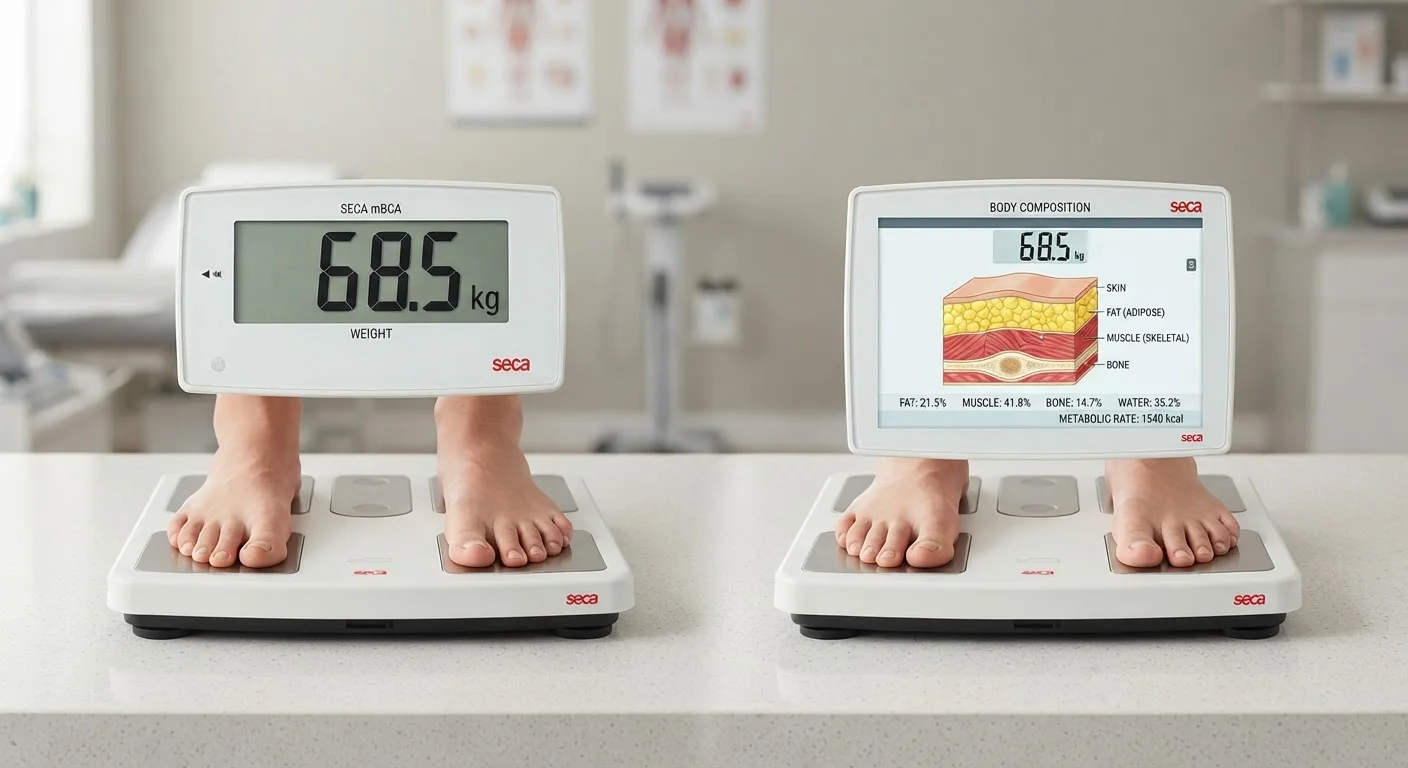
Key Takeaways
Option A
Body Weight
The single, simple number most people know.
Best for: Quick, low-effort tracking of overall mass trends over time.
Option B
Body Composition
The breakdown of what that number is actually made of.
Best for: Understanding the ratio of fat, muscle, bone, and water for a fuller health picture.
If you want a fast, accessible daily or weekly check-in
Body Weight
A bathroom scale is inexpensive, immediate, and useful for tracking broad trends when interpreted with appropriate context about normal daily fluctuation.
If you want to understand how diet or exercise is changing your physique
Body Composition
Composition data distinguishes fat loss from muscle gain, revealing changes that a stable scale number would completely obscure.
If a clinician is monitoring your metabolic or cardiovascular health markers
Body Composition
Metrics like fat mass, lean mass, and visceral fat distribution provide far more actionable clinical information than total body weight alone.
If you are new to tracking and want to start simply
Body Weight
Learning consistent weighing habits first is a practical starting point before adding the complexity of composition assessment tools.
What Each Metric Actually Measures
Body weight is the total gravitational force exerted by everything inside you - fat, muscle, bone, water, organs, and the contents of your digestive tract - expressed as a single number in pounds or kilograms. It is straightforward to measure and consistently reproducible with a standard scale.
Body composition, by contrast, breaks that total mass into its component tissues. The most common framework separates fat mass from fat-free mass (which includes skeletal muscle, bone, water, and organs). More detailed assessments further distinguish lean soft tissue, bone mineral density, and regional fat distribution. For a thorough walkthrough of each component, see what fat, muscle, and bone actually tell you about health.
Because body weight is a sum, it tells you nothing about the proportions of its parts. Body composition provides those proportions - and proportions are where much of the clinically meaningful information lives.
The Limitations the Scale Can't Overcome
Body weight has a well-documented blind spot: it cannot distinguish between tissue types. Consider two adults who both weigh 175 pounds. One may carry a higher percentage of lean muscle mass and a lower percentage of body fat; the other the reverse. Their scale readings are identical, but their metabolic profiles, cardiovascular risk factors, and functional fitness levels may differ substantially.
This limitation becomes especially visible during body recomposition - the process by which fat mass decreases while lean muscle mass increases. Because muscle and fat have different densities, these changes can offset each other on the scale, producing a stable weight reading even as the body's composition shifts meaningfully. why your weight can stay the same while your body changes explores this dynamic in detail.
Daily weight readings also reflect transient factors - hydration level, sodium intake, digestive contents, hormonal water retention - that have nothing to do with fat or muscle. why weight fluctuates day to day explains the science behind these normal swings.
| Criterion | Body Weight | Body Composition |
|---|---|---|
| What it measures | Total mass in one number | Ratio of fat, muscle, bone, water |
| Tool required | Standard bathroom scale | DEXA, BIA, skinfold calipers, or similar |
| Detects recomposition | No | Yes |
| Affected by hydration | Yes, significantly | Varies by method |
| Clinical detail | Low - single aggregate figure | High - tissue-specific breakdown |
| Cost and accessibility | Very low - scales are widely available | Moderate to high depending on method |
| Captures bone density | No | Yes (with DEXA) |
Why Body Composition Adds Clinical Context
Research consistently links specific composition characteristics - particularly elevated visceral fat (the fat stored around internal organs) and low lean muscle mass - to metabolic and cardiovascular health risks, independent of total body weight. This is why two people at the same BMI or body weight can have meaningfully different risk profiles. For a deeper look at fat type distinctions, see visceral fat vs. subcutaneous fat.
Composition data also captures bone mineral density, a component that standard scales and even BMI entirely ignore. bone density's role in body composition outlines why this matters for long-term structural health.
Body composition assessment isn't without its own limitations, however. Methods vary widely in accuracy and accessibility - from clinical-grade DEXA scans to consumer bioelectrical impedance devices. how body composition is actually measured covers the tradeoffs between available tools.
This article is for general informational and educational purposes only and does not constitute medical advice. Consult a qualified healthcare professional for guidance specific to your health situation.