

Key Takeaways
Body Recomposition
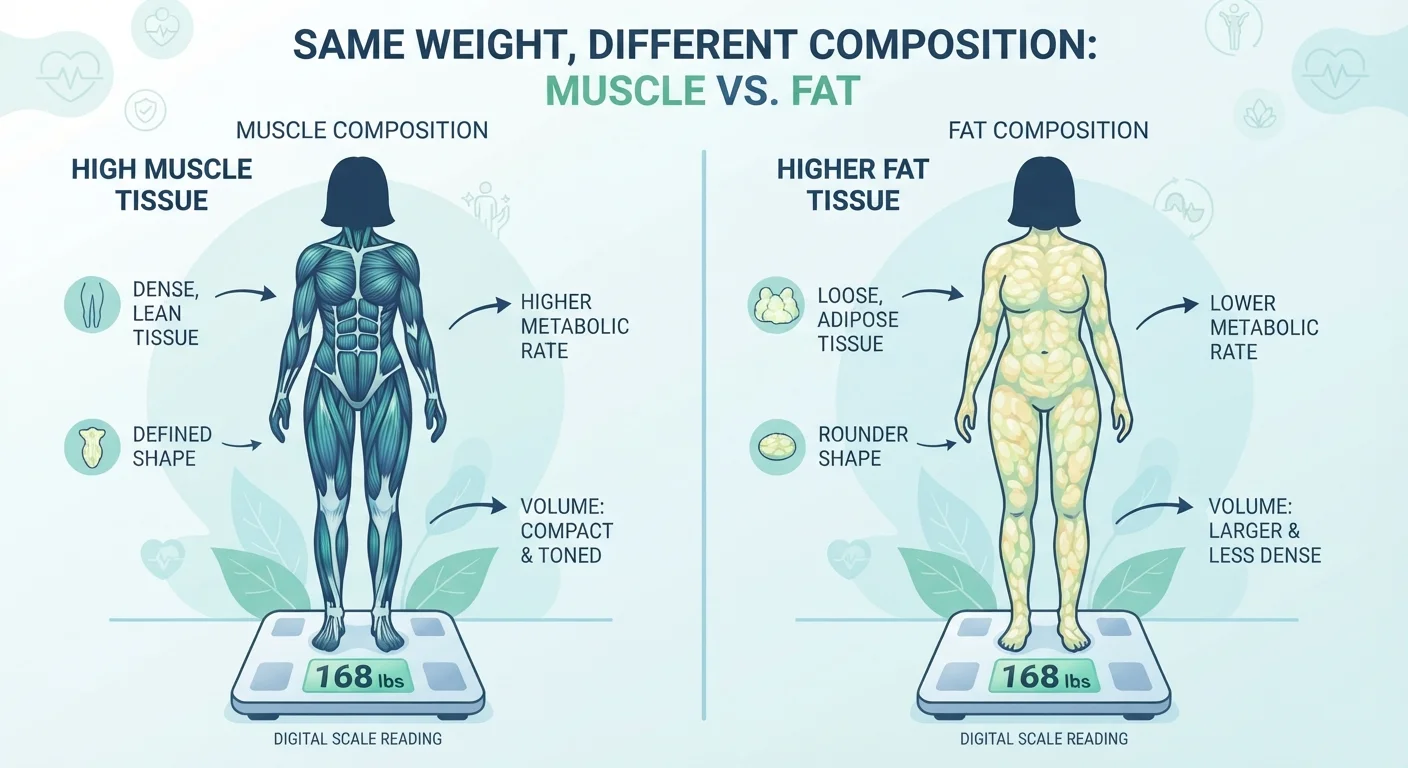
Body recomposition refers to the simultaneous process of losing fat and gaining muscle, which can occur even when total body weight stays the same. Because muscle and fat tissue have different densities and occupy different amounts of space, your body can change shape and function significantly without the scale moving. It's a real physiological phenomenon supported by research, not a fitness myth.
Recomposition is most pronounced in individuals who are new to resistance training, returning after a break, or in a slight caloric deficit combined with adequate protein intake - conditions where muscle protein synthesis and fat oxidation can occur concurrently.
What the Scale Is Actually Measuring
Step on a scale and it delivers a single number: your total mass. That's it. The scale doesn't know whether that mass is bone, water, fat, organ tissue, or muscle. It adds everything up and reports the sum - which is why treating that number as the primary measure of health or fitness progress can be misleading.
Body weight captures total mass, not composition. Two people can weigh exactly the same and have dramatically different amounts of lean muscle versus fat tissue - and very different health profiles as a result. Understanding what the scale can and can't tell you is the first step toward interpreting your own data more accurately.
For a broader look at why these distinctions matter, see our article on what fat, muscle, and bone actually tell you about health.
Why Muscle and Fat Don't Behave the Same Way on a Scale
Fat and muscle are both weighed equally by a scale, but they differ fundamentally in density. Muscle tissue is denser - it packs more mass into a smaller volume. Fat tissue is less dense and takes up more space per pound. This physical reality is what allows two people with identical scale weights to look noticeably different from one another.
~18%
Greater volume of fat vs. muscle per pound
Fat tissue occupies roughly 18% more volume than an equivalent weight of muscle tissue, contributing to visible shape differences at the same scale weight.
8-12 weeks
Timeframe for measurable recomposition
Multiple exercise science studies suggest consistent resistance training combined with adequate protein intake can produce measurable body composition changes within this window.
1.6-2.2g/kg
Protein intake range linked to muscle retention
Research in sports nutrition generally associates this daily protein intake range (per kilogram of body weight) with supporting muscle protein synthesis during caloric restriction.
It's a common misconception that "muscle weighs more than fat." A pound of each weighs exactly one pound. What differs is how much space each occupies in your body. As the science on common body composition claims makes clear, this density difference - not a weight difference - is what changes your body's shape and size even when the scale doesn't move.
This is also why someone who starts a resistance training program might notice their clothes fitting differently, their posture improving, and their strength increasing - all without a significant change in scale weight.
The Science Behind Body Recomposition
Body recomposition - losing fat while gaining muscle simultaneously - is documented in peer-reviewed research. It's not the default outcome for everyone, and it's not as fast as pursuing only one goal at a time, but it is a legitimate physiological process.
The conditions that favor recomposition include: being new to resistance training, returning to training after a period of inactivity, having a higher baseline body fat percentage, and consuming adequate dietary protein to support muscle protein synthesis. In these contexts, the body can draw on fat stores for energy while using dietary protein to build and repair muscle tissue - even in a slight caloric deficit.
Research published in sports nutrition and exercise science literature consistently shows that combining resistance training with sufficient protein intake produces meaningful changes in body composition over weeks to months - often without proportional changes in total body weight. For more on how muscle tissue affects energy metabolism, see the role of muscle mass in long-term energy expenditure.
Better Ways to Track Body Composition Changes
If the scale is an incomplete tool, what should you use instead? There's no single perfect answer, but a combination of methods gives a more accurate picture than any one measurement alone.
- Body measurements: Tracking circumference at consistent points - waist, hips, arms, thighs - can reveal shape changes the scale misses.
- Progress photos: Taken under consistent lighting and angles over weeks, these can surface gradual visual changes.
- How clothing fits: A practical, everyday indicator of how your body's shape is shifting.
- Bioelectrical impedance scales: These estimate body fat percentage using electrical current, but accuracy varies and results are influenced by hydration levels.
- DEXA scanning: Dual-energy X-ray absorptiometry is considered the clinical gold standard for body composition measurement, providing detailed data on fat mass, lean mass, and bone density.
For context on how these measurements relate to one another, our guide on body fat percentage versus BMI explains what each metric captures and where each falls short.
Track More Than One Metric
Instead of relying solely on the scale, consider logging at least two or three other indicators - waist measurement, strength benchmarks, or progress photos - taken on a consistent schedule. This gives you a more complete picture of how your body is actually responding to training and nutrition changes over time.
This article is for general informational purposes only and is not a substitute for professional medical advice. Consult a qualified healthcare provider before making significant changes to your exercise or nutrition routine, especially if you have an existing health condition.