

Key Takeaways
Option A
BMI (Body Mass Index)
The widely used population-level screening tool.
Best for: Quick, low-cost population screening and tracking weight-related risk trends at a group level.
Option B
Body Fat Percentage
The more precise measure of what your body is actually made of.
Best for: Assessing individual body composition, especially when distinguishing fat mass from lean muscle mass matters.
If you want a fast, no-equipment estimate of weight-related risk
BMI (Body Mass Index)
BMI requires only height and weight, making it accessible for quick screening - though it works best at the population level, not for individual diagnosis.
If you want to understand your actual body composition
Body Fat Percentage
Body fat percentage distinguishes fat mass from muscle and bone, giving a far more meaningful picture of individual body composition and metabolic health.
If you are very muscular or athletic
Body Fat Percentage
BMI frequently misclassifies people with high muscle mass as overweight or obese, while body fat percentage accurately reflects their lean-to-fat ratio.
If a clinician needs a baseline population health indicator
BMI (Body Mass Index)
BMI remains a practical, validated screening tool for large-scale public health tracking, even with its well-documented individual-level limitations.
What Each Metric Actually Measures
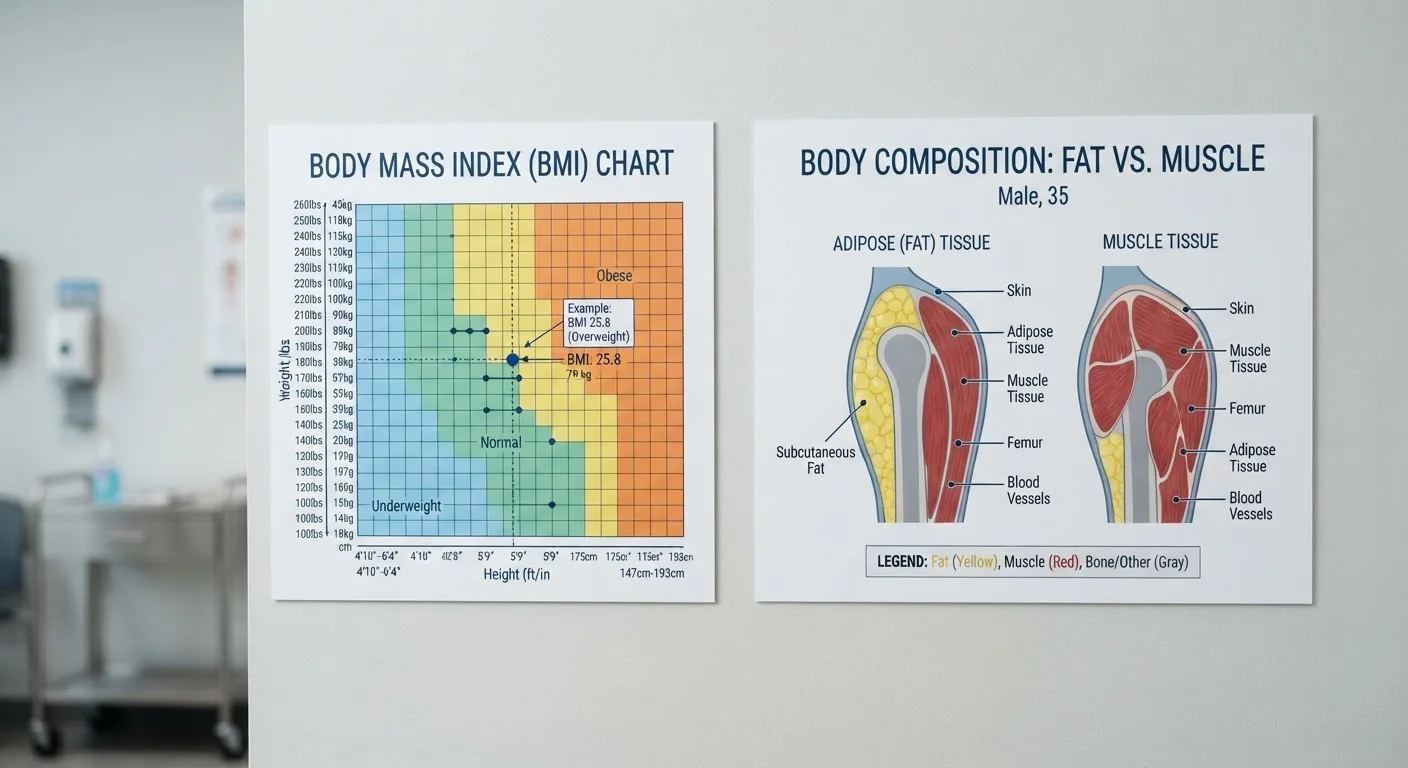
BMI is calculated by dividing a person's weight in kilograms by the square of their height in meters. That single formula produces a number used to categorize individuals as underweight, normal weight, overweight, or obese. Its appeal is simplicity - no specialized equipment, no clinical setting required. But that simplicity comes at a cost: BMI tells you nothing about what your weight is made of.
Body fat percentage answers a different question entirely: of all the mass in your body, what fraction is fat? The remainder - muscle, bone, organs, water, and connective tissue - is classified as lean mass. This ratio matters because fat tissue and lean tissue behave very differently in the body. Lean mass is metabolically active; excess fat, particularly in certain locations, is associated with a different set of physiological risks. To understand this distinction in more detail, see our guide to what fat, muscle, and bone actually tell you.
| Criterion | BMI | Body Fat Percentage |
|---|---|---|
| What it measures | Weight relative to height | Fat mass as a fraction of total body mass |
| Equipment needed | Scale and height measurement | DEXA, calipers, BIA scale, or water tank |
| Cost and accessibility | Free, no equipment required | Varies; accurate methods can be costly |
| Accounts for muscle mass | No | Yes |
| Distinguishes fat location | No | No (overall percentage only) |
| Best suited for | Population-level screening | Individual body composition assessment |
| Reliability for athletes | Often misleading | More accurate |
Where BMI Falls Short
BMI was originally developed in the 19th century as a statistical tool for describing populations, not diagnosing individuals. It has no way to distinguish between a pound of fat and a pound of muscle - so a highly trained athlete with dense muscle mass may register as "overweight" or even "obese" by BMI standards, despite having very low body fat. The inverse is also true: a sedentary person with little muscle but significant fat mass can fall into the "normal" BMI category - a phenomenon researchers sometimes call "normal-weight obesity."
BMI also does not account for age-related changes in body composition, sex differences in fat distribution, or ethnic variation in how fat is distributed relative to weight. For a deeper look at these limitations, our article on BMI as a health metric covers what it was designed for and where it consistently underperforms.
The Limitations of Body Fat Percentage
Body fat percentage is meaningfully more informative than BMI for individuals - but it is not without its own complications. Accurate measurement is technically demanding. Common methods include dual-energy X-ray absorptiometry (DEXA), hydrostatic (underwater) weighing, air displacement plethysmography, and skinfold calipers. Each varies in accuracy, accessibility, and cost. Consumer-grade bioelectrical impedance scales (the kind found in many homes and gyms) can be significantly affected by hydration status, recent exercise, and meal timing, producing results that vary considerably from one day to the next.
Body fat percentage also doesn't tell you where fat is stored. Research consistently shows that fat location - particularly the distinction between visceral fat (stored around internal organs) and subcutaneous fat (stored just beneath the skin) - carries different health implications. A body fat percentage number alone won't reveal that breakdown. For more on why fat location matters, see our article on visceral fat versus subcutaneous fat.
Two Numbers, Used Together
The most informed clinical and personal health picture typically draws on multiple data points - not a single metric in isolation. BMI remains a practical screening tool, especially where resources are limited, but clinicians increasingly pair it with waist circumference, body composition assessments, and metabolic markers to build a more complete profile.
It's also worth remembering that body weight itself - the number on the scale - is only one layer of information. As we explore in what body weight actually measures, the scale captures total mass without any context about its composition. And two people at identical weights can have dramatically different health profiles, a reality explained in body composition versus body weight.
Neither BMI nor body fat percentage is a verdict. They are starting points for conversation - ideally with a qualified healthcare provider who can interpret them alongside your full health history, lifestyle context, and individual circumstances.
This article is for general informational and educational purposes only and is not a substitute for professional medical advice, diagnosis, or treatment. Always consult a qualified healthcare provider with any questions about your health or body composition metrics.