

Key Takeaways
Metabolic Rate Across the Lifespan
Metabolic rate refers to the speed at which your body converts food and stored energy into fuel for all bodily functions. This rate is not fixed - it shifts in predictable ways as you move through different life stages, influenced by growth, hormonal changes, body composition, and organ function. Understanding how these changes unfold can help you make more informed decisions about nutrition and activity at any age.
Total daily energy expenditure (TDEE) includes basal metabolic rate (BMR), the thermic effect of food, and activity energy expenditure - all of which are subject to age-related change.
The Childhood and Adolescent Engine
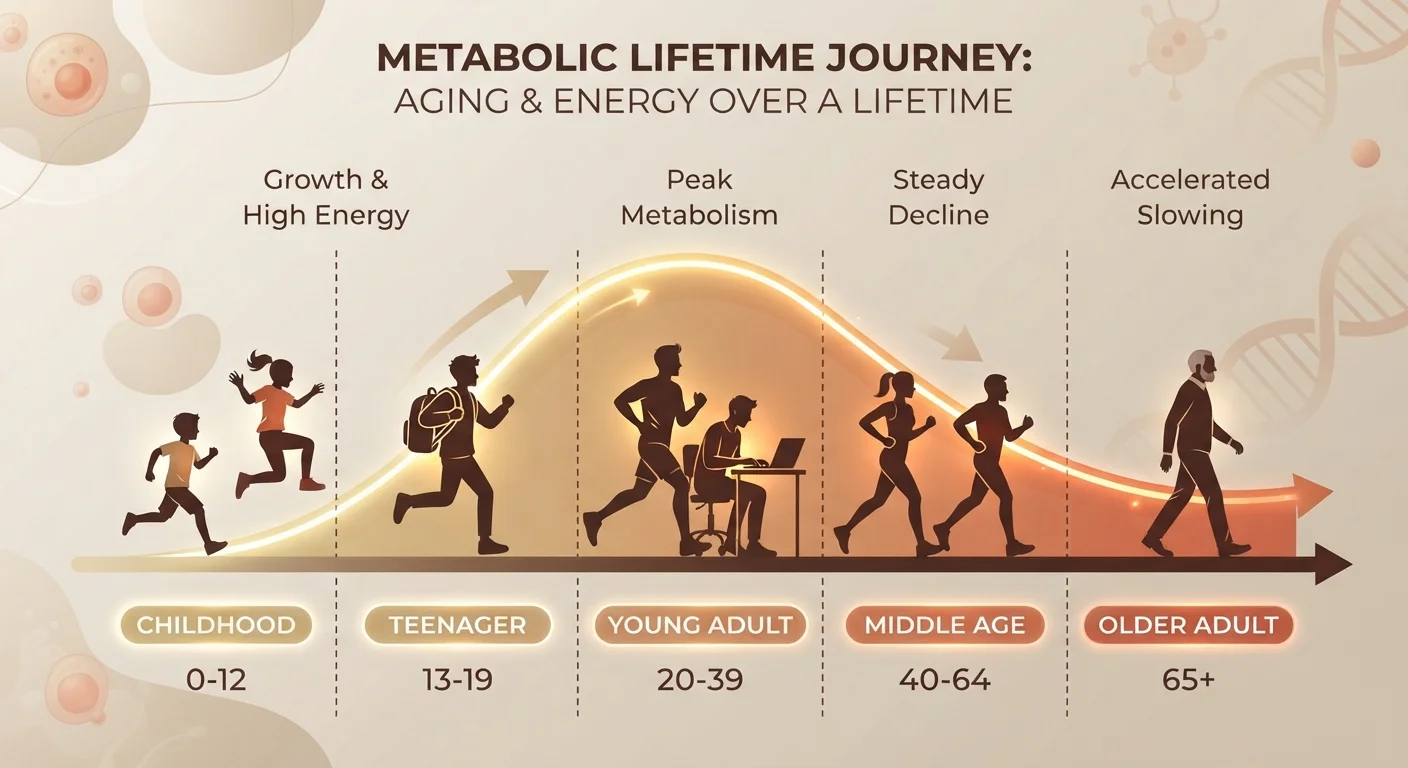
Children are metabolic powerhouses. Relative to body size, infants burn energy at roughly twice the rate of adults - a biological necessity driven by the extraordinary demands of growth, brain development, and organ maturation. If you've ever wondered why young children seem to eat constantly yet stay lean, this is a large part of the answer.
As children move into adolescence, puberty reshapes energy metabolism significantly. Surges in growth hormone, testosterone, and estrogen drive rapid increases in muscle and bone mass, elevating the body's baseline energy demands. This is why caloric needs spike noticeably during the teenage years, particularly for adolescents who are physically active. For a deeper look at how nutrient needs evolve across life stages, see how macronutrient needs shift across different life stages.
Supporting Metabolism During Adolescent Growth
Teenagers have some of the highest caloric and protein needs of any life stage, yet restrictive eating behaviors can emerge during this period. Rather than focusing on limiting food, the emphasis should be on adequacy - enough energy and protein to support healthy growth and physical development. If you have concerns about a teenager's eating patterns, consult a pediatric dietitian.
Young Adulthood to Midlife: Steadier Than You Think
A landmark 2021 study published in the journal Science challenged the long-held assumption that metabolism begins declining in your 30s. Researchers analyzing data from nearly 6,500 people across 29 countries found that, when adjusted for body size and composition, metabolic rate remains remarkably stable from approximately age 20 to 60. The perceived slowdown many people notice in their 30s and 40s appears to be driven more by lifestyle factors - reduced physical activity, gradual muscle loss, and changing eating patterns - than by an intrinsic age-related biological decline.
This doesn't mean nothing changes. Body composition shifts are real: muscle tissue, which burns more calories at rest than fat tissue, tends to decrease gradually after the mid-20s in the absence of resistance training. This phenomenon, known as sarcopenia when it becomes clinically significant, is one of the primary mechanisms through which energy expenditure quietly drops over time.
~0.7%
Annual metabolic decline after age 60
According to a 2021 study published in Science analyzing data from nearly 6,500 people across the lifespan.
Ages 20-60
Window of metabolic stability (adjusted for body composition)
The same Science study found that, when controlling for body size and fat-free mass, metabolic rate stays largely flat across these four decades.
~3-8%
Muscle mass lost per decade after age 30 without resistance training
A commonly cited estimate in exercise science literature, underlying why body composition management matters for long-term metabolic health.
The Hormonal Pivot Points
Certain life transitions create more abrupt metabolic shifts. Pregnancy, for example, increases total energy needs substantially to support fetal development and maternal tissue changes - though the specific amount varies significantly by individual. Those who are pregnant or planning to become pregnant should work closely with a healthcare provider to understand their nutritional needs, as general figures are not a substitute for personalized guidance.
Menopause represents another meaningful pivot. As estrogen levels decline, fat distribution tends to shift toward the abdominal region, and some evidence suggests resting metabolic rate may decrease modestly. These changes don't happen overnight and vary widely between individuals. For context on how sleep also changes during these transitions - which has its own metabolic implications - see how sleep architecture shifts across a lifetime.
Individual Variation Is Significant
Population-level metabolic trends provide useful context, but individual variation is substantial. Genetics, body composition, health conditions, medications, and lifestyle factors all modulate how these age-related changes play out for any given person. The patterns described here reflect averages from research populations and should not be interpreted as fixed personal predictions.
Metabolism After 60: The Real Slowdown
After age 60, metabolic rate does begin a more measurable decline - roughly 0.7% per year, according to the 2021 Science study. This is driven by a combination of factors: continued loss of muscle mass, reduced organ function, declining anabolic hormone levels (including growth hormone and sex hormones), and often lower levels of physical activity. Together, these changes mean that energy needs genuinely decrease in later life, though the degree varies considerably between individuals.
Importantly, reduced calorie needs do not mean reduced nutrient needs. Older adults typically require the same or greater amounts of protein, calcium, vitamin D, and B vitamins relative to their caloric intake. Eating too little to compensate for a slower metabolism can inadvertently accelerate the very muscle loss driving that slowdown.
Understanding what genuinely moves the metabolic needle - beyond age alone - is worth exploring. See factors that genuinely influence metabolic rate for a ranked, evidence-based breakdown.
This article is for general informational and educational purposes only and does not constitute medical or nutritional advice. Consult a qualified healthcare professional for guidance specific to your health, age, or medical history.