

Key Takeaways
Energy Balance
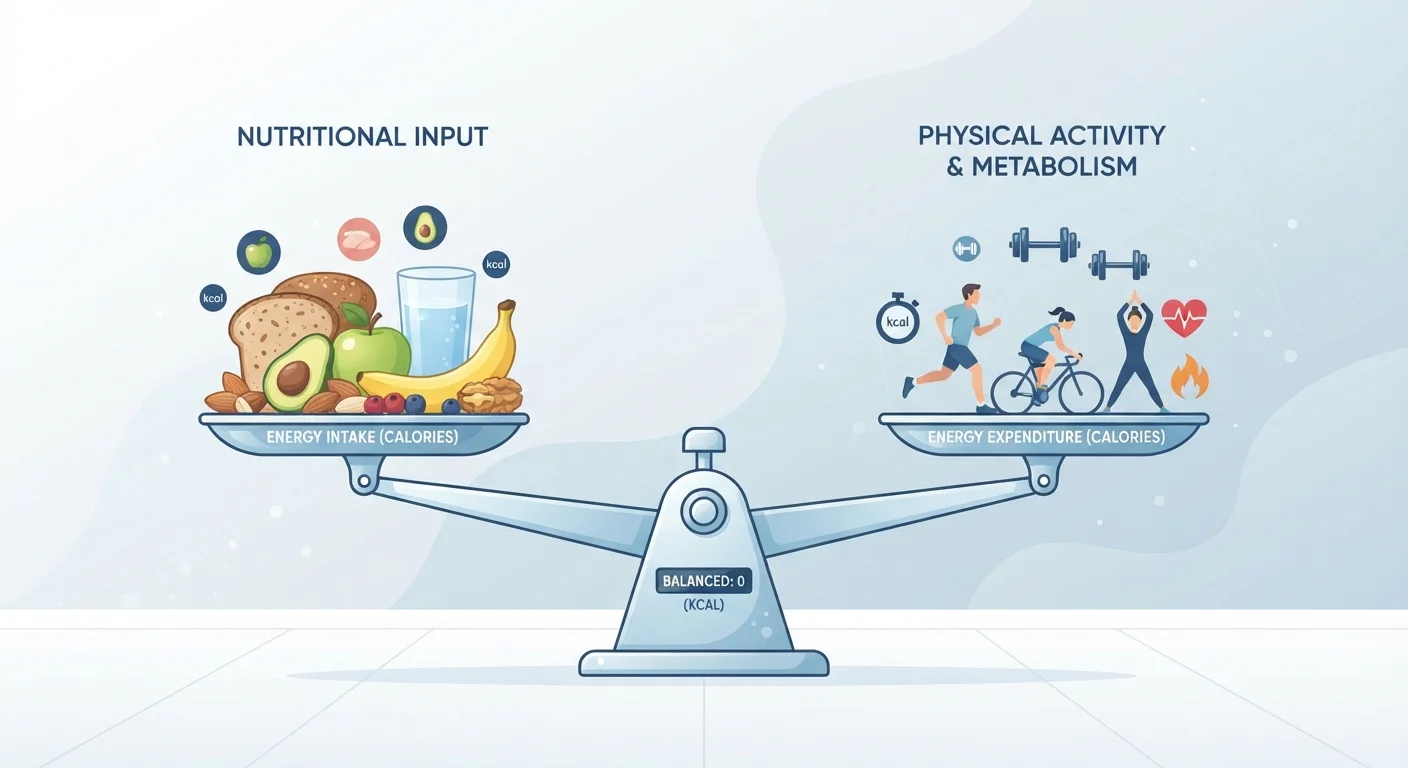
Energy balance refers to the relationship between the calories you consume through food and drink and the calories your body uses for all its functions and activities. When intake equals expenditure, body weight tends to remain stable. A consistent surplus leads to weight gain; a consistent deficit leads to weight loss. However, the body actively regulates both sides of this equation in ways that go well beyond simple arithmetic.
Energy balance is governed by thermodynamic principles but is modulated by hormonal signals, adaptive thermogenesis, gut microbiome composition, and genetic factors - making individual responses highly variable.
The Four Components of Energy Expenditure
Most discussions of energy balance focus on exercise, but physical activity typically accounts for only a fraction of the total calories the body uses each day. Total daily energy expenditure (TDEE) is the sum of four distinct components:
- Basal Metabolic Rate (BMR): The calories required to keep the body alive at rest - breathing, circulation, cell repair. BMR accounts for roughly 60-70% of TDEE in sedentary individuals.
- Thermic Effect of Food (TEF): The energy cost of digesting, absorbing, and metabolizing nutrients. Protein has a higher TEF than fat or carbohydrates.
- Non-Exercise Activity Thermogenesis (NEAT): Calories burned through all movement that isn't formal exercise - fidgeting, walking, posture adjustments. NEAT varies dramatically between individuals.
- Exercise Activity Thermogenesis (EAT): Calories from intentional physical activity. This is the component most people consciously influence.
Understanding that BMR and NEAT together dominate most people's energy output helps explain why exercise alone rarely produces the weight changes many people expect. For a deeper look at the vocabulary behind these concepts, see the plain-language weight management reference.
How the Body Defends Its Weight
The human body doesn't passively accept whatever calories it receives - it actively works to maintain a relatively stable internal state. This regulatory system involves several interacting mechanisms.
Leptin and ghrelin are two key hormones. Leptin, produced by fat cells, signals the brain that energy stores are sufficient and helps suppress appetite. Ghrelin, released by the stomach, stimulates hunger. When body weight drops, leptin falls and ghrelin rises - a combination that increases appetite and can reduce energy expenditure simultaneously.
Adaptive thermogenesis adds another layer. During sustained caloric restriction, the body reduces its resting metabolic rate beyond what would be predicted from tissue loss alone. Research suggests this adaptation can persist well after a diet ends, contributing to the biological difficulty many people experience in maintaining weight loss.
60-70%
Proportion of TDEE from basal metabolic rate
In sedentary individuals, BMR typically accounts for the largest share of daily calorie expenditure, underscoring its outsized role in energy balance.
~200-300 kcal
Estimated daily NEAT variation between individuals
Research in exercise physiology suggests non-exercise activity thermogenesis can vary by hundreds of calories per day between people with similar activity profiles.
Up to 15%
Metabolic rate reduction from adaptive thermogenesis
Studies have documented resting metabolic rate reductions beyond predicted tissue-loss effects following sustained caloric restriction, a phenomenon known as adaptive thermogenesis.
These regulatory mechanisms evolved to protect against starvation, not to facilitate intentional weight change. Recognizing this biology as a normal physiological response - rather than a personal failing - is important for forming realistic expectations. This connects to broader questions about what metabolism actually is and how it responds to lifestyle changes.
What Energy Balance Doesn't Tell You
Energy balance explains changes in body weight over time, but body weight itself is an incomplete measure of health or body composition. Two individuals at identical weights - and in identical energy balance - can have very different ratios of fat mass to lean mass, with distinct implications for metabolic health, strength, and physical function.
Fluid shifts, muscle gain, hormonal fluctuations, and digestive contents all affect the number on the scale from day to day without reflecting meaningful changes in energy balance. This is why short-term weight fluctuations are rarely informative on their own.
For a more complete picture of what the scale does and doesn't capture, see what body weight actually measures and what body composition reveals about health. Understanding energy balance is most useful when paired with a fuller picture of body composition.
This article is for general informational and educational purposes only and does not constitute medical advice. Consult a qualified healthcare professional for guidance specific to your health needs.