

Key Takeaways
Why Working Professionals Struggle to Exercise Consistently
The most common barrier to regular exercise isn't motivation - it's poor scheduling. When fitness competes with unpredictable work demands, commute variability, and genuine fatigue, loosely held intentions lose almost every time. The solution isn't more willpower; it's a more deliberately structured plan.
Full-time work typically consumes 40-50 hours per week, leaving genuinely limited discretionary time. When that remaining time isn't planned with the same intentionality as work tasks, it fills up with passive activities or recovery from mental fatigue. Building a workout schedule means actively protecting time, not just hoping it appears.
Daily movement vs. structured workouts explores an important distinction: informal activity throughout the day can complement - but typically doesn't replace - the benefits of planned exercise sessions. Understanding that difference helps you plan more effectively.
What you will need
How to Build Your Schedule Step by Step
The steps below walk you through the process of designing a workout schedule that fits your actual life - starting with an honest look at your time and ending with a plan built to survive the inevitable disruptions of a working adult's week.
Audit your actual week - not your ideal week
Open your calendar and look at a typical workweek with honesty. Mark every fixed commitment: work hours, commute, family responsibilities, and recurring obligations. Note which days run long and which end earlier than expected. The goal is to find your real available windows - not the hypothetical ones you wish you had.
Pay attention to energy patterns, too. If you're consistently drained after a 9-hour workday, scheduling a hard strength session at 7 p.m. on that day is a setup for skipping. Look for when you naturally have more energy - morning, lunch break, or right after work - and treat those slots as candidates.
Choose a realistic session frequency
For most full-time workers, three to four workouts per week strikes the best balance between training stimulus and sustainable recovery. Research in exercise science consistently shows that this range supports improvements in cardiovascular fitness and muscular strength for non-athletes, while leaving enough recovery time to prevent accumulated fatigue.
If you're just starting out, begin with two to three sessions and build up. If you're already active, four sessions with intentional rest days is a sound target. See how different weekly training frequencies compare across recovery and long-term adherence to help you decide.
Block your sessions as calendar appointments
Once you've identified your available windows and chosen your frequency, schedule workouts as calendar events - recurring, blocked, and treated with the same weight as a work meeting. Research on habit formation suggests that implementation intentions (deciding in advance when and where you will act) significantly improve follow-through compared to vague intentions to exercise "when possible."
For insight into whether fixed times or flexible scheduling works better for your personality and lifestyle, explore fixed workout times vs. flexible scheduling.
Assign a purpose to each session
Rather than repeating the same workout four times a week, assign each session a different focus: one or two strength sessions, one cardio-focused session, and one lower-intensity or mobility-focused session. This approach distributes physical stress across muscle groups and energy systems, reducing overuse risk while keeping training varied.
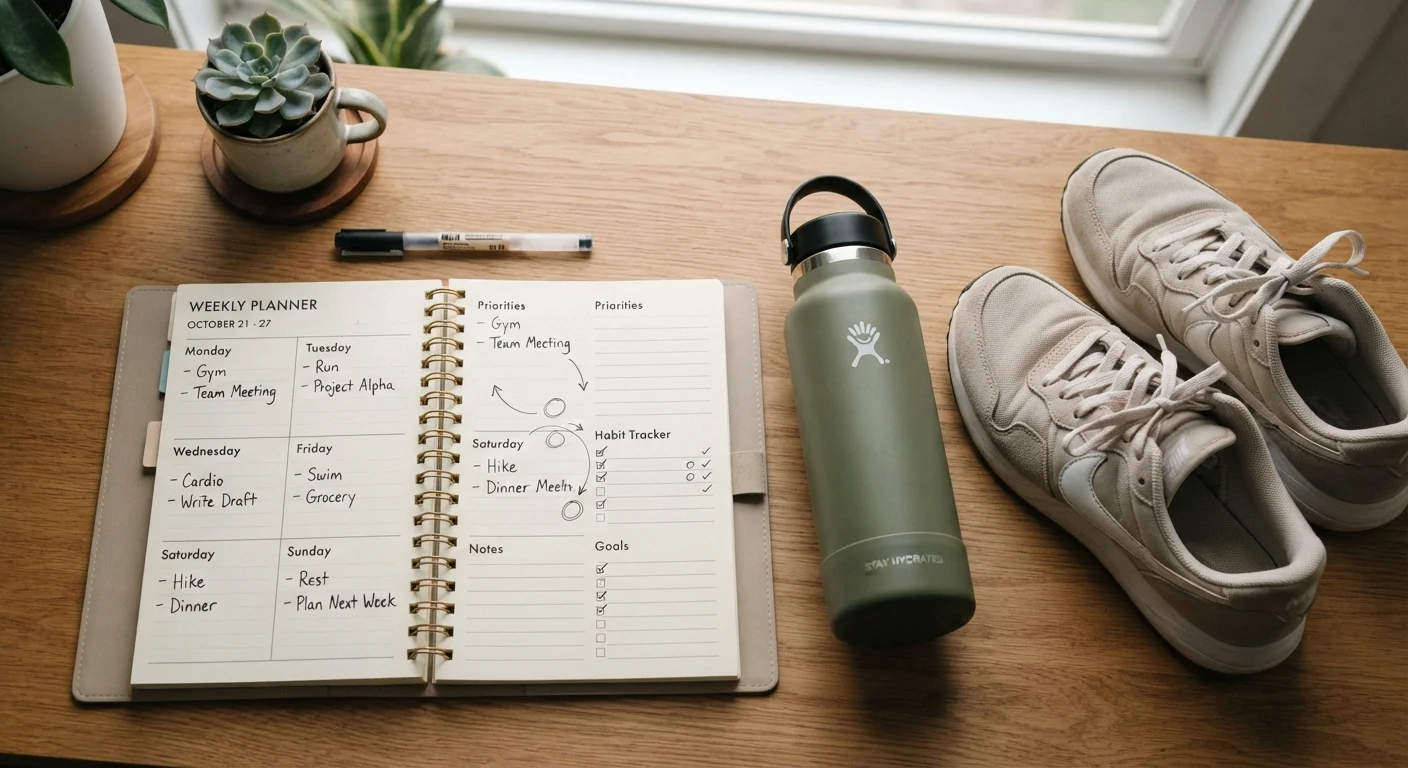
A sample structure might look like: Monday - strength; Wednesday - cardio; Friday - strength; Saturday - active recovery or mobility. For a broader walkthrough of how to balance exercise types across a week, see building a weekly exercise plan that covers all the bases.
Plan explicitly for rest and recovery
Rest days are not gaps in your discipline - they are programmed parts of an effective schedule. Muscle tissue repairs and strengthens during recovery, not during the workout itself. Adequate rest also reduces the risk of overtraining syndrome, a state of accumulated fatigue that can stall progress and increase injury susceptibility.
Schedule at least two full rest days per week, ideally non-consecutive with your hardest sessions. Light activity - a walk, gentle stretching - is entirely appropriate on rest days and supports recovery without adding training stress.
Build in a contingency plan for disrupted weeks
Work deadlines, travel, illness, and family demands will disrupt your schedule - this is not a failure, it's a predictable feature of real life. Prepare for it in advance by identifying your minimum viable week: the fewest sessions and shortest duration that still count as staying active.
For practical strategies that help routines survive real-world disruption, strategies that help fitness routines survive real life offers concrete approaches including habit stacking and minimum effective dose thinking.
The 'Minimum Viable Workout' Rule
On days when time or energy is genuinely short, commit to just 10-15 minutes of movement rather than skipping entirely. A short walk, a brief bodyweight circuit, or a stretching session keeps the habit alive and often leads to doing more once you've started. Consistency of showing up matters more than session length.
Protecting Your Schedule on Weekends and Over Time
Many working adults concentrate their exercise on weekends when work pressure lifts, then struggle to maintain weekday habits. While weekend activity is genuinely valuable, over-relying on it creates fragility - one busy weekend wipes out the week's activity entirely. The weekend routine problem explains how inconsistent weekends can quietly erode the weekday habits you've worked to build.
As your routine matures, expect to adapt it. New projects, life events, and seasonal changes will all require adjustments. That's normal and healthy. Adapting your workout routine across life seasons provides a framework for making those adjustments without losing momentum.
This Is General Information, Not Medical Advice
The guidance in this article is intended for generally healthy adults looking to build sustainable exercise habits. If you have a medical condition, injury, or other health concern, consult a qualified healthcare professional before starting or significantly changing your exercise routine. Special populations - including pregnant individuals, older adults, and those with chronic conditions - should seek personalized professional guidance.
This article provides general health and fitness information for educational purposes only. It is not a substitute for personalized advice from a qualified healthcare or fitness professional.