

Key Takeaways
Option A
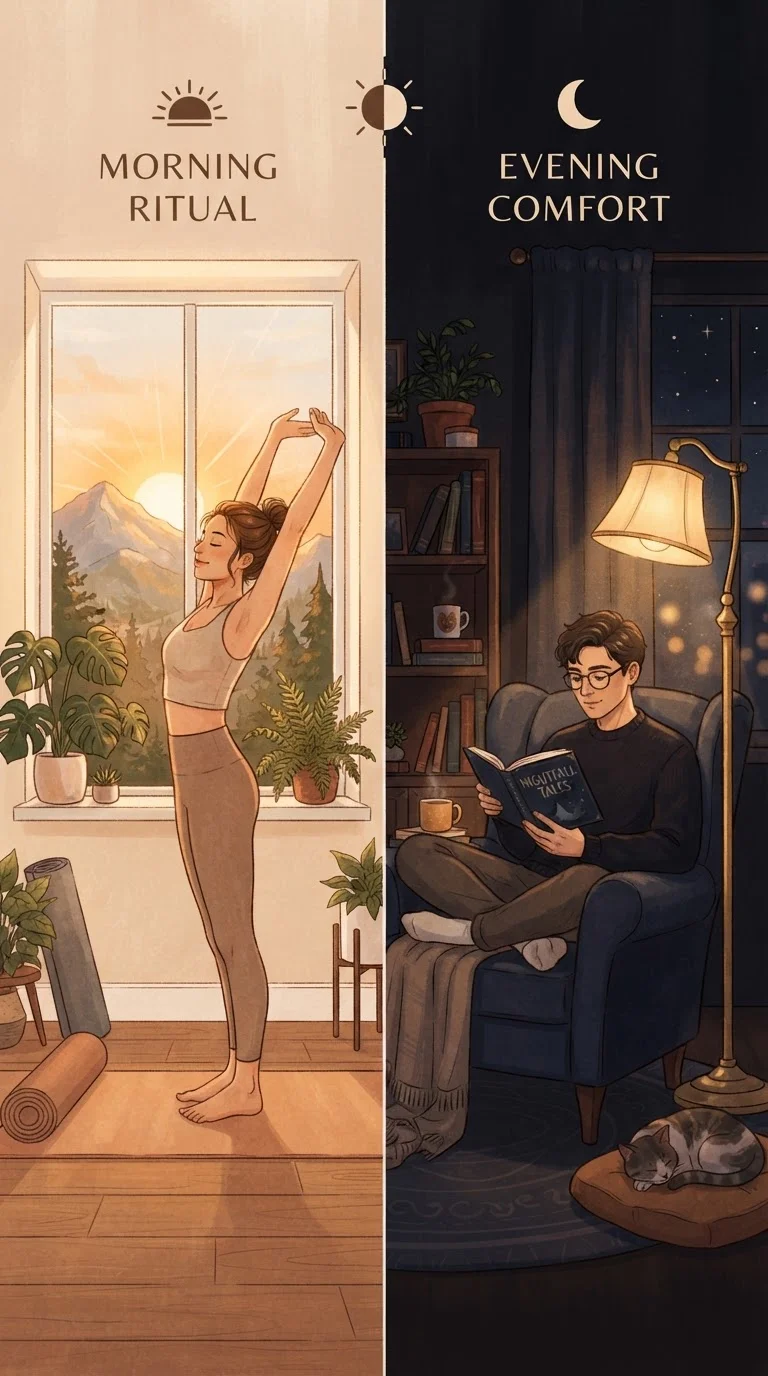
Early Bird (Morning Chronotype)
The naturally early riser aligned with conventional schedules.
Best for: People whose peak alertness, productivity, and energy naturally occur in the morning hours.
Option B
Night Owl (Evening Chronotype)
The late-rising type whose biology runs on a delayed clock.
Best for: People who think more clearly, feel more creative, and perform better in the afternoon and evening.
If your work or family schedule demands early mornings
Early Bird (Morning Chronotype)
Aligning your sleep timing with social obligations reduces chronic sleep debt and the metabolic strain of social jetlag.
If you have schedule flexibility and natural evening energy
Night Owl (Evening Chronotype)
Owls who can honor their biology by sleeping and waking later show no inherent health disadvantage when total sleep is adequate.
If you want to optimize cognitive performance during the day
Early Bird (Morning Chronotype)
Standard work hours align with morning-chronotype peak alertness windows, giving early risers a practical cognitive edge on typical schedules.
If you're an evening type struggling with a 9-to-5 schedule
Night Owl (Evening Chronotype)
Rather than forcing an unnatural schedule, focus on minimizing social jetlag with consistent sleep and wake times, even on weekends.
What Is a Chronotype, and Can You Change It?
A chronotype is your biological preference for sleeping and waking at certain times. It reflects the timing of your internal circadian clock - the roughly 24-hour system that regulates sleep, hormone release, body temperature, and metabolism. As explained in our deep dive on chronotype biology, this trait is substantially influenced by genetics, meaning your preference for mornings or evenings isn't simply a matter of discipline or habit.
Chronotypes exist on a spectrum. Most people fall somewhere in the middle, with a smaller portion at either extreme. Age also plays a role: teenagers and young adults naturally shift toward later sleep timing, while adults tend to shift earlier as they age. This is a normal biological pattern, not a character flaw.
Can you shift your chronotype? Research suggests modest adjustments are possible - particularly through consistent light exposure and sleep scheduling - but dramatic changes against your biology are difficult to sustain long-term.
Head-to-Head: Health Outcomes by Chronotype
Studies examining health outcomes across chronotypes reveal a nuanced picture. Early risers often show advantages in metabolic health, mood stability, and cardiovascular markers - but researchers believe much of this benefit comes from schedule alignment, not the chronotype itself.
| Criterion | Early Bird | Night Owl |
|---|---|---|
| Circadian alignment with standard schedules | Strong alignment | Frequent mismatch |
| Risk of social jetlag | Low | High (on standard hours) |
| Peak alertness window | Mid-morning | Early to mid-afternoon |
| Metabolic health markers | Generally favorable | Less favorable on misaligned schedules |
| Mood and mental health | Slightly more stable on average | More variable; schedule-dependent |
| Flexibility for shift or remote work | Less adaptive to late shifts | Better suited to flexible or late schedules |
| Genetic basis | Substantially heritable | Substantially heritable |
Night owls who are forced to wake early for work or social obligations experience what researchers call social jetlag - a chronic mismatch between their biological clock and their required schedule. This ongoing desynchrony has been associated with higher rates of fatigue, poorer diet quality, increased inflammation, and greater risk for metabolic disturbances, according to research published in peer-reviewed chronobiology journals.
Crucially, when night owls are permitted to sleep and wake on their own schedule - getting equivalent total sleep - many of these health differences narrow significantly. This suggests the issue is less about being a night owl per se, and more about the chronic sleep disruption that results from living in a world built around early schedules.
Sleep Quality, Consistency, and the Role of Light
Regardless of chronotype, sleep consistency - going to bed and waking at roughly the same time each day - is one of the strongest behavioral predictors of sleep quality and overall health. Irregular sleep timing disrupts circadian rhythms even in natural morning types.
Light exposure is the most powerful external cue for resetting your internal clock. Both early birds and night owls can support healthier sleep-wake timing by getting morning sunlight and limiting evening artificial light. Bright morning light suppresses residual melatonin and anchors your wake time, while reducing blue-light exposure after dark helps signal the brain that sleep is approaching.
For a practical breakdown of how light shapes your sleep drive throughout the day, see how light exposure shapes sleep timing.
This article provides general health information and is not a substitute for personalized medical advice. If you experience persistent sleep difficulties, consult a qualified healthcare professional.
Productivity, Exercise Timing, and Practical Takeaways
Peak cognitive performance tracks closely with your chronotype's alertness window. Early birds typically reach peak focus mid-morning, while night owls may not hit their stride until early afternoon or later. If you have schedule flexibility, structuring demanding tasks around your personal alertness peak - rather than the clock - can meaningfully improve output.
Exercise timing follows a similar pattern. Morning and evening workouts each have evidence-backed advantages, and the best time to exercise is largely the time you'll actually do it consistently. Night owls who prefer evening workouts should aim to finish intense sessions at least an hour before bed to avoid delaying sleep onset.
The science-backed bottom line: neither chronotype holds an inherent health advantage. What matters most is total sleep duration, timing consistency, and minimizing the gap between your biological clock and your daily schedule. If you're an early bird by nature, the modern world largely works in your favor. If you're a night owl, protecting your sleep by honoring your timing as much as your schedule allows - and using light strategically - is your most evidence-supported path to better health.
For more on building routines that support your natural rhythms, explore the science behind effective morning routines and practical sleep habit strategies.