

Key Takeaways
Chronotype
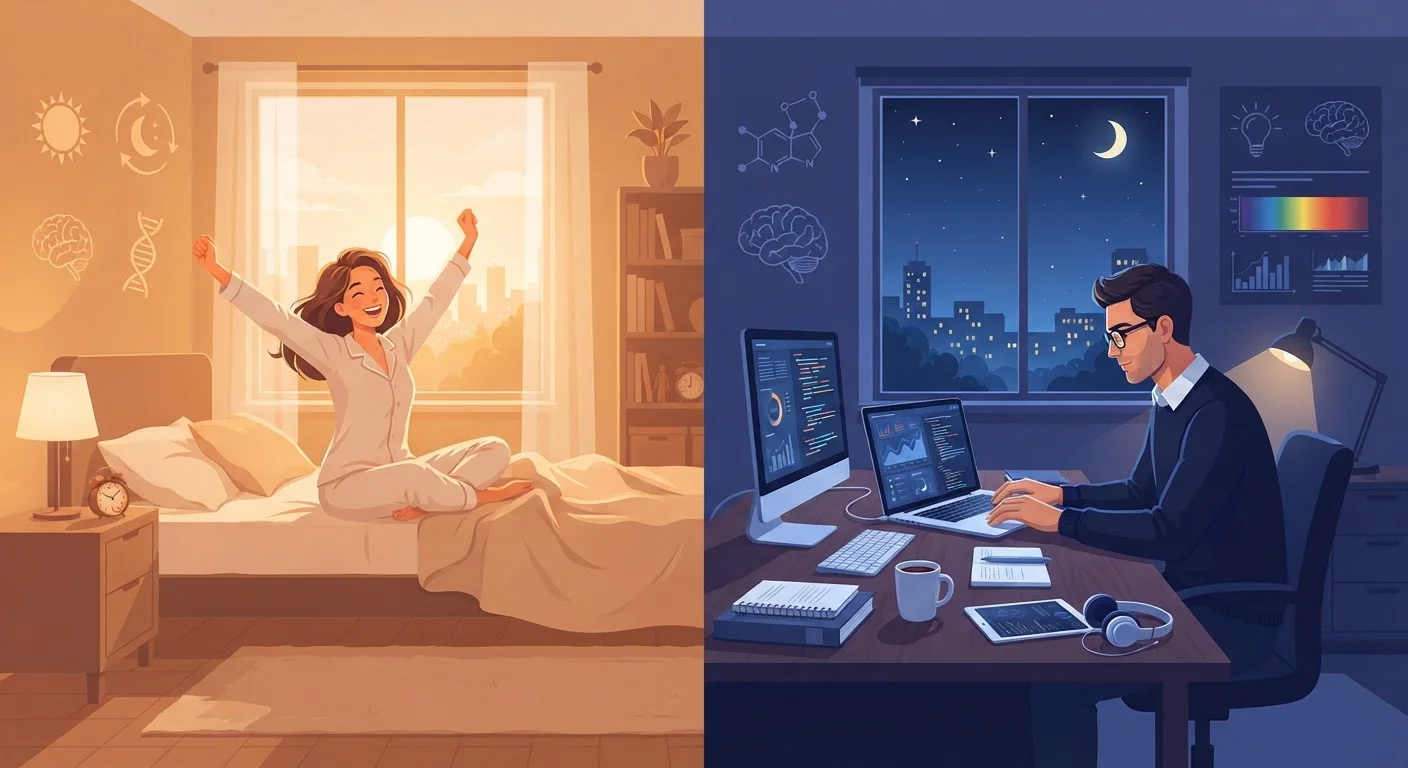
A chronotype is your body's natural preference for when to sleep and wake, driven by your internal biological clock. It determines whether you feel most alert in the morning, the evening, or somewhere in between. Chronotypes exist on a spectrum and are largely determined by genetics and age, not personal choice.
Chronotype is influenced by variants in circadian clock genes — including PER3, CLOCK, and CRY1 — that regulate the timing of the roughly 24-hour circadian cycle governing nearly every physiological process.
What Drives Your Internal Clock
Every person carries an internal timekeeping system — the circadian clock — that coordinates sleep, hormone release, body temperature, metabolism, and dozens of other functions across a roughly 24-hour cycle. The master pacemaker sits in a small region of the brain called the suprachiasmatic nucleus (SCN), located in the hypothalamus. It receives light signals directly from the retina and uses them to keep biological timing aligned with the external day-night cycle.
But the SCN doesn't operate identically in every person. Genetic variation in core clock genes — most notably PER1, PER2, PER3, CLOCK, and CRY1 — alters the natural period and phase of this internal clock. A slightly longer intrinsic cycle often correlates with an evening preference; a shorter one tilts toward morningness. These differences are inherited and largely stable across adulthood. Light exposure plays a critical role in anchoring — or misaligning — these genetically tuned clocks each day.
The Chronotype Spectrum — and Where Most People Fall
Chronotypes are not a binary choice between "morning person" and "night owl." Research consistently shows a normal distribution, with most people clustered near an intermediate type — neither strongly early nor strongly late. Extreme chronotypes at either end of the spectrum are less common but well-documented.
~25%
Population with clear morning chronotype
Research using large population datasets estimates roughly 25% of adults are clear morning types, with a similar proportion being clear evening types and the majority falling in between.
1–2 hours
Typical social jetlag in evening chronotypes
Studies using the Munich Chronotype Questionnaire have found evening types commonly experience one to two hours of social jetlag on workdays compared to their free-day sleep timing.
19–21
Peak age of eveningness
Large-scale chronotype research published in sleep science journals identifies the late teens to early twenties as the developmental peak of evening preference across the lifespan.
Sleep researchers use the concept of sleep timing — specifically the midpoint of sleep on free days — as the most objective marker of chronotype. Someone whose natural sleep window runs from midnight to 8 a.m. has a later chronotype than someone who naturally sleeps from 10 p.m. to 6 a.m., even if total sleep duration is identical.
Age is one of the strongest non-genetic modulators of chronotype. Children tend toward morningness. Chronotype shifts progressively later through adolescence and peaks in eveningness around ages 19–21. It then gradually reverses, with older adults often becoming the earliest risers of all. Hormonal changes during puberty appear to drive the adolescent delay, though the precise mechanisms are still being studied.
Social Jetlag: When Your Biology Clashes With the Clock
Modern society runs on a morning-oriented schedule — early work shifts, school start times, and cultural norms that reward rising early. For people with intermediate or morning chronotypes, this alignment is relatively seamless. For evening types, it creates a chronic state researchers call social jetlag: a weekly mismatch between biological sleep timing and socially required wake times.
Social jetlag is measured in hours — the difference between your natural sleep midpoint on free days versus work days. Studies have linked higher levels of social jetlag to disrupted sleep architecture, daytime sleepiness, poorer mood regulation, and associations with metabolic and cardiovascular risk factors. Importantly, these effects appear to stem from the misalignment itself, not from the evening chronotype alone.
Understanding this distinction matters. Evening types are not simply undisciplined or unhealthy by nature. When their schedules allow alignment with their biology, many of the associated health disadvantages diminish. Comparing chronotype health outcomes requires accounting for social jetlag as a confounding variable.
Can You Shift Your Chronotype — and Should You Try?
Behavioral and environmental strategies can nudge chronotype timing by one to two hours in many people, though they cannot fundamentally rewire genetic predispositions. The most evidence-backed levers include:
- Morning light exposure: Bright light — especially natural sunlight — shortly after waking advances the circadian phase, making it easier to wake and feel alert earlier. Strategic light timing is one of the most powerful tools available.
- Consistent sleep and wake times: Maintaining a regular schedule seven days a week, including weekends, reinforces circadian anchoring and reduces social jetlag.
- Evening light reduction: Limiting bright and blue-spectrum light in the two hours before bed delays melatonin suppression and supports earlier sleep onset.
- Meal and activity timing: Eating and exercising at consistent, earlier times provides secondary circadian cues that complement light-driven phase shifts.
These strategies are most effective when applied consistently and with realistic expectations. Anyone considering significant schedule changes — especially those with sleep disorders, shift work demands, or underlying health conditions — should consult a qualified healthcare provider or sleep specialist. The circadian science behind morning routines explains how consistent timing habits interact with biology over time.
This article is for general informational and educational purposes only and does not constitute medical advice. Consult a qualified healthcare professional for guidance specific to your health needs.