

Key Takeaways
Start here
Why Sleep Deserves Your Attention
Build foundation
How Sleep Actually Works
Take action
Behavioral Habits That Support Consistent Rest
Optimize your space
Your Sleep Environment: What to Adjust First
Know your limits
When to Seek Professional Guidance
Why Sleep Deserves Your Attention
Sleep is often the first thing sacrificed when life gets busy - and one of the last things people think to improve when their health feels off. Yet the research case for prioritizing sleep is as strong as it is for diet or physical activity. During sleep, your body carries out essential repair processes: muscle tissue is rebuilt, immune responses are consolidated, and the brain clears metabolic waste products that accumulate during waking hours.
Poor sleep quality is associated with a wide range of health concerns, from impaired concentration and mood instability to longer-term risks for cardiovascular and metabolic health. This doesn't mean a single bad night causes lasting harm - it means that chronic, ongoing sleep disruption matters in ways that compound over time. Understanding that sleep is an active, productive state - not simply the absence of being awake - is the starting point for taking it seriously. For a deeper look at the physiology involved, see the complete guide to sleep science.
How Sleep Actually Works
Sleep is organized into repeating cycles, each lasting roughly 90 minutes and consisting of distinct stages. Early in the night, deeper slow-wave sleep dominates - this is the phase most associated with physical restoration and immune function. Later cycles include more REM sleep, the stage closely linked to memory consolidation, emotional processing, and creativity.
Your sleep timing is governed largely by two biological systems: the circadian rhythm (an internal roughly-24-hour clock synchronized by light exposure) and sleep pressure (a drive that builds the longer you stay awake). When these two systems are well-aligned - meaning you sleep and wake at consistent times and get adequate light exposure during the day - falling asleep and staying asleep becomes easier. Disrupting either system, through irregular schedules, jet lag, shift work, or late-night light exposure, can throw off the whole process.
Circadian rhythm
Your body's internal roughly-24-hour clock that regulates sleep timing, hormone release, and other biological processes, primarily synchronized by light and darkness.
Sleep pressure
The biological drive to sleep that accumulates the longer you stay awake, created by the buildup of adenosine (a chemical byproduct of brain activity) in the brain.
REM sleep
Rapid Eye Movement sleep - a stage characterized by vivid dreaming and heightened brain activity, strongly associated with memory consolidation and emotional regulation.
Slow-wave sleep
The deepest stage of non-REM sleep, during which physical restoration, immune function, and growth hormone release are most active.
Melatonin
A hormone produced by the pineal gland in response to darkness that signals to your body it is time to prepare for sleep. Light exposure, especially blue-spectrum light, suppresses its release.
Sleep hygiene
A collection of behavioral and environmental habits - like consistent sleep times, a cool dark room, and limiting stimulants - that collectively support better sleep quality.
Understanding these mechanics helps explain why behavioral strategies work. You're not just following arbitrary rules; you're working with your biology rather than against it.
Behavioral Habits That Support Consistent Rest
The single most evidence-supported behavioral change for sleep is maintaining a consistent wake time - even on weekends. A fixed wake time anchors your circadian rhythm and helps regulate sleep pressure so that fatigue arrives at the right time each night. From there, a short wind-down routine in the 30-60 minutes before bed signals to your nervous system that the day is ending.
- Limit stimulating activities close to bed - intense exercise, work tasks, and engaging screen content all activate alertness systems that take time to quiet.
- Reduce alcohol in the evening. While alcohol may help you fall asleep faster initially, it fragments sleep in the second half of the night and suppresses REM sleep.
- Manage evening light exposure. Dimming indoor lighting and minimizing blue-spectrum screen light in the final hour before bed supports natural melatonin rise.
- Use relaxation techniques such as slow breathing, progressive muscle relaxation, or light stretching to ease the transition to sleep. These practices also support stress management - see everyday stress management strategies for complementary approaches.
No single habit works in isolation. The goal is to build a consistent system that your body comes to recognize as the nightly path toward rest. For how sleep fits into a broader daily routine, the daily habits guide offers useful context.
Start With Your Wake Time, Not Your Bedtime
Most people try to fix sleep by going to bed earlier, but sleep researchers typically recommend anchoring your schedule from the wake-up end first. Pick a consistent wake time you can keep every day - including weekends - and work backward to determine when you need to wind down. This approach steadily aligns your internal clock without forcing sleep before your body is ready.
Your Sleep Environment: What to Adjust First
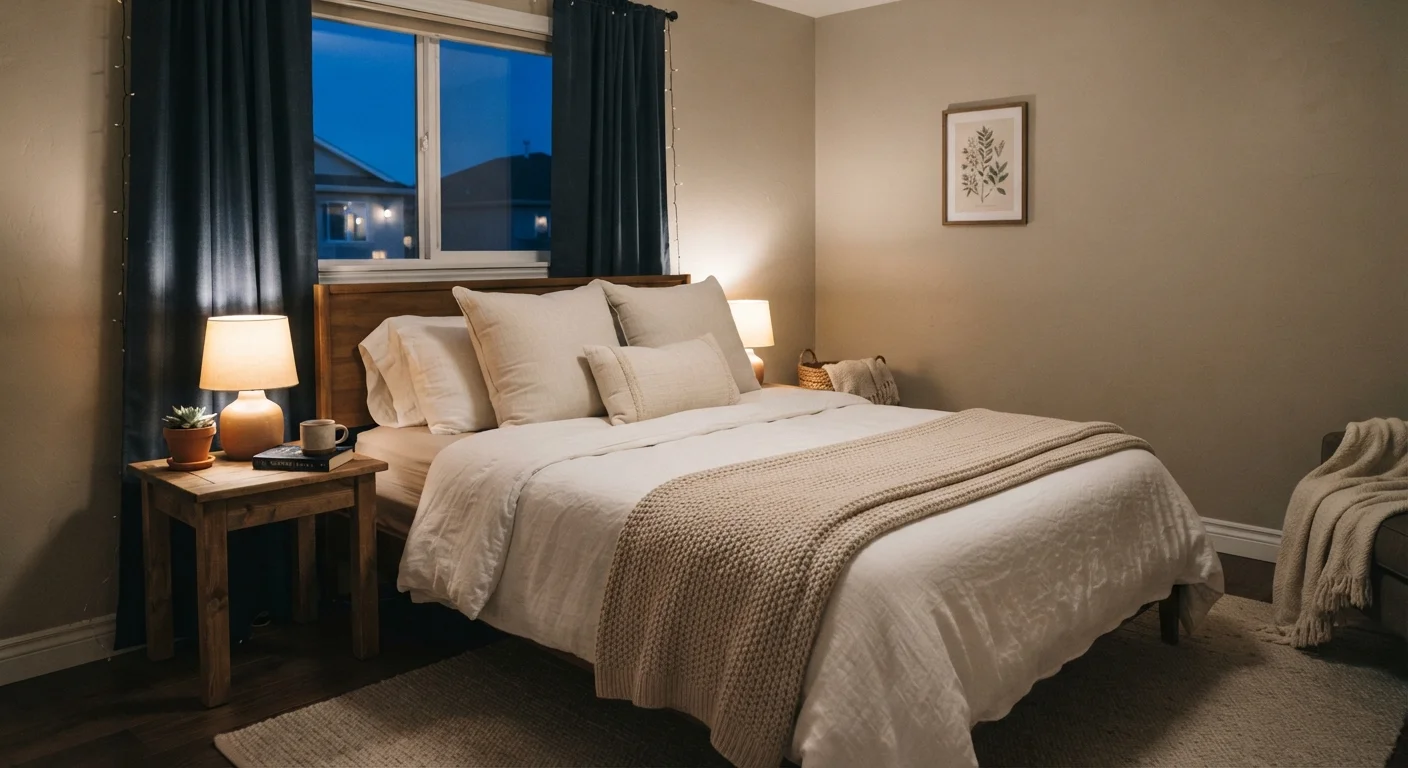
Your bedroom environment sends continuous signals to your brain about whether sleep is appropriate. Three factors have the strongest research backing: light, temperature, and noise.
- Light
- Even low levels of light during sleep can affect sleep depth and duration. Blackout curtains or a sleep mask are among the simplest environmental investments you can make.
- Temperature
- Core body temperature naturally drops as you fall asleep. A cooler room - most sleep researchers point to the low-to-mid 60s °F range as a general guideline - supports this process. Exact comfort varies by individual.
- Noise
- Intermittent noise is more disruptive than consistent background sound. White noise or earplugs can help mask unpredictable disturbances without forcing complete silence.
For a structured audit of your sleep space, the bedroom environment checklist walks through each factor in detail. These environmental adjustments complement the better sleep habits hub, where you'll find additional practical routines.
When to Seek Professional Guidance
Behavioral and environmental strategies cover a lot of ground, but they have limits. If you've consistently applied good sleep habits for several weeks and still struggle to fall asleep, stay asleep, or feel rested, that's a signal worth taking seriously.
Certain symptoms - loud or irregular snoring, waking with gasping or choking, uncontrollable urges to move your legs at night, or falling asleep unintentionally during the day - may point to a sleep disorder that no amount of bedroom optimization will resolve on its own. These conditions are diagnosable and treatable, but they require professional evaluation. The complete overview of sleep disorders explains what these conditions look like and how they are typically approached.
Sleep also intersects with mental health in important ways. Chronic sleep difficulty can both reflect and worsen anxiety, depression, and other conditions - another reason professional input matters when self-directed strategies aren't enough. Practices from mindfulness and mental wellness may serve as useful complements to professional care, not replacements for it.
This article is for general informational purposes only and does not constitute medical advice. If you have concerns about your sleep or health, please consult a qualified healthcare professional.