

Key Takeaways
Why Sleep Is a Biological Imperative
Sleep is not passive downtime. It is an active, highly regulated biological state that the brain and body depend on to survive and function. Research consistently shows that chronic insufficient sleep is associated with impaired cognition, weakened immune response, metabolic dysregulation, and increased cardiovascular risk — consequences that accumulate with even modest nightly deficits.
Every living animal studied shows some form of sleep or sleep-like behavior, suggesting evolutionary pressure to preserve it. In humans, the functions of sleep span memory consolidation, cellular repair, hormone secretion, emotional regulation, and waste clearance in the brain via the glymphatic system — a network of fluid-filled channels that becomes most active during sleep. Understanding this foundation clarifies why sleep cannot simply be substituted with rest or compensated for on weekends.
The Two Systems That Drive Sleep
Sleep timing and intensity are regulated by two interacting biological mechanisms that researchers describe as Process C (the circadian system) and Process S (homeostatic sleep pressure).
Process C: The Circadian Clock
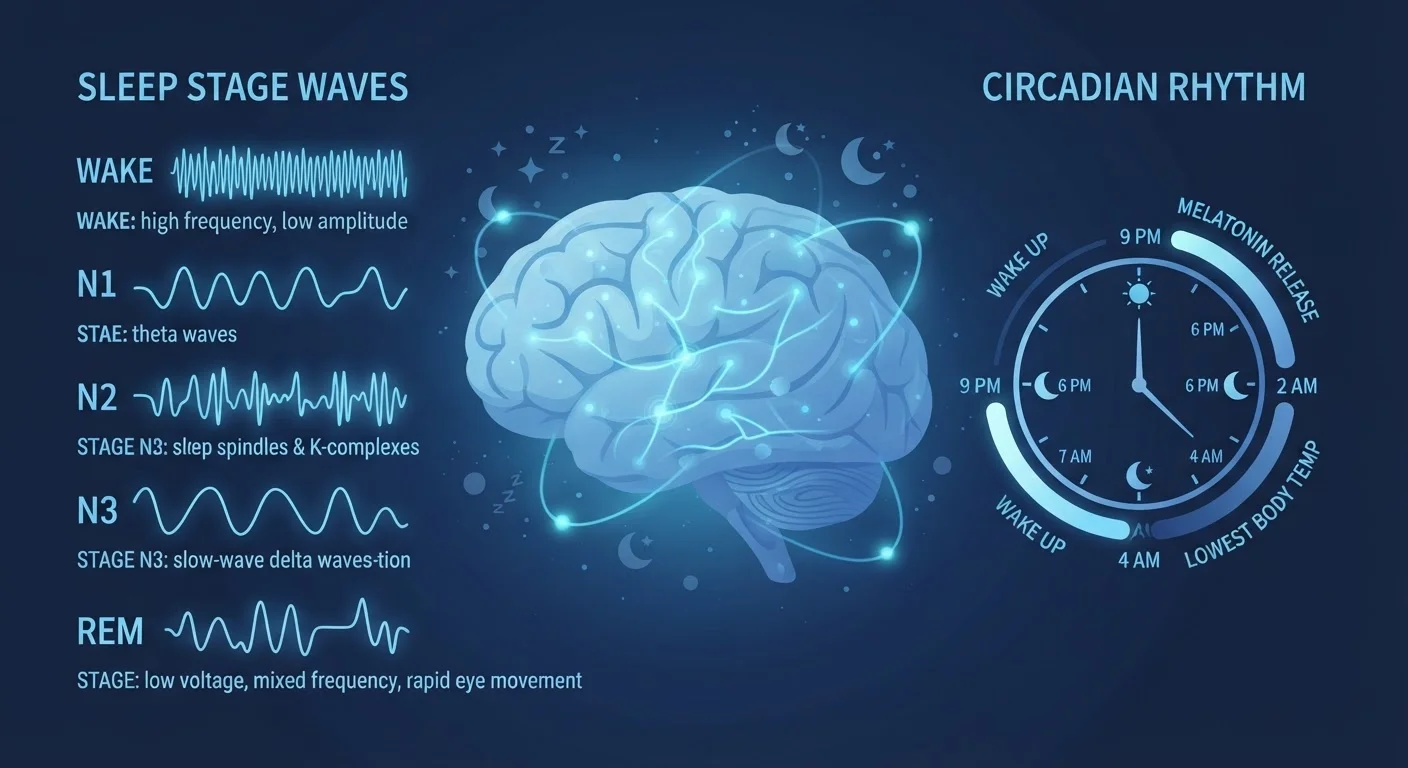
Nearly every cell in the body contains molecular clock machinery tied to a roughly 24-hour cycle. The master pacemaker, located in the suprachiasmatic nucleus (SCN) of the hypothalamus, synchronizes these peripheral clocks primarily using light as its time cue. When light hits the retina, the SCN suppresses melatonin production and promotes wakefulness. As light fades in the evening, melatonin rises, signaling the body to prepare for sleep.
Process S: Homeostatic Sleep Pressure
Simultaneously, the brain accumulates a metabolic byproduct called adenosine throughout every waking hour. Adenosine binds to receptors in the brain and progressively increases the drive to sleep — this is why the longer you stay awake, the harder it becomes to resist sleep. During sleep, adenosine is cleared, and wakefulness pressure resets. Caffeine works by temporarily blocking adenosine receptors, masking — but not eliminating — the accumulated sleep debt.
Anchor your wake time first, not your bedtime. A consistent morning alarm trains the circadian clock more reliably than trying to fall asleep at a fixed hour.
Circadian research shows the morning light signal is the primary zeitgeber (time-giver) that resets the SCN daily — making wake time the most powerful lever for clock stability.
If you use caffeine, consider stopping intake by early afternoon. Caffeine's half-life is approximately five to six hours, meaning afternoon consumption can still meaningfully impair sleep onset at night.
Because caffeine blocks adenosine receptors rather than eliminating accumulated adenosine, late intake masks sleep pressure without clearing it, potentially degrading both sleep quality and next-day alertness.
Sleep Stages and Their Functions
A full night of sleep consists of multiple 90-minute cycles, each containing distinct stages that serve different physiological purposes. For a detailed breakdown of each stage and what happens within them, see The Architecture of a Night's Sleep.
NREM Sleep (Stages N1, N2, N3)
- N1 (light sleep): The transition from wakefulness. Brain activity slows and muscles may twitch. Easily disrupted.
- N2 (consolidated sleep): Heart rate and body temperature drop. Sleep spindles — bursts of neural activity — appear and are thought to support memory consolidation.
- N3 (slow-wave or deep sleep): The most physically restorative stage. Growth hormone is secreted, tissue repair occurs, and the immune system is bolstered. Slow, high-amplitude delta waves dominate brain activity.
REM Sleep
Rapid Eye Movement sleep is characterized by near-total muscle paralysis and intense brain activity resembling wakefulness. This is when most vivid dreaming occurs. REM is critical for emotional memory processing, creativity, and learning. Its proportion increases in later sleep cycles — a reason that cutting sleep short disproportionately reduces REM.
Hormones and Neurochemicals Involved in Sleep
Sleep is orchestrated by a precise interplay of hormones and neurotransmitters. Disrupting any one of them can cascade into broader sleep problems.
| Substance | Role in Sleep |
|---|---|
| Melatonin | Signals darkness and onset of sleep window; does not induce sleep directly |
| Adenosine | Builds homeostatic sleep pressure throughout waking hours |
| Cortisol | Rises in early morning to promote wakefulness; chronic elevation disrupts sleep onset |
| Growth Hormone | Released predominantly during slow-wave sleep; drives tissue repair and metabolism |
| Serotonin | Precursor to melatonin; supports mood and sleep-wake transitions |
| GABA | Inhibitory neurotransmitter that quiets neural activity to enable sleep onset |
What Disrupts Healthy Sleep Physiology
Modern life introduces multiple inputs that interfere directly with the biological systems described above.
Artificial Light Exposure
Blue-wavelength light from screens and overhead lighting suppresses melatonin production with particular effectiveness. Exposure in the two hours before bed has been shown in laboratory studies to delay sleep onset and reduce total REM sleep.
Irregular Sleep Schedules
Shifting bedtime and wake times — common on weekends — creates a mismatch between the circadian clock and actual sleep timing, sometimes called social jet lag. This misalignment impairs cognitive performance and metabolic health independent of total sleep time.
Alcohol
Although alcohol may accelerate sleep onset, it fragments sleep architecture significantly. It suppresses REM sleep in the first half of the night and causes rebound wakefulness in the second half as the body metabolizes it.
Chronic Stress and Elevated Cortisol
Persistent psychological stress sustains elevated cortisol levels into the evening, directly opposing the physiological drop in core body temperature and cortisol that the body requires to transition into sleep. This creates a cycle where poor sleep worsens stress reactivity the following day.
Sleep Debt Does Not Fully Resolve Overnight
The idea that weekend 'catch-up sleep' erases accumulated weekday deficits is not supported by current evidence. While extra sleep may reduce subjective sleepiness temporarily, research suggests that cognitive impairments from chronic sleep restriction can persist beyond a single recovery night. Consistently meeting nightly sleep needs remains the most protective approach.
Applying Sleep Science to Everyday Life
Understanding the underlying physiology provides a rational basis for sleep hygiene recommendations that might otherwise seem arbitrary. Dimming lights in the evening protects melatonin production. Consistent wake times anchor the circadian clock. Avoiding alcohol near bedtime preserves sleep architecture. Managing stress through structured wind-down routines reduces cortisol interference.
For practical strategies grounded in the same evidence base, the Better Sleep Habits hub offers routines and lifestyle adjustments aligned with current sleep research. These recommendations intersect meaningfully with nutrition and exercise habits covered in Daily Habits Supported by Sleep Research, Nutrition Science, and Exercise Physiology. Readers building broader wellness foundations will also find the Sleep & Recovery hub a useful reference for integrating rest with overall health.
If you experience persistent difficulty sleeping — including chronic insomnia, excessive daytime sleepiness, or suspected sleep disorders — consult a qualified healthcare professional. This article provides general educational information and is not a substitute for personalized medical evaluation or treatment.
This article is for informational purposes only and does not constitute medical advice. Always consult a licensed healthcare provider for diagnosis, treatment, or questions about a medical condition.