

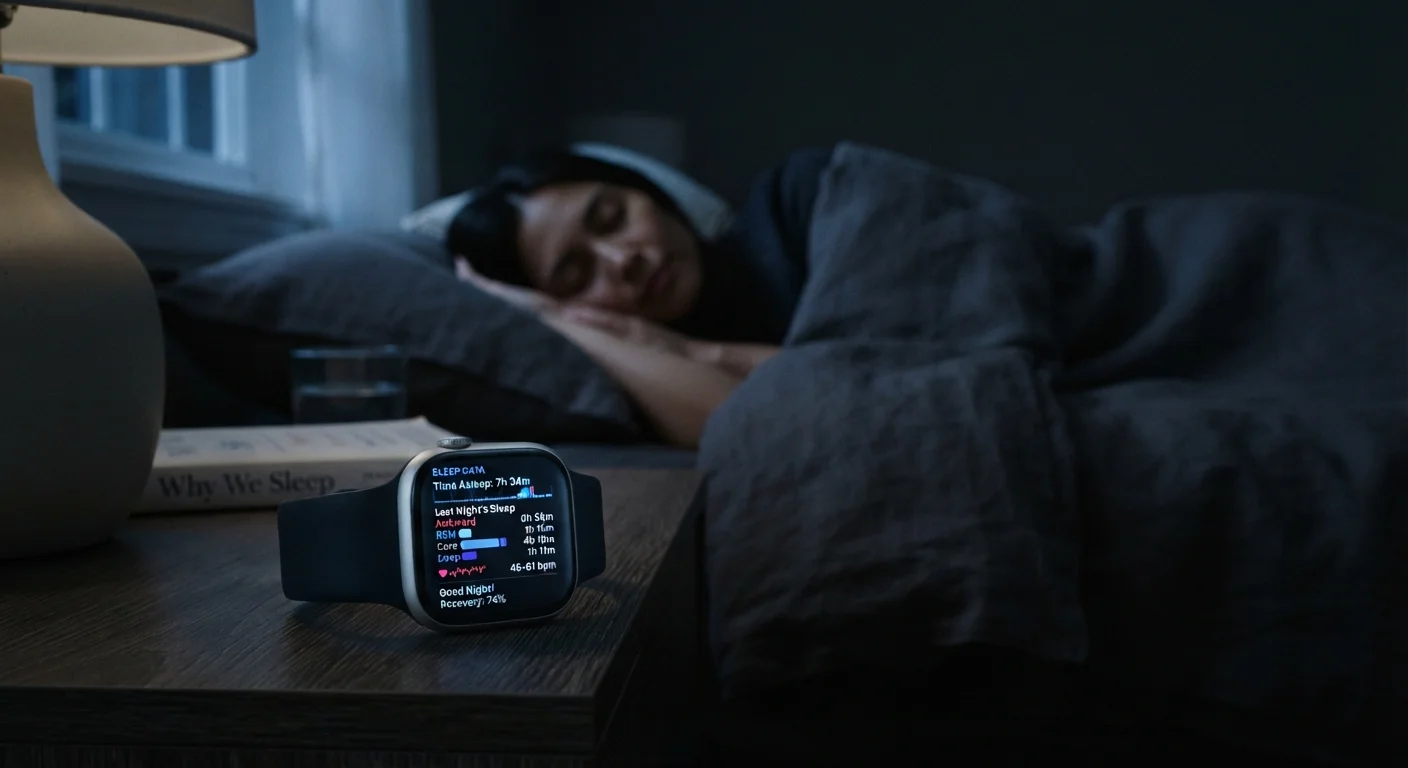
Key Takeaways
Tracks total sleep duration consistently over time
Even if stage estimates are imprecise, most trackers reliably log when you were in bed and broadly when you were asleep, making them useful for monitoring whether you're meeting duration goals.
Reveals behavioral patterns across days and weeks
Longitudinal data can surface correlations between lifestyle factors - like alcohol, exercise timing, or screen use - and sleep quality that are hard to perceive in real time.
Motivates consistency through habit awareness
Seeing your sleep and wake times charted over a month can provide concrete feedback that encourages a more regular schedule, which is one of the strongest levers for sleep quality.
Detects nighttime heart rate and recovery trends
Resting heart rate and heart rate variability during sleep are reasonably well-measured by optical sensors and can reflect overall recovery, stress load, and illness before symptoms appear.
Provides useful context for healthcare conversations
A weeks-long export of sleep data gives a clinician broader context than a patient's memory alone, potentially flagging patterns worth clinical follow-up.
Sleep stage classification is often inaccurate
Without EEG data, trackers infer REM, deep, and light sleep from indirect signals. Studies comparing wearables to polysomnography have found meaningful discrepancies, particularly in deep sleep detection.
Tends to overestimate total sleep time
Lying still while awake can register as light sleep, causing trackers to inflate sleep totals. This matters if you're trying to accurately gauge whether you're meeting recommended sleep hours.
Cannot diagnose sleep disorders
Conditions like sleep apnea, restless legs syndrome, or narcolepsy require clinical evaluation. A tracker may flag disrupted sleep but cannot identify its cause or severity.
Risk of orthosomnia - tracker-induced sleep anxiety
Focusing heavily on sleep scores can create performance pressure around sleep itself, paradoxically making it harder to fall and stay asleep. This is a well-documented concern among sleep researchers.
Algorithm transparency is limited
Most manufacturers do not publish the exact methods their algorithms use to classify sleep, making independent validation difficult and preventing users from fully understanding what the data represents.
Our Verdict
Consumer sleep trackers offer genuine value as pattern-recognition tools, helping you spot trends in sleep duration, consistency, and disruptions over weeks and months. However, their ability to accurately classify sleep stages or detect clinical disorders is limited. They are useful lifestyle aids, not diagnostic instruments.
Sleep trackers are best for people who want to build awareness of their sleep habits and identify behavioral patterns - not for those seeking medical-grade sleep analysis or a diagnosis.
How Consumer Sleep Trackers Actually Work
Most wearable sleep trackers - whether worn on the wrist or clipped to a finger - rely primarily on two signals: accelerometry (movement detection) and photoplethysmography (optical heart rate sensing). Some higher-end devices also incorporate skin temperature and blood oxygen saturation. Using these inputs, proprietary algorithms estimate when you fell asleep, when you woke, and what sleep stages you cycled through.
This is fundamentally different from how sleep is measured in a clinical setting. A formal sleep study, known as polysomnography, records brain electrical activity via electroencephalography (EEG) - the true gold standard for identifying sleep stages. Consumer trackers have no access to brain wave data, so all stage classification is inferred, not directly observed. If you want a deeper look at what clinical measurement actually captures, see what polysomnography actually measures.
What Sleep Trackers Do Well
Despite their technical limitations, consumer trackers offer real-world value in several areas.
Tracks total sleep duration consistently over time
Even if stage estimates are imprecise, most trackers reliably log when you were in bed and broadly when you were asleep, making them useful for monitoring whether you're meeting duration goals.
Reveals behavioral patterns across days and weeks
Longitudinal data can surface correlations between lifestyle factors - like alcohol, exercise timing, or screen use - and sleep quality that are hard to perceive in real time.
Motivates consistency through habit awareness
Seeing your sleep and wake times charted over a month can provide concrete feedback that encourages a more regular schedule, which is one of the strongest levers for sleep quality.
Detects nighttime heart rate and recovery trends
Resting heart rate and heart rate variability during sleep are reasonably well-measured by optical sensors and can reflect overall recovery, stress load, and illness before symptoms appear.
Provides useful context for healthcare conversations
A weeks-long export of sleep data gives a clinician broader context than a patient's memory alone, potentially flagging patterns worth clinical follow-up.
The most meaningful benefit is longitudinal pattern detection. A single night's data tells you little, but several weeks of data can reveal that you consistently sleep less on worknights, that late meals correlate with more restless sleep, or that your resting heart rate is elevated on days you're under deadline pressure. These patterns are genuinely useful behavioral insights.
Where the Data Falls Short
Understanding the limitations of sleep tracker data is just as important as knowing what it can offer.
Sleep stage classification is often inaccurate
Without EEG data, trackers infer REM, deep, and light sleep from indirect signals. Studies comparing wearables to polysomnography have found meaningful discrepancies, particularly in deep sleep detection.
Tends to overestimate total sleep time
Lying still while awake can register as light sleep, causing trackers to inflate sleep totals. This matters if you're trying to accurately gauge whether you're meeting recommended sleep hours.
Cannot diagnose sleep disorders
Conditions like sleep apnea, restless legs syndrome, or narcolepsy require clinical evaluation. A tracker may flag disrupted sleep but cannot identify its cause or severity.
Risk of orthosomnia - tracker-induced sleep anxiety
Focusing heavily on sleep scores can create performance pressure around sleep itself, paradoxically making it harder to fall and stay asleep. This is a well-documented concern among sleep researchers.
Algorithm transparency is limited
Most manufacturers do not publish the exact methods their algorithms use to classify sleep, making independent validation difficult and preventing users from fully understanding what the data represents.
Research published in peer-reviewed sleep journals has consistently found that consumer wearables tend to overestimate total sleep time and struggle to accurately distinguish light sleep from wakefulness. Deep sleep and REM stage detection carries meaningful error rates compared to EEG-based measurement. This doesn't make trackers useless - it means you should treat stage breakdowns as rough estimates rather than precise physiological readouts.
When to See a Doctor Instead of Checking Your App
If you consistently wake unrefreshed, snore loudly, experience morning headaches, or feel excessively sleepy during the day despite adequate time in bed, these are symptoms that warrant a conversation with a healthcare provider - not a tracker optimization. Consumer devices are not equipped to rule out conditions like obstructive sleep apnea, which affects millions of Americans and requires clinical testing to diagnose and treat safely.
Using Tracker Data Constructively
The most effective approach treats your tracker as a behavioral mirror, not a medical device. Here are practical ways to extract real value from the data:
- Track trends, not nightly scores. Look at weekly or monthly averages rather than fixating on any single night's reading.
- Cross-reference with how you feel. If your tracker says you slept well but you feel exhausted, trust your body. If it flags a poor night and you feel fine, don't catastrophize.
- Use it to test habits. Wondering if a consistent bedtime makes a difference? Run a two-week comparison and let the data guide reflection.
- Bring patterns to your doctor. Exporting several weeks of data can help a clinician spot red flags worth investigating - but it's context, not diagnosis.
For a low-tech complement to wearable tracking, keeping a sleep diary adds subjective context that trackers miss: mood, stress level, caffeine timing, and perceived sleep quality - all useful inputs your wrist sensor can't capture.
It's also worth noting that tracker dependency can become counterproductive. Some people develop heightened sleep anxiety - sometimes called orthosomnia - when they become preoccupied with achieving perfect sleep scores. If you notice your tracker data increasing rather than reducing stress, stepping back from nightly reviews may serve your sleep better. See how similar dynamics play out with fitness wearables in our look at activity tracker habits that quietly undermine your progress.
This article is for general informational purposes only and does not constitute medical advice. If you have concerns about your sleep health, please consult a qualified healthcare professional.