

Key Takeaways
Our Verdict
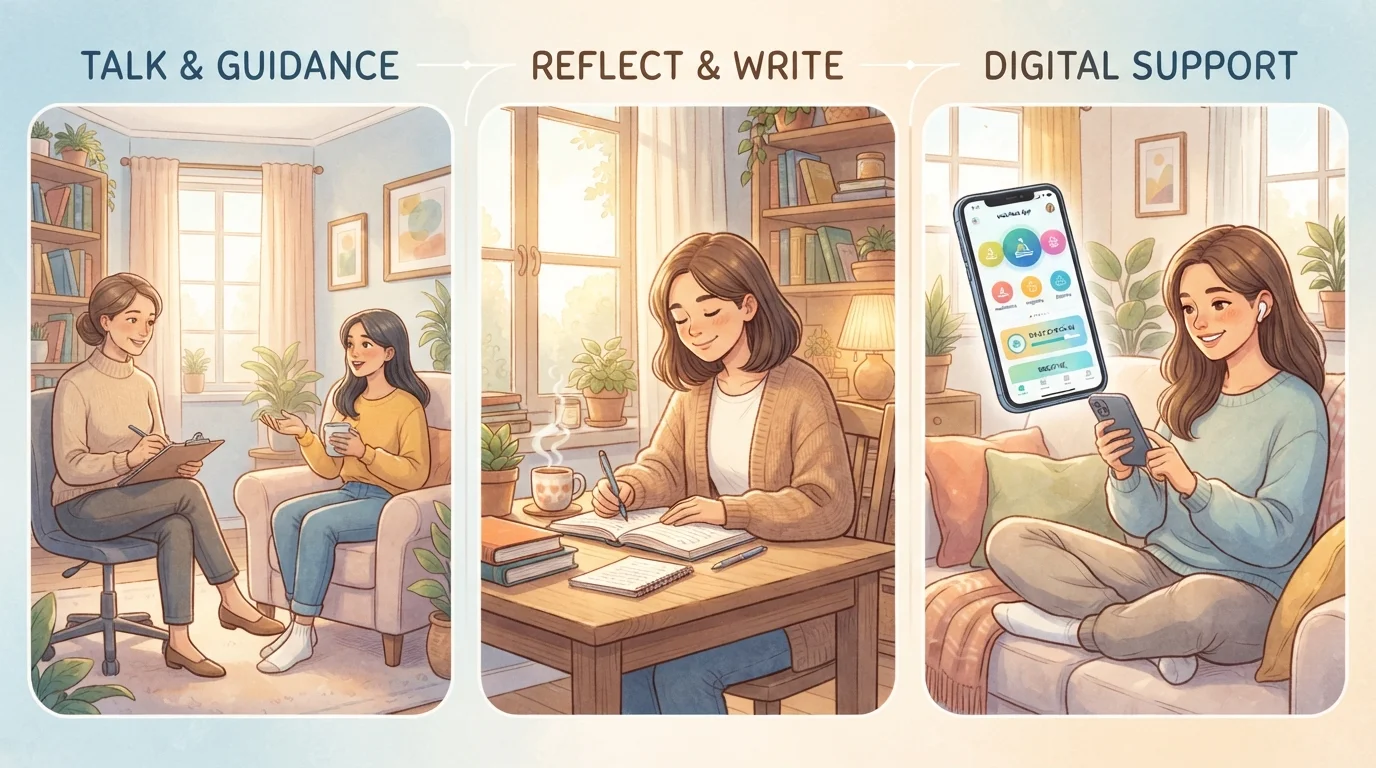
No single approach wins across every situation. Therapy carries the strongest evidence base for significant or chronic stress, while self-help practices offer sustainable daily habits at little to no cost. Digital tools fill genuine access gaps but work best as complements rather than standalone solutions. The most effective plan is usually the one that matches your current needs, resources, and capacity for follow-through.
| Best for | Recommended |
|---|---|
| Those dealing with persistent, complex, or clinical-level stress and anxiety | Professional Therapy |
| Those seeking low-cost, flexible daily habits they can build independently | Self-Help Approaches |
| Those with limited access to in-person care or needing on-demand support | Digital Tools |
| Those managing everyday stress who want the strongest overall outcomes | A Combined Approach |
Why the Approach You Choose Matters
Stress is one of the most common health complaints among American adults, yet the path to managing it looks different for everyone. Some people thrive with weekly therapy sessions. Others build real resilience through daily journaling, breathwork, or exercise. And a growing number turn to apps for on-demand guidance they can access any time of day.
The challenge isn't a shortage of options - it's knowing which approach fits your situation. Each method has a distinct evidence base, a different cost profile, and practical trade-offs worth understanding before you invest time and energy. This comparison is designed to give you a clear, honest picture of what therapy, self-help, and digital tools each offer - and where each one falls short. For a broader orientation, see our grounded starting point for everyday stress management.
Professional Therapy: The Strongest Evidence Base
When stress crosses into chronic territory - interfering with sleep, relationships, work, or physical health - professional therapy is generally the most rigorously supported intervention. Cognitive Behavioral Therapy (CBT), in particular, has decades of research behind it demonstrating its effectiveness for stress, anxiety disorders, and related conditions. Acceptance and Commitment Therapy (ACT) and mindfulness-based therapies also have meaningful evidence supporting their use.
What therapy offers that other approaches cannot is personalization. A licensed therapist can identify patterns in your thinking and behavior that fuel stress, help you develop targeted coping strategies, and adjust the approach based on how you're responding. That relationship itself - sometimes called the therapeutic alliance - is consistently associated with positive outcomes in psychological research.
The practical limitations are real, though. Therapy costs money, requires scheduling, and involves waitlists in many areas. Stigma, though decreasing, remains a barrier for some. And it's worth noting that not every therapist is equally skilled, or equally matched to every client. If you feel your current stress management approach isn't gaining traction, our article on signs your stress management routine isn't working explores when to reconsider your strategy.
| Professional Therapy | Self-Help Approaches | Digital Tools | |
|---|---|---|---|
| Evidence Base | Strong; decades of clinical research | Moderate; varies by technique | Uneven; few apps rigorously tested |
| Personalization | High; tailored by a licensed professional | Low; self-directed only | Low to moderate; algorithm-based |
| Cost | High; varies with insurance coverage | Low to none | Free to low monthly subscription |
| Accessibility | Limited by location and waitlists | Always available | Available 24/7 on any device |
| Best for Stress Severity | Moderate to severe or chronic | Mild to moderate | Mild; supportive for any level |
| Accountability | Built-in via therapist relationship | Self-managed only | App reminders; no human accountability |
Self-Help Approaches: Accessible and Sustainable
Self-guided stress management encompasses a wide range of evidence-informed practices: regular physical activity, structured relaxation techniques like progressive muscle relaxation, mindfulness practice, journaling, and cognitive reframing exercises adapted from CBT. Many of these methods have solid research support when practiced consistently.
The core advantage is accessibility. Most self-help tools require nothing more than time and intention. Practices like breathwork techniques or progressive muscle relaxation can be learned from books, reputable websites, or free resources and integrated into a daily routine without any ongoing cost.
The limitation is that self-guided approaches demand self-awareness and consistent motivation - two things that are genuinely harder to sustain when stress is at its peak. Without external accountability, it's easy for helpful habits to quietly drop away. Research also suggests self-help works best for mild to moderate stress, rather than for clinical-level anxiety or trauma responses. Pairing self-help with physical activity is one well-supported combination; see our overview of exercise as a stress tool for the evidence behind that approach.
Digital Tools: Convenient but Uneven
Mental wellness apps have exploded in number over the past decade, and some genuinely deliver evidence-based content. Apps built around guided meditation, CBT-based exercises, mood tracking, and sleep support can be meaningful additions to a stress management routine - particularly for people who lack immediate access to a therapist or need support outside of office hours.
However, the quality varies enormously. Many apps make therapeutic claims without rigorous clinical backing. Independent evaluations by researchers have found that only a small proportion of commercially available mental health apps have been tested in controlled trials. Some offer features primarily designed for engagement rather than clinical benefit.
Digital tools are generally best understood as supplements rather than substitutes for professional care. They can reinforce skills learned in therapy, provide structure for self-help practice, and offer a low-barrier entry point for people just beginning to address their stress. Pairing a mindfulness app with deliberate practice, for example, may strengthen outcomes - our piece on mindfulness vs. meditation for stress relief breaks down what each involves. For a fuller picture of managing stress as an ongoing practice, see our complete stress management overview.
This article is for general informational purposes only and is not a substitute for professional medical or mental health advice. If you are experiencing significant stress, anxiety, or related symptoms, please consult a qualified healthcare or mental health professional.