

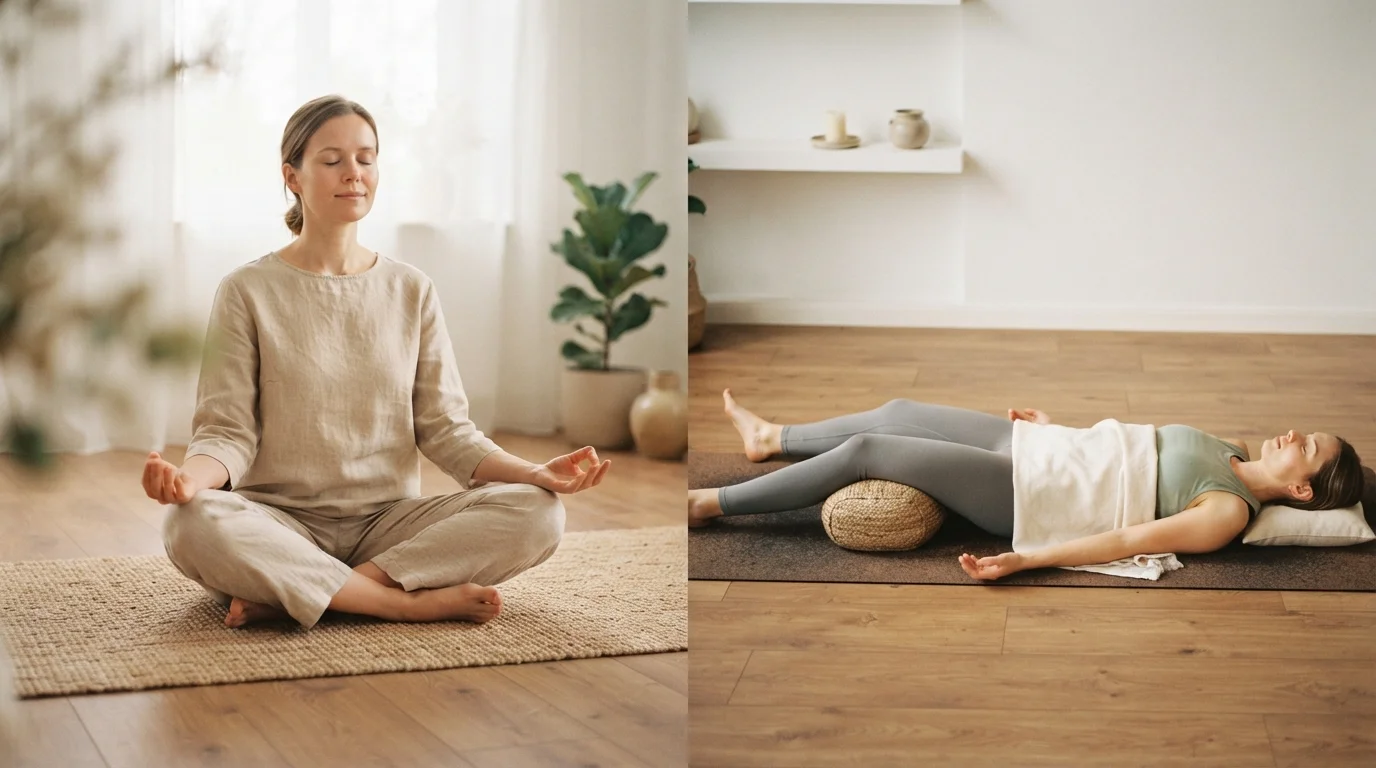
Key Takeaways
Option A
Mindfulness Meditation
The attention-training approach to stress relief.
Best for: People who want to reshape their relationship with anxious thoughts and build long-term emotional regulation skills.
Option B
Progressive Muscle Relaxation
The body-first, systematic tension-release technique.
Best for: People who carry physical tension and prefer a concrete, step-by-step practice with quick, tangible results.
If your stress mostly shows up as racing or repetitive thoughts
Mindfulness Meditation
Mindfulness trains you to observe thoughts without reacting to them, weakening the hold anxious thinking patterns have over time.
If you tend to hold tension in your muscles - tight shoulders, jaw clenching, or headaches
Progressive Muscle Relaxation
PMR directly targets the physical manifestation of stress by cycling through systematic tension and release of specific muscle groups.
If you want something you can learn and apply in a single sitting
Progressive Muscle Relaxation
PMR follows a clear, repeatable sequence that most people grasp quickly without prior experience or ongoing instruction.
If you are building a long-term stress resilience routine
Mindfulness Meditation
Consistent mindfulness practice is associated with durable changes in stress reactivity and emotional regulation over weeks and months.
If you want to address both mental and physical stress simultaneously
Mindfulness Meditation
Body-scan variations of mindfulness bridge cognitive and somatic awareness, making them effective for both thought patterns and physical tension.
How Each Technique Works
Despite sharing the goal of stress relief, mindfulness meditation and progressive muscle relaxation (PMR) arrive there by very different routes.
Mindfulness meditation is a mental training practice rooted in Buddhist tradition and adapted for clinical use, most notably through Jon Kabat-Zinn's Mindfulness-Based Stress Reduction (MBSR) program developed in the late 1970s. The core skill is intentional, non-judgmental attention - typically anchored to the breath, body sensations, or present-moment experience. Over time, regular practice is thought to change how practitioners relate to stressful thoughts, reducing automatic reactivity. For a deeper look at how mindfulness and meditation relate but differ, see our comparison of mindfulness vs. meditation for stress relief.
Progressive muscle relaxation was developed by physician Edmund Jacobson in the 1920s and refined over subsequent decades. The method is straightforward: systematically tense individual muscle groups - feet, calves, thighs, abdomen, hands, shoulders, face - hold for roughly five to ten seconds, then release completely. The contrast between tension and release trains the body to recognize and return to a relaxed baseline, directly countering the physical arousal response to stress.
| Criterion | Mindfulness Meditation | Progressive Muscle Relaxation |
|---|---|---|
| Primary mechanism | Attention training; cognitive reappraisal | Tension-release cycle; parasympathetic activation |
| Learning curve | Moderate - benefits build over weeks | Low - technique grasped in one session |
| Typical session length | 10-45 minutes | 10-20 minutes |
| Evidence for anxiety reduction | Strong (multiple meta-analyses) | Strong (consistent trial support) |
| Physical tension relief | Indirect; body-scan variants more direct | Direct and immediate |
| Best entry point | Structured program or guided app | Audio guide or written instructions |
| Long-term resilience building | Well-supported with sustained practice | Supported; some studies show lasting gains |
What the Research Says
Both practices are among the most studied non-pharmacological stress-management tools available.
Mindfulness meditation has a substantial evidence base. Meta-analyses published in peer-reviewed journals, including a widely cited 2014 review in JAMA Internal Medicine, have found that mindfulness programs produce moderate improvements in anxiety, depression, and pain. Effects on stress biomarkers such as cortisol are more variable, but subjective stress reduction is consistently reported across studies. The benefits appear to accumulate with practice - people completing eight-week MBSR programs tend to show greater gains than those with only brief exposure.
PMR also carries strong empirical support. Research has documented its effectiveness in reducing state anxiety, lowering blood pressure during stressful tasks, improving sleep onset, and reducing tension-type headaches. Its physiological pathway - activating the parasympathetic nervous system through deliberate muscular release - is well understood and relatively direct. Studies consistently show benefit even with short practice periods of ten to fifteen minutes.
~38%
Anxiety reduction in MBSR participants
A meta-analysis of mindfulness-based programs found roughly a 38% reduction in anxiety symptoms on average, according to research reviewed in Clinical Psychology Review.
8 weeks
Typical MBSR program length
The standard Mindfulness-Based Stress Reduction curriculum spans eight weeks of structured group sessions and daily home practice.
15-20 min
Effective PMR session duration
Research trials showing significant reductions in state anxiety and muscle tension with PMR commonly use sessions in the 15-20 minute range.
Importantly, the two approaches are not in competition. Several studies have examined combined protocols and found additive benefits, particularly for populations managing chronic stress or anxiety symptoms alongside physical tension.
Time, Learning Curve, and Practical Fit
For many Americans, the deciding factor between stress-relief strategies is simply whether the practice fits into daily life.
Mindfulness meditation has a moderate learning curve. Beginners often struggle with mind-wandering, misunderstanding the goal as achieving a blank mind rather than noticing distraction and gently returning attention. Structured programs like MBSR span eight weeks with weekly sessions and daily home practice. Shorter, app-guided or instructor-led introductions can help, though they vary in quality. For a comparison of entry points - including apps, self-help resources, and therapy - see our overview of stress management approaches.
PMR is easier to begin independently. Audio guides, worksheets, and brief written instructions are widely available through hospital systems and university health services. Most people can complete a full-body PMR session in fifteen to twenty minutes, and the technique feels immediately tangible because the physical sensations of tension and release are unmistakable. If you are weighing more body-focused mindfulness methods as well, our body scan vs. breath awareness comparison covers related ground.
Both practices can be framed as either passive or active coping depending on how they are used - for broader context on that distinction, see our guide to passive relief vs. active coping. And for a broader hub covering mindfulness and rest strategies, visit our Mindfulness & Rest resource hub.
This article is for general informational and educational purposes only and does not constitute medical advice. If you are experiencing significant anxiety, chronic stress, or related symptoms, please consult a qualified healthcare professional.