

Key Takeaways
Why Supplement Labels Feel So Complicated
Unlike a food label - which most people encounter daily - a supplement label uses a distinct regulatory format governed by the Dietary Supplement Health and Education Act (DSHEA). This means the layout, terminology, and required disclosures differ from what you see on a cereal box or yogurt container. Terms like IU (International Units), mcg (micrograms), and %DV (percent daily value) appear without much explanation, and phrases like "proprietary blend" or "as part of a healthy diet" can muddy the waters further.
Understanding this label is worth the effort. Getting familiar with the structure helps you spot the difference between a well-documented product and one that obscures critical information. For a related skill, see how reading a standard nutrition label compares in terms of format and information density.
What you will need
Step-by-Step: Decoding Every Section of a Supplement Label
Work through these steps in order each time you pick up a new supplement. A systematic approach prevents you from being misled by front-of-bottle marketing claims.
Check the Serving Size First
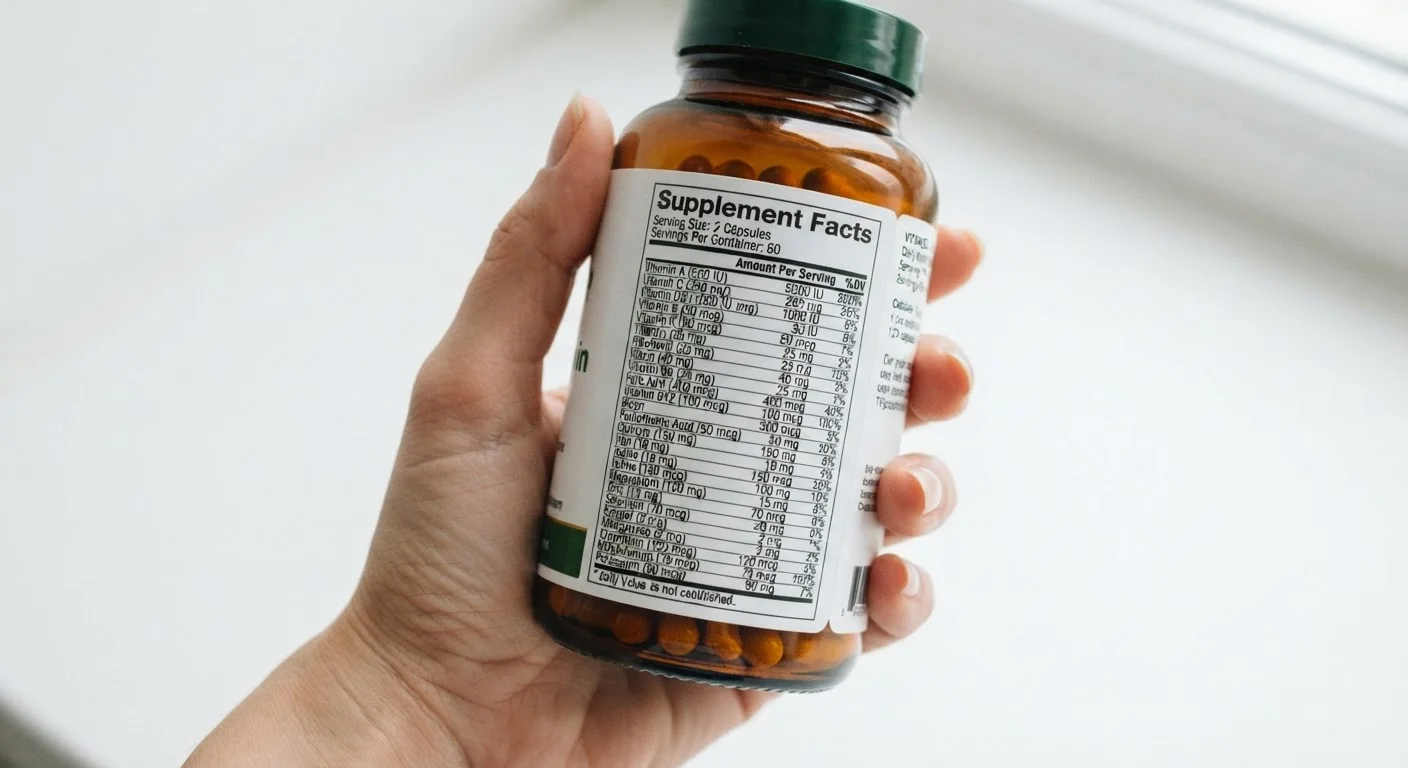
The "Supplement Facts" panel - the equivalent of a food label's Nutrition Facts box - always opens with serving size. This is the amount on which every other number on the label is based. A bottle listing 500 mg of vitamin C per serving means nothing until you know whether one serving is one capsule or three. Misreading serving size is the single most common labeling error consumers make.
Read the %DV Column
The %DV column tells you what percentage of a nutrient's daily reference value one serving provides, based on a 2,000-calorie diet for adults. A %DV of 20% or more is generally considered high; 5% or less is considered low. For nutrients where you want more - like vitamin D or magnesium - a higher %DV is helpful as a benchmark. The reference values used are established by the FDA and reflect population-level guidance, not individual needs.
Translate the Units (IU, mcg, mg)
Once you know the serving size, look at the unit next to each nutrient amount. Milligrams (mg) and micrograms (mcg) are weight-based and straightforward to compare. International Units (IU) are activity-based and require a conversion if you need to compare across labels using different units. For example, vitamin D 600 IU is approximately equivalent to 15 mcg - a conversion the FDA now requires on updated labels, which is why many newer products display both.
Identify Any Proprietary Blends
If you see a section with a branded name like "Energy Complex" or "Immune Support Matrix," followed by a list of ingredients and a single combined weight, you are looking at a proprietary blend. The total weight of all combined ingredients is disclosed, but the individual amounts are not. This makes it impossible to verify whether any single ingredient is present at a dose that matches the research behind it. Approach proprietary blends with additional scrutiny, particularly if any ingredient is the primary reason you chose the product.
Look for Third-Party Verification Seals
Dietary supplements in the United States are not required to be approved by the FDA before they go to market. Manufacturers are responsible for ensuring their products are safe and accurately labeled. Third-party organizations - such as USP, NSF International, and ConsumerLab - independently test supplements and award verification seals when a product meets their standards for label accuracy, potency, and absence of harmful contaminants. These seals do not confirm that a supplement is effective, but they do confirm that what is on the label is what is in the bottle.
Review Disclaimer Language and Structure Claims
By law, dietary supplements may carry structure/function claims - statements like "supports immune health" or "promotes bone strength." These claims do not require FDA approval and must appear with a disclaimer stating the product has not been evaluated by the FDA and is not intended to diagnose, treat, cure, or prevent any disease. If you see this disclaimer, it signals that the product is classified as a supplement, not a drug. Be cautious of marketing language that edges toward implying disease treatment, as this would indicate the label is making claims beyond what is legally permitted for a supplement.
Common Terms Defined
Even after following the steps above, a few terms trip up almost everyone. Here is a plain-language glossary of the ones you are most likely to encounter:
- IU (International Unit)
- A unit of biological activity used for fat-soluble vitamins like A, D, and E. Because IU values measure activity rather than mass, they are not directly comparable to milligrams or micrograms. In recent years, labels have shifted toward weight-based units for clarity.
- mcg (microgram)
- One-thousandth of a milligram. Used for nutrients needed in very small amounts, such as vitamin B12, folate, and vitamin D (increasingly). A dose of 1,000 mcg equals 1 mg - relevant when comparing products listed in different units.
- mg (milligram)
- One-thousandth of a gram. Common for minerals like magnesium, calcium, and zinc, as well as B vitamins like niacin.
- Proprietary blend
- A mixture of ingredients listed collectively under a single name with a total weight disclosed, but without individual ingredient amounts. This is legal under DSHEA but limits your ability to assess whether any single ingredient is present at a meaningful level.
- Upper Tolerable Intake Level (UL)
- The maximum daily amount of a nutrient considered unlikely to cause harm for most healthy adults. Exceeding the UL - especially with fat-soluble vitamins and certain minerals - can carry health risks. The UL is set by the National Academies of Sciences, Engineering, and Medicine and is publicly available.
For a comprehensive look at daily values, food sources, and functions for key vitamins and minerals, the micronutrient quick-reference guide is a useful companion resource.
Food First, Supplements Second
Most healthy adults can meet their micronutrient needs through a balanced, varied diet. Supplements are designed to fill genuine gaps - not to replace whole foods. Before investing in a supplement routine, consider tracking your dietary intake for a week and discussing findings with a registered dietitian or physician. The micronutrient quick-reference guide can help you see which nutrients your diet may already cover well.
This article is for general informational purposes only and does not constitute medical advice. Always consult a qualified healthcare professional before adding any supplement to your routine, especially if you have an existing health condition, are pregnant, or take prescription medications.