

Key Takeaways
Handwashing (Mechanical Pathogen Removal)
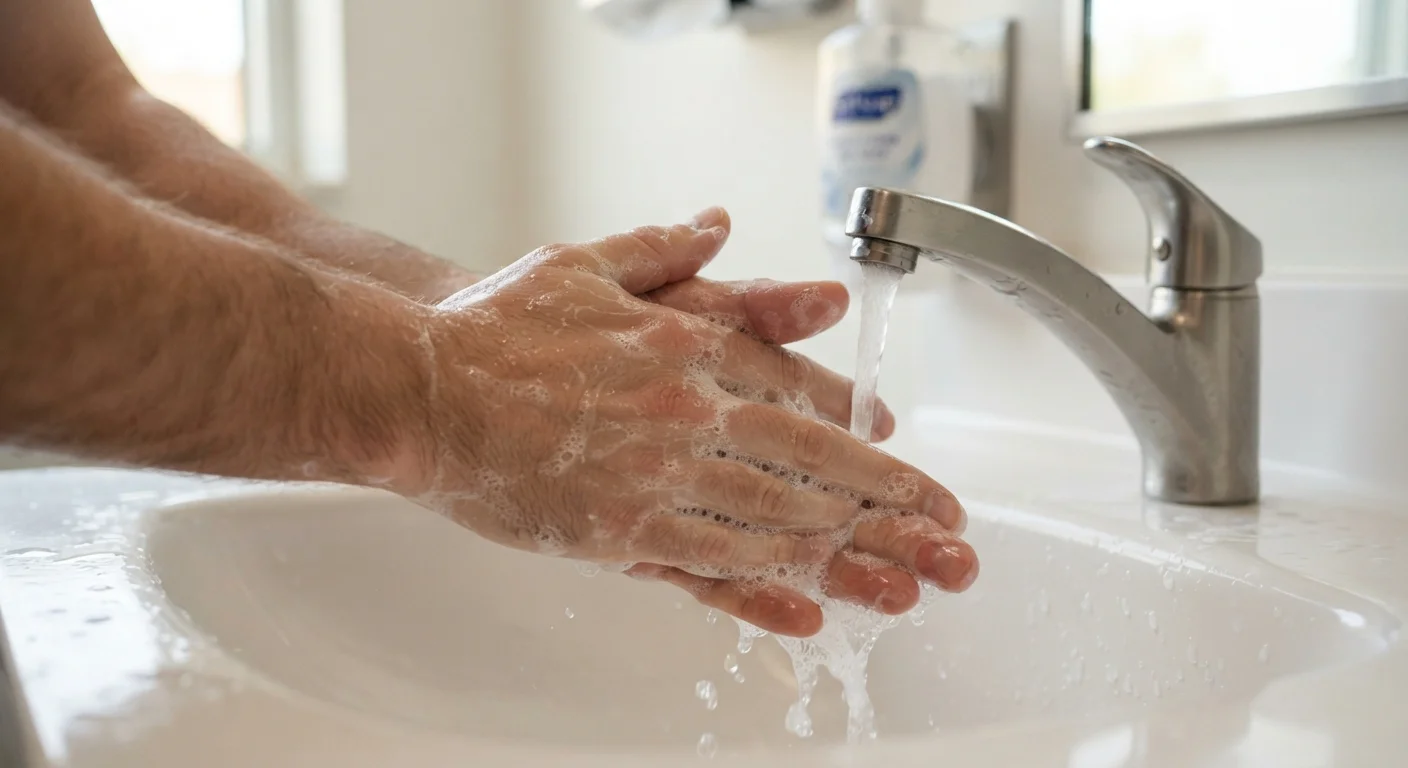
Handwashing is the process of using soap and water to physically dislodge, inactivate, and rinse away pathogens — including bacteria, viruses, and fungi — from the skin's surface. Unlike rinsing with water alone, soap disrupts the outer membranes of many pathogens and reduces surface tension, making microbes easier to lift away. The friction of scrubbing and the thoroughness of rinsing are what complete the removal process.
Soap molecules are amphiphilic: one end binds to oils (and the lipid envelopes of many viruses), while the other binds to water, allowing pathogens to be emulsified and washed away.
What Happens on Your Hands Before You Wash Them
Human hands are in near-constant contact with surfaces, people, and our own faces — the CDC estimates people touch their faces an average of 23 times per hour. Each contact event transfers microorganisms. The skin's natural texture, including fine ridges and microscopic folds, creates pockets where bacteria and viruses can persist, protected by a thin film of sebum (skin oil) and organic debris.
Water alone cannot dissolve this oily layer. When you rinse without soap, many pathogens are simply redistributed rather than removed. This is the fundamental reason technique matters — and why the chemistry of soap is central to the story.
The Chemistry of Soap: Why It Works at a Molecular Level
Soap is made of molecules called surfactants, which have a dual structure: a hydrophilic (water-attracting) head and a hydrophobic (oil-attracting) tail. When you lather soap onto wet hands, the hydrophobic tails embed into oily residue on the skin, while the hydrophilic heads orient toward water. This creates structures called micelles — tiny spheres that trap oil droplets, along with the bacteria and viruses suspended in them.
Many dangerous pathogens, including influenza viruses and coronaviruses, have lipid (fatty) outer envelopes. Soap disrupts these envelopes directly, rendering the pathogens non-functional even before rinsing. For non-enveloped pathogens, such as norovirus, soap still works by physically lifting them off the skin surface. This is one reason why soap and water is broadly effective across a wide range of pathogens.
Soap Type Matters Less Than You Think
Regular soap and antibacterial soap perform similarly for routine handwashing. The FDA has raised concerns about certain antimicrobial agents, such as triclosan, citing insufficient evidence of added benefit and potential risks with prolonged use. For most everyday situations, any plain soap used with proper technique is the evidence-backed choice.
For a direct comparison of when to choose soap versus hand sanitizer, see Hand Sanitizer vs. Soap and Water.
The Role of Friction, Time, and Technique
The chemical action of soap must be paired with mechanical action — active scrubbing — to be fully effective. Rubbing your hands together generates friction that physically dislodges pathogens from the skin's surface and from under the fingernails, where microbes commonly accumulate. Studies show that brief or perfunctory washing leaves substantially more microbial load on the hands than thorough scrubbing.
The CDC recommends scrubbing all surfaces of the hands — backs, between fingers, and under nails — for at least 20 seconds before rinsing. This duration allows both the chemical disruption of pathogens and the mechanical dislodging to occur sufficiently. Rinsing under clean running water then removes the micelle-encased pathogens.
23–40%
Reduction in diarrheal illness risk
CDC data indicate that handwashing with soap can reduce diarrheal disease risk by approximately 23–40% in community settings.
16–21%
Reduction in respiratory illness risk
Studies cited by the CDC suggest handwashing reduces the incidence of respiratory illnesses, including colds, by roughly 16–21%.
20 seconds
Minimum recommended scrubbing time
The CDC recommends scrubbing all hand surfaces for at least 20 seconds to achieve meaningful pathogen removal.
Proper drying also matters: wet hands transfer bacteria more readily than dry ones. A clean towel or air drying after washing completes the process. It's worth noting that the quality of the water and the availability of a clean towel are real barriers in many settings — a public health consideration that goes beyond individual behavior.
When and How Often to Wash: Evidence-Based Guidance
Not all handwashing moments are equally valuable for disease prevention. Public health research consistently identifies specific high-risk junctures where washing provides the most benefit: before handling or consuming food, after using the restroom, after contact with someone who is ill, and after touching animals or high-contact surfaces in public spaces.
Consistent handwashing at these key moments — rather than compulsive or extremely frequent washing — is what the evidence supports. Washing too often can itself create problems by damaging the skin barrier, which is your body's first line of physical defense. For more on that balance, see how over-washing can undermine your skin's protective function.
Many popular beliefs about hygiene don't align with current evidence. For a broader look at what holds up to scrutiny, hygiene myths that have outlasted the evidence is a useful companion resource.
This article is for general health information and educational purposes only. It is not a substitute for professional medical advice, diagnosis, or treatment. Always consult a qualified healthcare provider with questions about your health.