

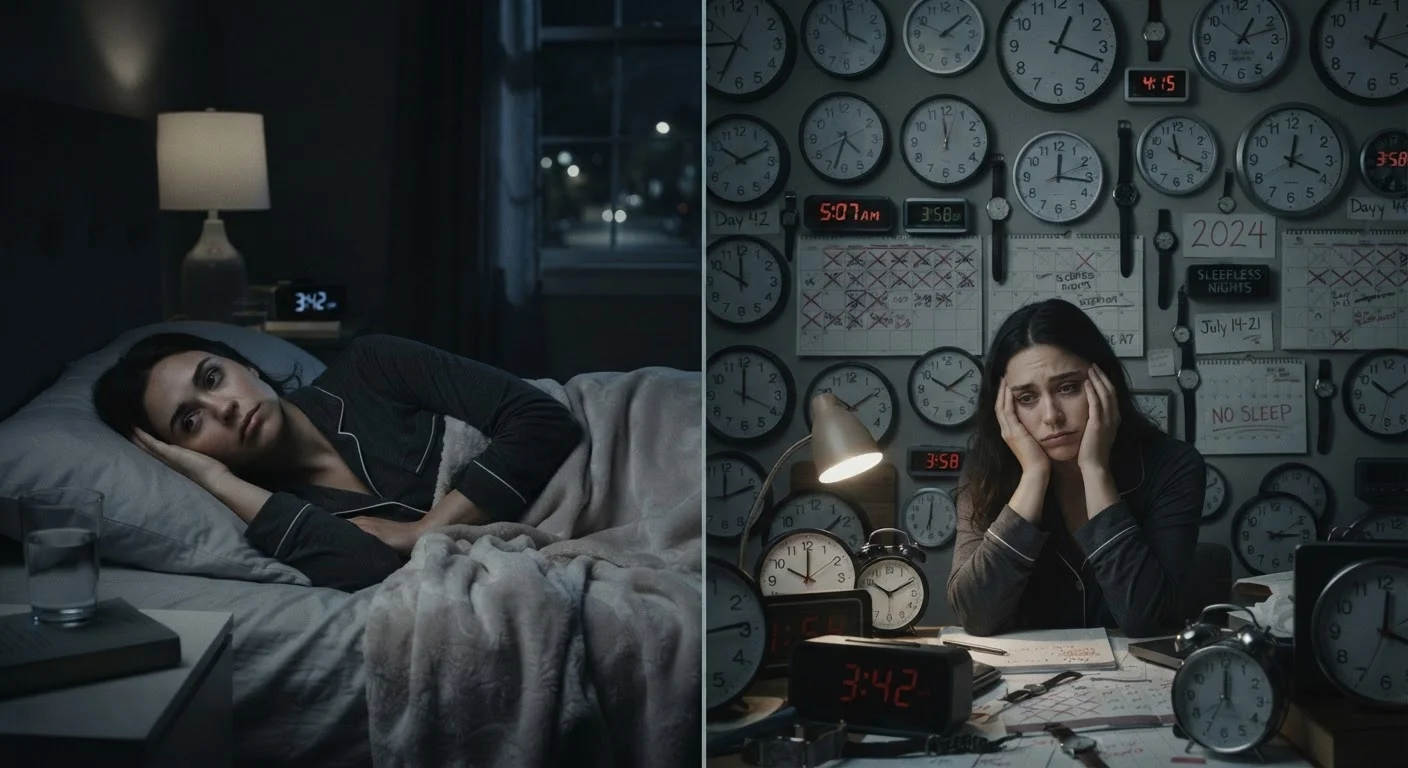
Key Takeaways
Option A
Short-Term (Acute) Insomnia
The temporary, often trigger-driven sleep disruption.
Best for: Understanding sleep difficulties that emerge around a specific stressor or life event and typically resolve within weeks.
Option B
Chronic Insomnia
The persistent, self-reinforcing sleep disorder.
Best for: Recognizing when repeated sleeplessness has crossed into a clinical pattern requiring professional evaluation and structured care.
If your sleep problems started alongside a clear life stressor
Short-Term (Acute) Insomnia
Acute insomnia is closely tied to identifiable triggers. Sleep often improves once the stressor resolves, though healthy sleep habits can speed recovery.
If you've had trouble sleeping most nights for more than three months
Chronic Insomnia
Persistent, frequent sleep difficulties meeting the three-month threshold warrant professional evaluation and structured treatment such as CBT-I.
If you're unsure which type applies to you
Chronic Insomnia
When in doubt, consulting a healthcare provider is the safest course. Untreated chronic insomnia carries greater health risks than short-term disruption.
Defining the Two Types: Duration and Frequency
Insomnia is not a single, monolithic condition. Sleep medicine clinicians distinguish between two primary categories — short-term (also called acute) insomnia and chronic insomnia — primarily on the basis of how long the problem persists and how often it occurs.
Short-term insomnia is defined as difficulty falling or staying asleep, or waking too early, that lasts fewer than three months. It is common — affecting an estimated 15–20% of adults at any given time — and is usually traceable to a specific life event such as a job loss, relationship conflict, illness, travel across time zones, or a major deadline.
Chronic insomnia meets a stricter clinical threshold: sleep difficulties occurring at least three nights per week, persisting for three months or longer, and causing meaningful daytime impairment. Research estimates suggest roughly 10% of adults meet criteria for chronic insomnia. Importantly, the original trigger may have long since passed — the sleep problem has taken on a life of its own. Just as acute and chronic stress differ in their impact on the body, the transition from short-term to chronic insomnia involves distinct physiological and psychological processes.
How Each Type Develops — and Why Chronic Insomnia Persists
The widely accepted "3-P model" (predisposing, precipitating, and perpetuating factors) helps explain why some cases of acute insomnia resolve while others evolve into a chronic pattern.
- Predisposing factors are baseline vulnerabilities — a tendency toward anxious arousal, a family history of sleep problems, or a naturally lighter sleep drive.
- Precipitating factors are the triggering events: the stressor, illness, or change that kicks off the insomnia.
- Perpetuating factors are the behaviors and thought patterns that sustain the problem after the original trigger has faded.
In short-term insomnia, the precipitating factor dominates. Once it resolves, sleep often normalizes — provided no unhelpful coping patterns have formed. In chronic insomnia, perpetuating factors take over: compensatory behaviors like spending extra hours in bed, irregular schedules, or heightened anxiety about sleep itself become the primary drivers. This is why the consistency of sleep timing matters enormously — erratic schedules are a key perpetuating factor that can deepen chronic insomnia.
| Criterion | Short-Term Insomnia | Chronic Insomnia |
|---|---|---|
| Duration | Less than 3 months | 3 months or longer |
| Frequency | Variable, tied to stressor | ≥3 nights per week |
| Primary driver | Precipitating life event | Perpetuating thoughts and behaviors |
| Daytime impairment | Often mild to moderate | Significant and persistent |
| Typical resolution | Often self-resolving | Rarely resolves without intervention |
| First-line approach | Sleep hygiene, stress management | CBT-I; professional evaluation |
| Estimated prevalence | ~15–20% of adults | ~10% of adults |
General Management Approaches
Because the two types differ in their mechanisms, general approaches to managing them also diverge.
For short-term insomnia, sleep hygiene measures — consistent wake times, limiting caffeine, reducing pre-bed screen exposure, and addressing the underlying stressor — are typically the first line of action. Many cases improve without clinical intervention once the precipitating situation resolves.
For chronic insomnia, cognitive behavioral therapy for insomnia (CBT-I) is recognized by major sleep medicine organizations as the most effective first-line approach. CBT-I targets the perpetuating factors directly: it restructures unhelpful thoughts about sleep and uses behavioral techniques such as sleep restriction and stimulus control to re-establish healthy sleep-wake associations. It is also worth noting that chronic insomnia often co-occurs with other sleep conditions — distinguishing insomnia from disorders like sleep apnea is an important step, as the causes and management of insomnia and sleep apnea differ considerably.
This article is for general informational and educational purposes only. It is not a substitute for professional medical advice, diagnosis, or treatment. If you are experiencing persistent sleep difficulties, please consult a qualified healthcare professional.