

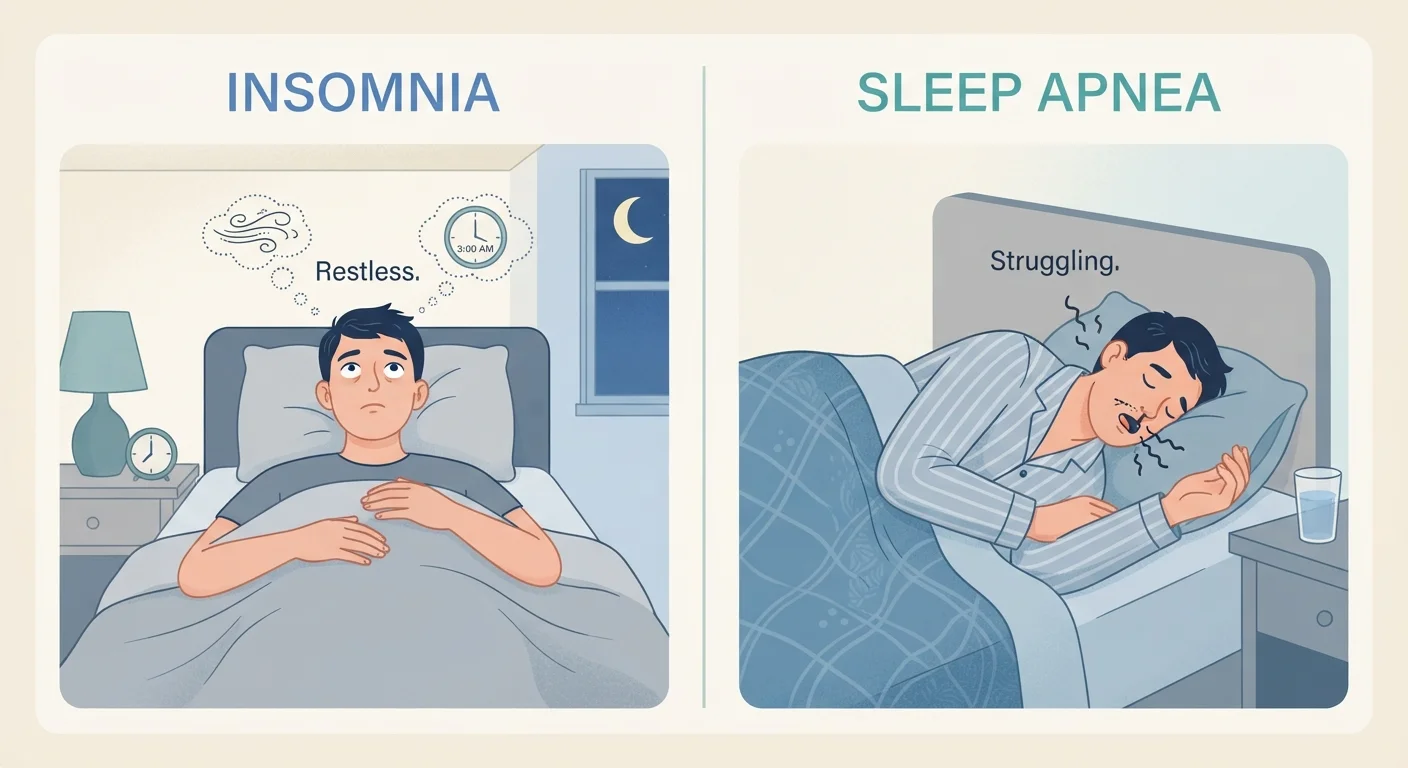
Key Takeaways
Option A
Insomnia
The sleep-initiation and maintenance disorder driven by the mind and behavior.
Best for: Recognizing a condition where the brain struggles to enter or sustain sleep despite adequate opportunity.
Option B
Sleep Apnea
The breathing-based sleep disruptor rooted in airway physiology.
Best for: Identifying a condition where physical airway obstruction or neurological signals interrupt breathing during sleep.
If you lie awake for hours despite feeling tired
Insomnia
Difficulty initiating or maintaining sleep without obvious breathing events is the hallmark of insomnia, often addressed through behavioral therapies.
If a bed partner reports loud snoring, gasping, or breathing pauses
Sleep Apnea
These are defining signs of obstructive sleep apnea, a condition that requires professional evaluation and typically a sleep study to confirm.
If you wake frequently and also snore heavily
Consult a sleep specialist
Comorbid insomnia and sleep apnea (COMISA) is well-documented; a specialist can untangle which disorder is primary and guide combined treatment.
What Each Disorder Actually Is
Insomnia and sleep apnea are among the most common sleep disorders in American adults, yet they operate through completely different mechanisms. Understanding that distinction matters not just academically — it shapes how each condition is evaluated and managed.
Insomnia is characterized by persistent difficulty falling asleep, staying asleep, or waking too early, occurring at least three nights per week for three or more months in the case of chronic insomnia. The core problem lies in a state of physiological and cognitive hyperarousal: the brain remains too activated to transition into and sustain sleep even when the person is exhausted. Stress, anxiety, learned sleep-preventing behaviors, irregular schedules, and certain medications are frequent contributors. For a closer look at how acute cases evolve into chronic ones, see our overview of short-term vs. chronic insomnia.
Sleep apnea is a breathing disorder. During sleep, the airway partially or fully collapses (obstructive sleep apnea, or OSA) or the brain fails to send proper signals to breathing muscles (central sleep apnea). These events fragment sleep repeatedly through the night — often dozens or hundreds of times — without the person being fully aware. The result is severely disrupted, non-restorative sleep. For a deeper dive into OSA specifically, our article on obstructive sleep apnea and snoring explains the key distinctions.
How the Symptoms Differ — and Overlap
Both disorders leave sufferers fatigued, irritable, and cognitively impaired during the day. That shared surface presentation is exactly why confusion between them is so common. But the symptom profiles diverge meaningfully on closer inspection.
| Criterion | Insomnia | Sleep Apnea |
|---|---|---|
| Core mechanism | Cognitive/behavioral hyperarousal | Airway obstruction or neurological signaling failure |
| Primary complaint | Can't fall or stay asleep | Wakes unrefreshed despite sleeping |
| Awareness of disruption | Usually fully aware of wakefulness | Often unaware of breathing events |
| Snoring / gasping | Not a defining feature | Common and often reported by partner |
| Morning headaches | Less common | Frequently reported |
| Daytime sleepiness | Common but variable | Often severe |
| Diagnosis method | Clinical interview, sleep diary | Sleep study (lab or home) |
| First-line treatment | CBT-I (behavioral therapy) | PAP therapy or oral appliance |
Insomnia's hallmark is a conscious awareness of sleeplessness — lying awake, watching the clock, dreading the next day. Sleep apnea's hallmark is quite the opposite: the person is technically asleep but wakes gasping, or sleeps through the night yet feels completely unrefreshed. A bed partner's report of loud snoring, choking sounds, or visible breathing pauses is among the most clinically useful signals pointing toward apnea rather than insomnia.
Mood and mental health are affected by both. Research has consistently linked poor sleep to worsened anxiety and depression, regardless of the underlying cause — a relationship explored in detail in our piece on sleep disorders and mental health.
Diagnosis and Why It Matters
Getting the right diagnosis is the prerequisite for effective treatment. Treating insomnia when sleep apnea is the primary driver — or vice versa — can leave the underlying problem unaddressed and potentially worsen outcomes.
Insomnia is typically diagnosed through clinical interview, sleep history, and validated questionnaires. No laboratory test is required, though a sleep diary kept for one to two weeks can provide valuable pattern data. Cognitive Behavioral Therapy for Insomnia (CBT-I) is the first-line treatment recommended by major sleep medicine organizations, generally preferred over sleep medications for long-term management.
Sleep apnea diagnosis usually requires a sleep study — either a polysomnography conducted in a sleep lab or a home sleep apnea test, depending on clinical suspicion and individual factors. Treatment commonly involves positive airway pressure (PAP) therapy, oral appliances, or in some cases surgical interventions. A healthcare provider determines which approach is appropriate.
It is also worth knowing that the two conditions frequently coexist. Comorbid insomnia and sleep apnea — sometimes called COMISA — is recognized in the clinical literature as particularly challenging to treat, since each disorder can reinforce the other. This is yet another reason why professional evaluation is essential rather than self-diagnosing based on symptoms alone. For broader context on how sleep disorders are categorized and what they mean for overall health, see our sleep disorders explained overview.
This article is for general informational and educational purposes only and does not constitute medical advice. If you are experiencing persistent sleep difficulties, consult a qualified healthcare professional for an accurate diagnosis and appropriate care.