

Key Takeaways
Sleep-Mental Health Bidirectional Relationship
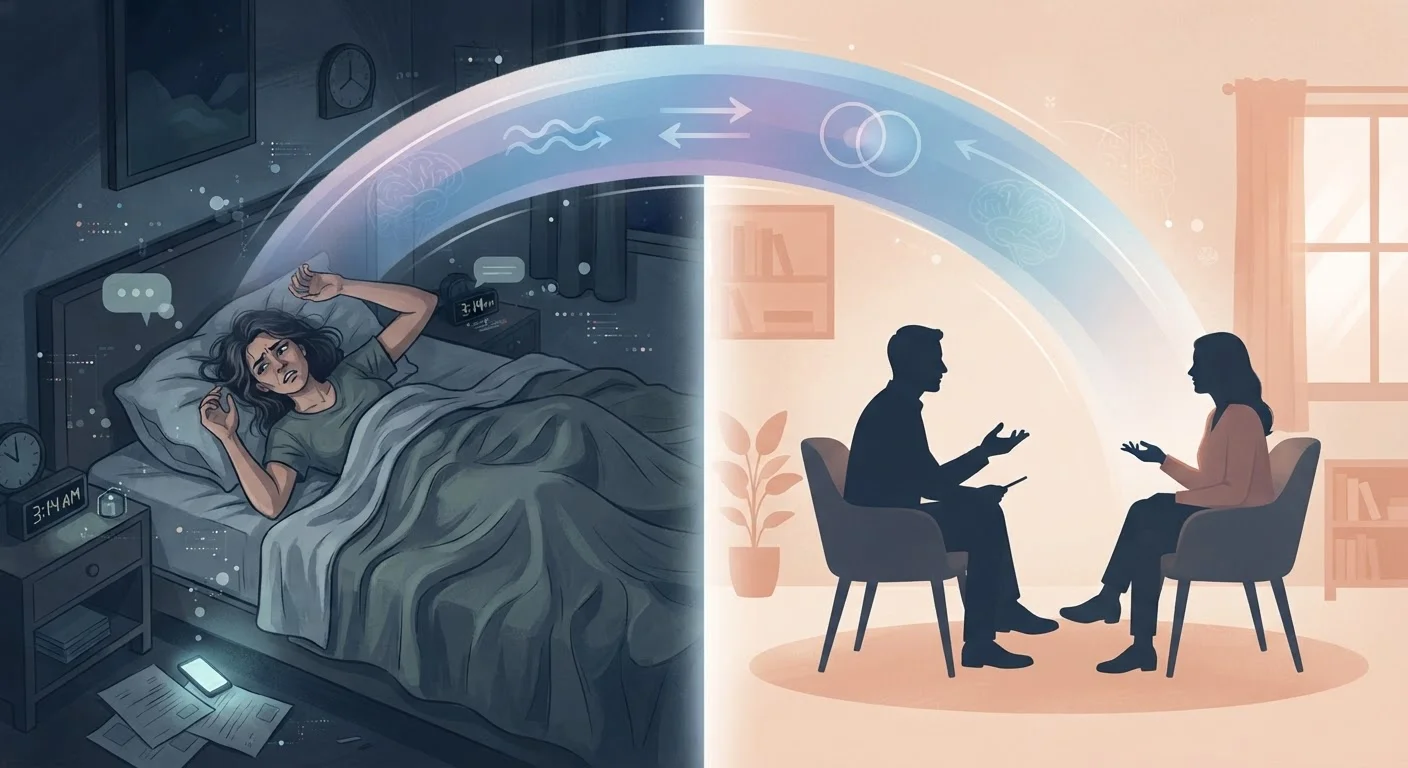
The sleep-mental health bidirectional relationship refers to the scientifically established cycle in which poor or disrupted sleep worsens mental health conditions — such as anxiety, depression, and PTSD — while those same conditions simultaneously interfere with normal sleep. Neither side is simply the cause or the effect; each continuously influences the other. Recognizing this feedback loop is essential to understanding and addressing both types of problems effectively.
Neurobiologically, this relationship involves overlapping dysregulation in systems governing the hypothalamic-pituitary-adrenal (HPA) axis, serotonin signaling, and prefrontal cortical activity, which together regulate both mood and sleep architecture.
The Bidirectional Loop: How Sleep and Mental Health Interact
For decades, clinicians viewed sleep problems primarily as symptoms of mental health conditions — a side effect of depression, anxiety, or trauma. Contemporary research has fundamentally revised that view. Sleep disturbances and psychiatric disorders operate in a continuous feedback cycle, each amplifying the other in measurable ways.
When sleep is chronically disrupted, the brain's capacity to regulate emotions diminishes. The prefrontal cortex — responsible for rational thought and emotional control — becomes less effective. At the same time, the amygdala, which processes threat and fear responses, grows more reactive. This neurological shift creates fertile ground for anxiety and depressive symptoms to emerge or worsen.
Conversely, anxiety and depression alter sleep architecture directly. Elevated stress hormones suppress slow-wave sleep (the deepest, most restorative stage) and increase nighttime arousals. People with depression frequently experience early-morning waking and REM sleep abnormalities. The result is a cycle that neither side initiates cleanly — and that neither side can exit without the other being addressed. For a closer look at how sleep debt compounds these emotional effects, see how sleep debt quietly erodes emotional resilience.
Specific Sleep Disorders and Their Mental Health Connections
Different sleep disorders intersect with mental health in distinct, clinically meaningful ways:
- Insomnia: The most extensively studied sleep disorder in psychiatric research. Longitudinal studies have found that chronic insomnia roughly doubles the risk of developing major depression. It also significantly elevates anxiety disorder risk. Importantly, insomnia often precedes psychiatric episodes rather than following them, making it both a symptom and a potential trigger. Learn how insomnia compares with other conditions in our overview: Insomnia vs. Sleep Apnea.
- Obstructive Sleep Apnea (OSA): Characterized by repeated breathing interruptions during sleep, OSA fragments rest and reduces oxygen delivery to the brain. Research links untreated OSA to increased rates of depression, mood instability, and cognitive impairment.
- Nightmare Disorder and PTSD-Related Sleep Disturbances: Recurrent, distressing nightmares are both a diagnostic criterion and a perpetuating factor in post-traumatic stress disorder (PTSD). Nightmares disrupt sleep continuity and reinforce trauma-related hyperarousal, making psychological recovery significantly harder.
- Hypersomnia: Excessive daytime sleepiness, whether from a primary disorder or secondary to conditions like bipolar disorder, impairs daily functioning and is often misread as laziness or disengagement, delaying appropriate care.
~2x
Higher depression risk with chronic insomnia
Multiple longitudinal studies have found that people with chronic insomnia are approximately twice as likely to develop major depression compared to those without sleep problems.
75%
Of depression patients report sleep disturbances
Research estimates that roughly 75% of individuals diagnosed with major depressive disorder experience significant sleep disruption, including insomnia or hypersomnia.
90%
Of PTSD patients experience sleep disturbances
Studies consistently find that the vast majority of individuals with PTSD — approximately 90% — report clinically significant sleep disturbances, most commonly insomnia and recurrent nightmares.
Breaking the Cycle: Integrated Approaches to Treatment
Because the relationship runs in both directions, effective care typically requires addressing sleep and mental health simultaneously rather than treating one and hoping the other resolves. Cognitive Behavioral Therapy for Insomnia (CBT-I) — a structured, evidence-based program that targets the thoughts and behaviors perpetuating insomnia — has shown robust results not only for sleep but for co-occurring depression and anxiety symptoms.
Similarly, effective treatment of depression or anxiety often leads to measurable improvements in sleep quality. Research increasingly supports integrated care models, where mental health clinicians and sleep specialists collaborate or where practitioners are trained to screen and address both domains.
Understanding how stress interrupts sleep is a useful starting point for anyone caught in this cycle. Broader guidance on better sleep habits can also support recovery, though lifestyle changes alone are rarely sufficient for clinical conditions.
For a comprehensive foundation on sleep conditions, our complete overview of sleep disorders covers types, warning signs, and general management strategies. And for those interested in the deeper science, chronic sleep deprivation's effects on emotional regulation explains how ongoing poor sleep reshapes emotional processing over time.
This article is for informational purposes only and is not a substitute for professional medical or psychiatric advice. If you are experiencing sleep difficulties or mental health symptoms, please consult a qualified healthcare provider.