

Key Takeaways
Age-Related Body Composition Shift
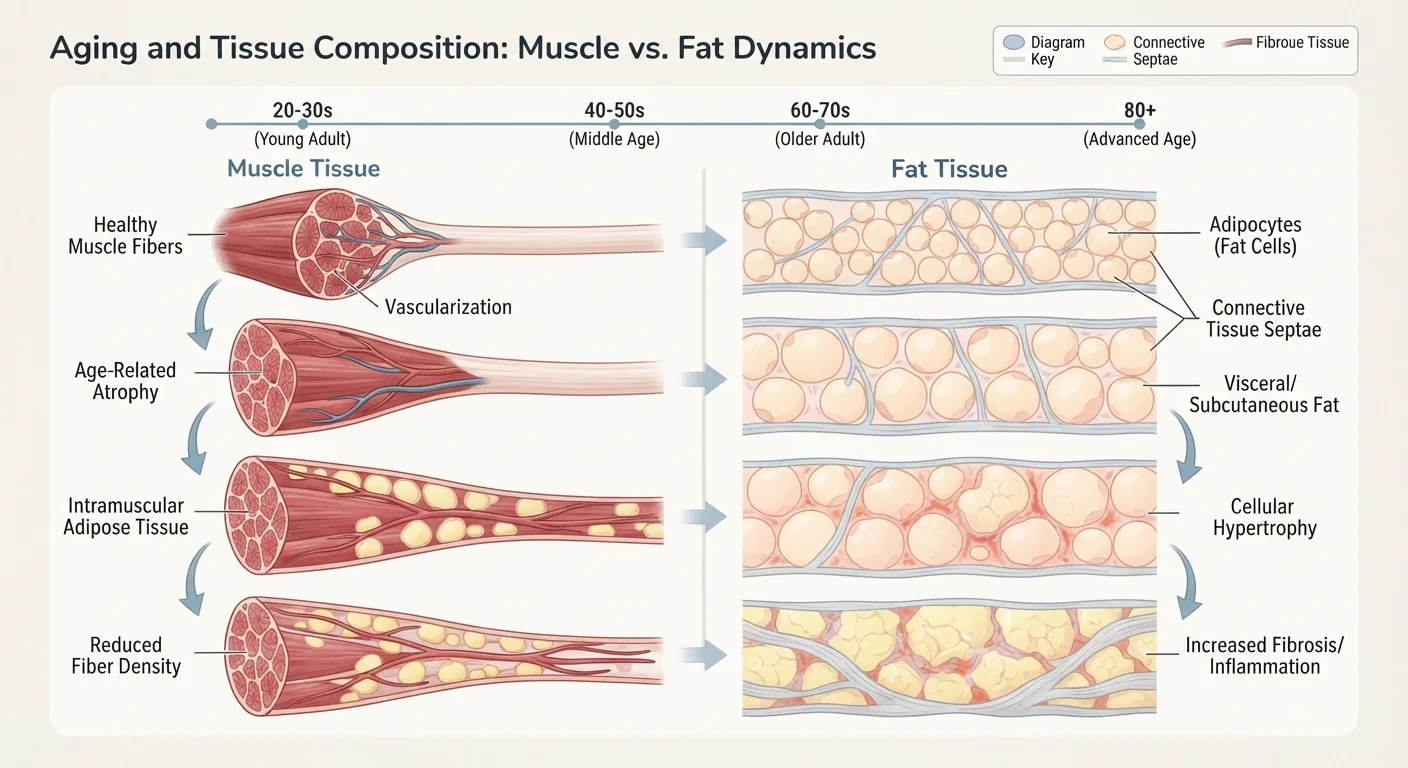
As people grow older, their bodies undergo predictable changes in the proportion of muscle, fat, and bone tissue - independent of diet or exercise habits. Muscle mass tends to decline, fat tends to increase and redistribute toward the abdomen, and bone density typically decreases. These shifts are driven by hormonal, metabolic, and cellular changes that begin gradually in early adulthood.
The age-related loss of skeletal muscle mass and function is clinically termed sarcopenia, while increased visceral adiposity - fat around internal organs - is associated with elevated metabolic risk distinct from overall body weight.
What Actually Changes Inside the Body as We Age
Body composition - the relative proportions of fat, muscle, and bone - shifts throughout life, but the changes become more pronounced in midlife and beyond. Understanding what drives these shifts at a tissue level gives a clearer picture of what health metrics like weight and BMI often miss.
Skeletal muscle is particularly vulnerable to age-related change. After roughly age 30, adults begin losing a small but measurable percentage of muscle tissue each decade. This process is gradual at first, then accelerates meaningfully after 60. The mechanism involves a decline in anabolic hormones (those that build and maintain tissue), reduced motor neuron function, and diminished muscle protein synthesis - the process by which the body repairs and rebuilds muscle fibers after activity.
Simultaneously, fat mass tends to increase even when total body weight remains stable. More significantly, fat redistribution occurs - subcutaneous fat (just under the skin) may decrease in the limbs while visceral fat, which surrounds internal organs, tends to accumulate. This shift has metabolic implications beyond what the scale shows. Understanding what fat, muscle, and bone actually tell you helps contextualize why these tissue-level changes matter independently of overall weight.
The Science of Sarcopenia and Bone Density Loss
Sarcopenia - from the Greek for "poverty of flesh" - is the clinical term for age-related loss of skeletal muscle mass and function. It is not simply being less muscular; sarcopenia is defined by measurable declines in muscle quantity, quality, and physical performance. Estimates vary, but research suggests a meaningful proportion of adults over 60 meet diagnostic criteria for some degree of sarcopenia.
Bone density follows a parallel trajectory. Peak bone mass is generally reached in early adulthood. After that, a slow net loss begins, driven by an imbalance between bone formation and resorption. In women, the pace of bone loss accelerates sharply around menopause due to falling estrogen levels - a hormone that plays a protective role in bone maintenance. Men experience more gradual bone loss tied in part to declining testosterone.
1-2%
Annual muscle mass loss after age 60
Research estimates that older adults without countermeasures may lose approximately 1-2% of skeletal muscle mass per year, with strength declining at a faster rate.
~30%
Muscle mass lost by age 80 on average
Some longitudinal studies suggest adults may lose close to 30% of peak muscle mass by the eighth decade of life, contributing to functional decline and fall risk.
2-3×
Rate of bone loss acceleration post-menopause
Bone density loss in women can accelerate two to three times faster in the years immediately following menopause compared to the premenopausal rate.
These changes are not isolated events. Muscle and bone are metabolically linked - muscle contractions apply mechanical stress to bone, stimulating bone-forming cells. When muscle mass declines, this stimulus diminishes, compounding bone density loss. This interconnection underscores why interventions targeting muscle often benefit bone simultaneously.
It's worth noting that body composition ranges considered typical shift with age and sex. Reference ranges for body fat and muscle mass across age groups provide useful context for interpreting individual measurements.
What the Research Says About Slowing These Changes
The evidence base for slowing age-related composition changes is more robust than is commonly appreciated - and it centers on modifiable behaviors rather than supplements or interventions with weak or mixed data.
Resistance training has the strongest and most consistent evidence base. Multiple randomized controlled trials demonstrate that progressive resistance exercise - lifting weights, using resistance bands, or performing bodyweight exercises with progressive challenge - increases muscle mass and strength in older adults, including those in their 70s and 80s. The effect on bone density is similarly well-supported.
Protein intake is the other pillar with strong research backing. Older adults may need higher protein intake per unit of body weight than younger adults to achieve the same rate of muscle protein synthesis. Distributing protein intake across meals, rather than concentrating it in one sitting, appears to optimize this process according to current evidence.
Sleep and stress play supporting roles. Chronic sleep deprivation elevates cortisol, a hormone associated with muscle breakdown and fat accumulation. Sustained psychological stress similarly disrupts the hormonal environment that supports muscle maintenance. Lifestyle factors that shape body composition over time covers this interplay in more depth.
It's important to be transparent: current evidence supports slowing age-related composition changes, not halting or fully reversing them. Claims that any single supplement or protocol can stop sarcopenia or fully restore youthful composition are not well-supported by the current scientific literature. Common body composition claims that don't hold up to scrutiny offers a useful corrective to widespread misconceptions.
This article is for general informational purposes only and does not constitute medical advice. Consult a qualified healthcare provider before making changes to your diet, exercise routine, or health management plan - particularly if you have existing health conditions or are in a special population group such as pregnancy or older age.