

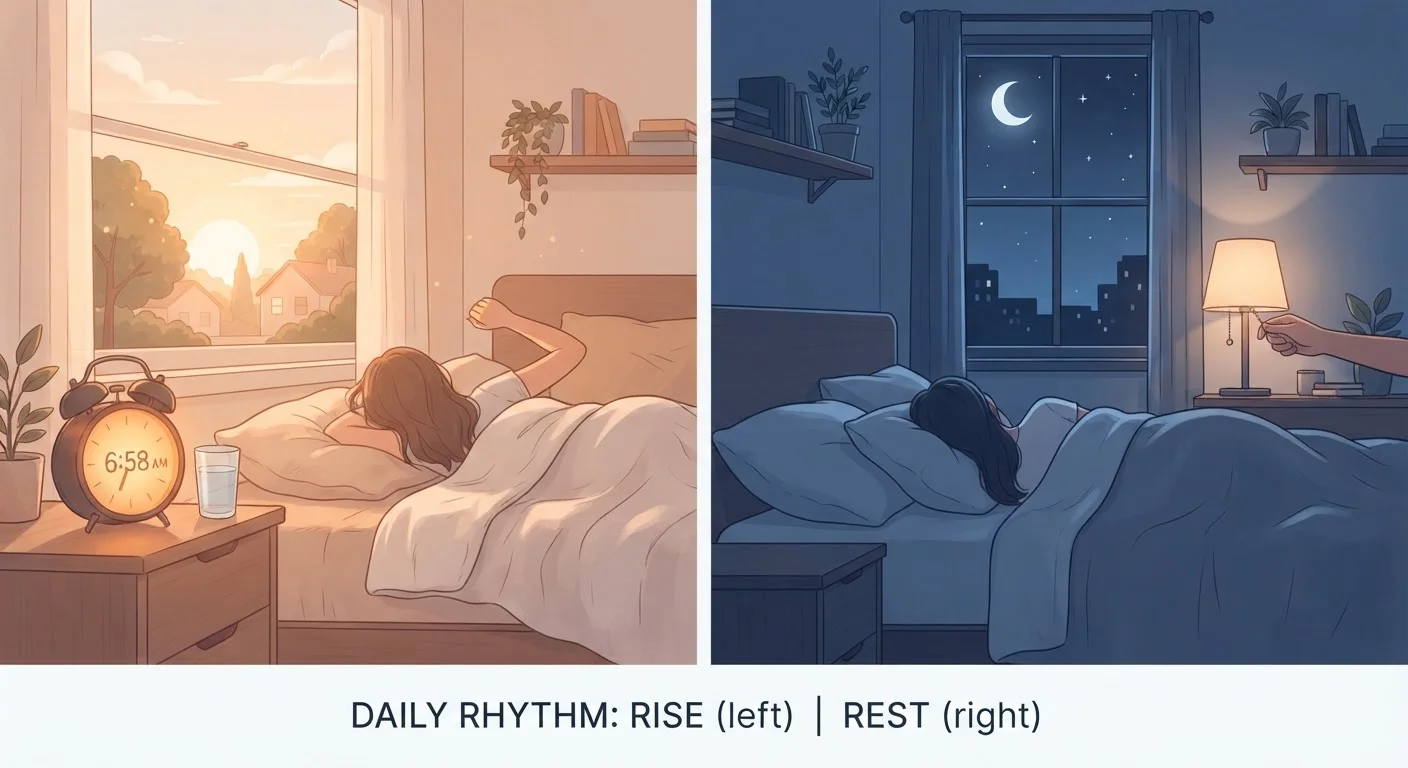
Key Takeaways
Option A
Fixed Wake Time
The circadian-aligned, science-backed anchor.
Best for: Anyone wanting to stabilize their internal clock quickly, including those recovering from irregular schedules or insomnia.
Option B
Fixed Bedtime
The intuitive, routine-friendly evening anchor.
Best for: People with highly predictable evening schedules who can reliably wind down at the same time each night.
If your schedule is irregular or you struggle with insomnia
Fixed Wake Time
A consistent wake time builds homeostatic sleep pressure and resets circadian rhythm faster than any other single intervention. It is the cornerstone of Cognitive Behavioral Therapy for Insomnia (CBT-I).
If your evenings are highly structured and predictable
Fixed Bedtime
When evening routines rarely vary, a fixed bedtime can reinforce a wind-down habit and reduce decision fatigue around when to stop activities.
If you want the strongest overall sleep consistency
Fixed Wake Time
Even when combined with a fixed bedtime, the wake anchor drives greater circadian stability because morning light exposure and cortisol timing are tied to the hour you rise.
If you are a shift worker or have variable social commitments
Fixed Wake Time
Bedtime is easily disrupted by social events, work demands, and travel, while keeping wake time consistent limits circadian drift even when bedtime fluctuates.
Why the 'Anchor' Concept Matters
Sleep regularity — going to bed and waking at consistent times — is widely recognized as a pillar of good sleep health. As explained in our article why your body clock matters more than bedtime, your circadian rhythm operates on roughly a 24-hour cycle governed by light exposure, hormone timing, and behavioral cues. An "anchor" is simply the fixed end of your schedule that keeps that cycle from drifting.
The core debate is practical: most people cannot perfectly control both ends of the sleep window every day. Life intervenes — late meetings, social events, early flights. So which single anchor preserves sleep quality better when the other end must flex?
The Case for a Fixed Wake Time
Sleep scientists and clinicians broadly favor anchoring the morning end of the schedule. Here is why:
- Homeostatic sleep pressure: Every hour you are awake, your brain accumulates adenosine — a chemical that drives sleepiness. Waking at the same time each day ensures you begin building that pressure from a consistent starting point, making it easier to fall asleep at night.
- Circadian entrainment: Morning light exposure anchors your suprachiasmatic nucleus (the brain's master clock) more powerfully than any evening cue. Rising at a consistent hour triggers a predictable cortisol awakening response and sets melatonin release for that evening.
- CBT-I alignment: Cognitive Behavioral Therapy for Insomnia — the evidence-based first-line treatment — uses fixed wake time as its primary behavioral tool, specifically because it is the most controllable and biologically influential variable.
The trade-off is short-term discomfort. If you anchor your wake time before your body has fully adapted, you may experience several days of earlier fatigue and grogginess. This temporary difficulty is normal and generally resolves within one to two weeks as your rhythm consolidates.
| Criterion | Fixed Wake Time | Fixed Bedtime |
|---|---|---|
| Primary mechanism | Builds homeostatic sleep pressure | Reinforces wind-down routine |
| Circadian impact | Directly entrains master clock via morning light | Indirect; relies on evening cues |
| Ease of maintaining | Easier to protect from social disruption | Vulnerable to evening variability |
| CBT-I alignment | Core component of CBT-I protocol | Secondary; not the primary CBT-I lever |
| Short-term adjustment | May cause initial grogginess | Feels more natural initially |
| Best suited for | Irregular schedules, insomnia, shift workers | Predictable, low-variability evenings |
The Case for a Fixed Bedtime
A fixed bedtime is not without merit. Going to bed at a consistent hour helps establish a reliable pre-sleep routine — the winding-down sequence of dimmed lights, reduced screen use, and relaxation that signals your nervous system to prepare for sleep. Research on sleep consistency vs. sleep duration suggests that regularity at both ends of the night is associated with better metabolic and cognitive outcomes.
A fixed bedtime is also psychologically intuitive. Most people think about sleep as something they begin, not something they end. For those whose evenings are calm and predictable, anchoring bedtime can reinforce a healthy wind-down habit and reduce the kind of evening drift described in our piece on evening habits that push bedtime later.
The limitation is variability. Evening obligations — social engagements, work deadlines, family demands — make a fixed bedtime harder to protect than a fixed wake time. When bedtime slips, so does sleep onset, and the entire rhythm can begin to drift without a morning anchor to correct it.
Putting It Into Practice
For most people, the practical recommendation is to start with a fixed wake time and treat it as non-negotiable — even on weekends. Once that anchor is stable and you are consistently feeling sleepy at roughly the same hour each night, add a fixed bedtime window to complete the structure.
A few principles worth noting:
- Choose a wake time you can realistically sustain seven days a week, not just on workdays.
- Expose yourself to natural light within 30 minutes of waking — this is the single most powerful circadian cue available.
- Avoid long or late naps that erode sleep pressure. For guidance on when napping helps versus hurts, see our article on napping done right.
- If bedtime is the anchor you choose, build a consistent 20–30 minute wind-down ritual starting at the same time each evening.
The same logic applies across other health habits — as explored in fixed workout times vs. flexible scheduling, locking one consistent behavioral cue often does more for long-term adherence than trying to control an entire routine at once.
This article is for general informational purposes only and does not constitute medical advice. If you experience persistent sleep difficulties, please consult a qualified healthcare professional.