

Key Takeaways
Circadian Rhythm (Body Clock)
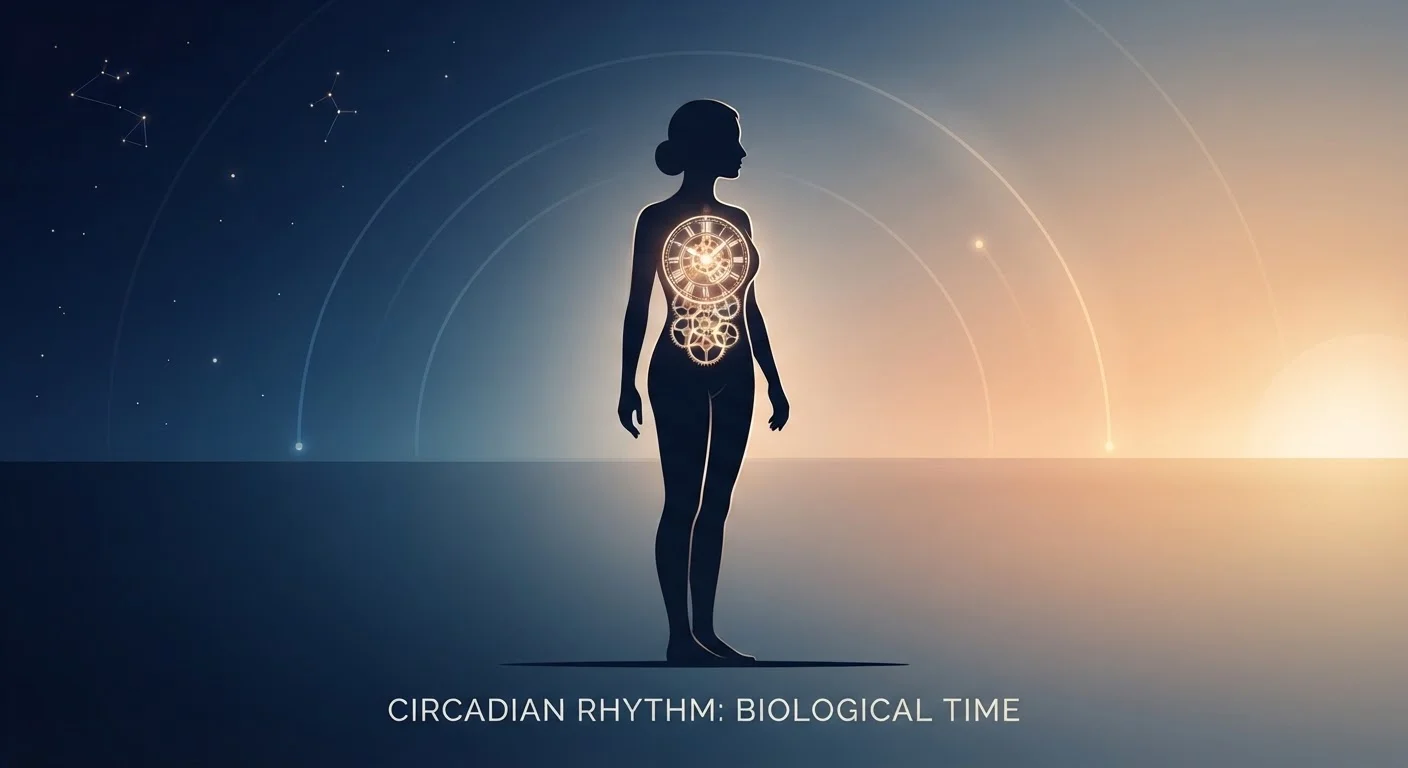
Your circadian rhythm is an internal biological timing system that runs on a roughly 24-hour cycle. It governs when you feel alert, when you feel sleepy, and when your body performs key repair and regulatory functions. Unlike a simple preference or habit, it is a deeply embedded physiological mechanism driven by specialized genes and brain structures. The timing of this rhythm — not just how many hours you sleep — plays a central role in how restorative your sleep actually is.
The suprachiasmatic nucleus (SCN) in the hypothalamus acts as the master circadian pacemaker, synchronizing peripheral clocks in nearly every organ system via hormonal and neural signals.
Why Bedtime Alone Misses the Point
Most sleep advice focuses on a single number: eight hours. But growing sleep science research suggests that when you sleep relative to your internal clock may be just as important as how long you sleep. Two people can both log eight hours yet experience dramatically different levels of restoration — and circadian alignment is often the deciding factor.
Your body clock coordinates the release of hormones, the cycling of sleep stages, and the timing of cellular repair. When your sleep window is misaligned with that internal schedule, you can end up sleeping during phases when your biology is still primed for wakefulness — producing lighter, more fragmented sleep regardless of duration. For a deeper look at the biological machinery involved, see our guide to what your circadian rhythm really is.
How Your Internal Clock Actually Works
The circadian system is driven by a master pacemaker in the brain — the suprachiasmatic nucleus — which synchronizes thousands of cellular clocks throughout the body. This system doesn't simply respond to fatigue; it actively anticipates when sleep and wakefulness should occur, preparing your physiology hours in advance.
Two overlapping biological processes regulate your daily sleep-wake cycle: the circadian drive (your clock-timed alerting signal) and sleep pressure (the buildup of sleep-promoting compounds during waking hours). Understanding how these interact explains a lot of common sleep experiences — including why staying up extremely late can sometimes paradoxically make it harder to fall asleep. Our article on the two-process model of sleep explores this dynamic in detail.
~24.2 hrs
Average human circadian period without light cues
Research has shown that in the absence of external time cues, the human circadian clock runs slightly longer than 24 hours, requiring daily light-based resetting.
~30%
Adults reporting irregular sleep-wake schedules
Studies using wrist actigraphy have found that a substantial proportion of adults show notable night-to-night variability in sleep timing, a marker of circadian disruption.
2+ hrs
Social jet lag shift linked to measurable health effects
Research published in sleep science literature indicates that two or more hours of weekend-to-weekday schedule misalignment is associated with poorer metabolic and mood outcomes.
The Power of Consistency Over Precision
You don't need to hit the same bedtime to the minute every night. What matters more is regularity — particularly your wake time. A consistent rise time anchors your circadian clock, stabilizes the daily buildup of sleep pressure, and makes it reliably easier to fall asleep at night. Variable wake times, by contrast, introduce a form of internal jet lag that leaves your clock perpetually recalibrating.
This effect is compounded when weekends deviate sharply from weekdays — a pattern researchers call social jet lag. Even two hours of schedule drift across the week is enough to measurably affect alertness and mood. For a research-grounded comparison of timing versus total duration, see sleep consistency vs. sleep duration.
Anchor Your Day With a Fixed Wake Time
Choose a consistent wake time you can maintain seven days a week — including weekends — and prioritize it above a fixed bedtime. Your body clock responds strongly to this anchor, making it easier to feel sleepy at an appropriate hour naturally. Even minor improvements in schedule consistency can yield noticeable gains in sleep quality over one to two weeks.
Light: The Master Reset Button
Of all the external signals that influence your body clock, light is the most powerful. Morning light exposure — especially natural daylight within the first hour after waking — reinforces your clock's timing and promotes alertness throughout the day. Evening exposure to bright, blue-spectrum light delays your clock's transition into sleep mode by suppressing melatonin production.
Practical circadian hygiene therefore isn't just about dark bedrooms and screen limits at night. It's equally about actively seeking morning light. These complementary strategies work together to keep your clock well-calibrated. Our article on morning light and evening darkness offers practical detail on both sides of this equation.
This article is for informational purposes only and is not medical advice. If you experience persistent sleep difficulties, consult a qualified healthcare professional.