

Key Takeaways
Circadian Rhythm
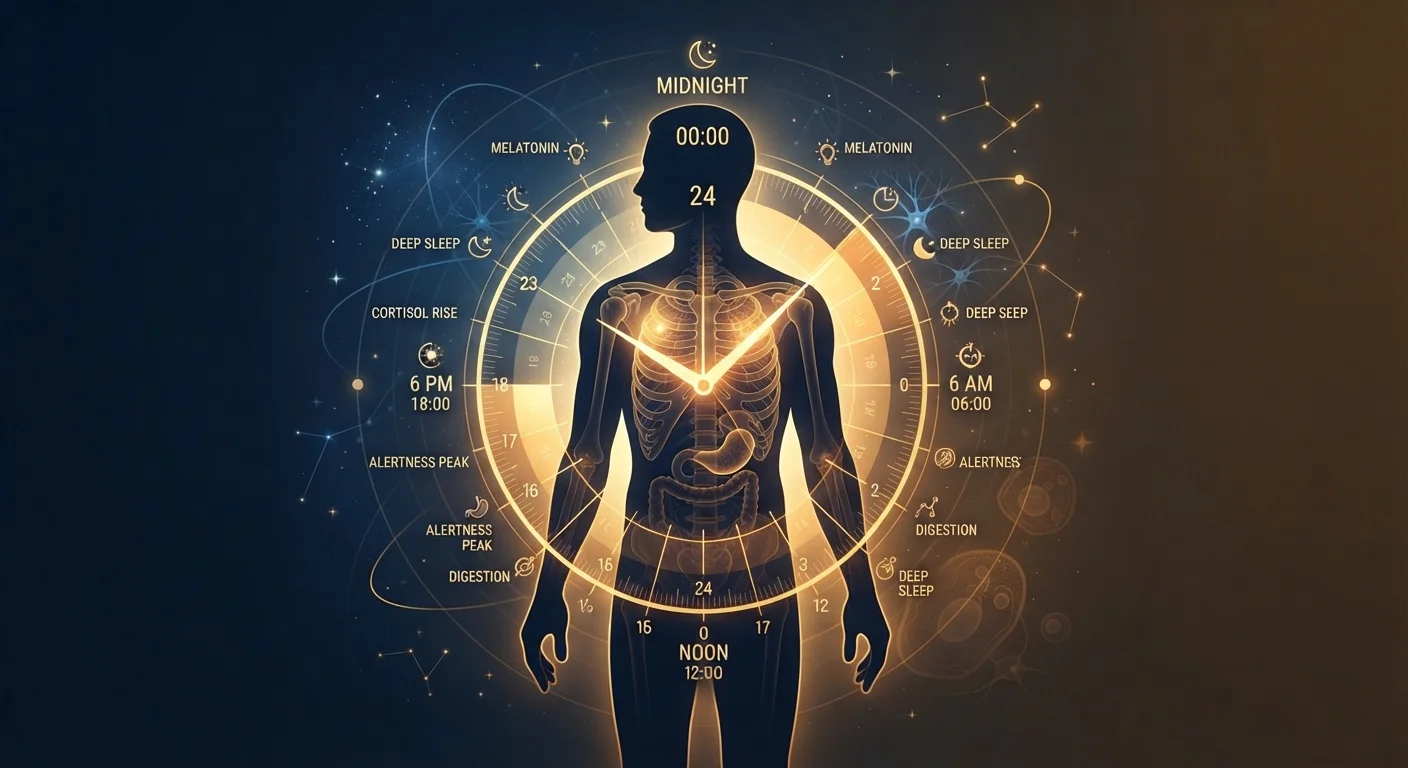
A circadian rhythm is an internal, roughly 24-hour biological cycle that regulates when you sleep, wake, eat, and perform countless other body functions. It is driven by a cluster of nerve cells in the brain called the suprachiasmatic nucleus (SCN), located in the hypothalamus. This clock responds primarily to light and darkness to keep your body synchronized with the external environment.
The molecular mechanism relies on interlocking feedback loops of clock genes — including CLOCK, BMAL1, PER, and CRY — that cycle in and out of activity over approximately 24 hours, generating the oscillating signals that drive biological timing.
The Master Clock Inside Your Brain
Deep within the hypothalamus sits a structure no larger than a grain of rice: the suprachiasmatic nucleus (SCN). Despite its modest size, the SCN functions as the body's master pacemaker, broadcasting timing signals to virtually every organ and tissue. It receives direct input from the eyes — specifically from light-sensitive cells in the retina — and uses that information to anchor your internal clock to the 24-hour day.
What makes this system remarkable is that it does not operate top-down alone. Research has confirmed that nearly every cell in the human body contains its own molecular clock, driven by interlocking loops of gene expression. The SCN coordinates these peripheral clocks through hormonal signals, body temperature fluctuations, and neural pathways, keeping the whole system synchronized like sections of an orchestra following a conductor.
Light remains the most influential external time cue, or zeitgeber (German for "time giver"). Morning light exposure advances the clock; bright light late at night delays it. This is why consistent morning light is one of the most evidence-supported tools for anchoring a healthy circadian schedule. See better sleep habits for practical guidance on building routines aligned with this biology.
Far Beyond Bedtime: What Circadian Rhythms Actually Control
Most people associate the circadian rhythm exclusively with feeling sleepy at night — but that is only one of its roles. The clock governs a sweeping range of physiological processes across the full 24-hour cycle.
~24.2 hrs
Average intrinsic human circadian period
Research using isolation studies has found the average free-running circadian period in humans is slightly longer than 24 hours, requiring daily light entrainment to stay synchronized.
~20%
U.S. workers on non-standard shift schedules
Estimates from the Bureau of Labor Statistics suggest roughly one in five American workers regularly works evening, night, or rotating shifts, putting them at elevated risk for circadian misalignment.
2018
Nobel Prize awarded for circadian clock discovery
The 2017 Nobel Prize in Physiology or Medicine was awarded to Jeffrey Hall, Michael Rosbash, and Michael Young for their work uncovering the molecular mechanisms controlling circadian rhythms.
- Hormone release: Cortisol — the body's primary alerting hormone — peaks in the early morning to prepare the body for activity, then declines through the day. Melatonin, the signal for darkness and sleep onset, rises in the evening in response to dim light.
- Core body temperature: The body cools by approximately 1–2°F in the hours approaching sleep, facilitating the transition into deeper sleep stages. It begins rising again before natural waking time.
- Immune function: Many immune responses are time-gated. Research suggests that the timing of infection exposure and the body's inflammatory response vary across the circadian cycle.
- Metabolism and digestion: Insulin sensitivity, digestive enzyme production, and nutrient processing efficiency all follow circadian patterns, which is part of why meal timing influences metabolic outcomes.
- Cognition and mood: Reaction time, working memory, and emotional regulation peak and trough at predictable points in the day, driven in part by circadian-controlled neurotransmitter activity.
This breadth explains why circadian disruption — even short-term — can affect energy, mood, appetite, and immune defenses simultaneously. For a deeper look at how these rhythms shape daily energy, see how circadian rhythms shape your energy all day.
What Disrupts Circadian Alignment — and Why It Matters
The circadian system is remarkably stable under consistent conditions, but it is sensitive to disruption. Common sources of misalignment include irregular sleep and wake times, exposure to artificial light after dark, late-night eating, transmeridian travel (jet lag), and rotating or overnight shift work.
When the internal clock falls out of step with the external environment or with the body's own peripheral clocks — a state researchers call circadian misalignment — the consequences are not limited to feeling groggy. Epidemiological studies of shift workers have documented associations between chronic circadian disruption and increased risk of metabolic disorders, cardiovascular concerns, and immune dysregulation. It is important to note that associations do not establish direct causation, and individual responses vary considerably.
For readers experiencing persistent sleep timing problems that go beyond occasional jet lag, circadian rhythm disorders represent a clinically recognized category worth understanding. Consulting a healthcare provider is the appropriate step for evaluating personal symptoms.
“Circadian clocks are not just clocks for sleep. They are clocks for virtually every physiological and biochemical process in the body, and when those clocks are disrupted, the health consequences can be profound.”
— Joseph Takahashi, Neuroscientist and circadian biology researcher, University of Texas Southwestern Medical Center
This article is for informational purposes only and is not a substitute for professional medical advice, diagnosis, or treatment. Always consult a qualified healthcare provider regarding any health concerns or before making changes to your health routine.
Individual Differences: Why Not Every Clock Runs on the Same Schedule
If you have ever noticed that some people are naturally energetic in the early morning while others hit their stride in late evening, you have observed chronotype variation in action. Chronotype refers to an individual's innate preference for earlier or later timing of sleep, wakefulness, and peak performance — and it is substantially shaped by genetics.
Variants in clock genes such as PER3, CLOCK, and others have been linked to differences in natural sleep timing. Age also plays a documented role: adolescents experience a biologically driven shift toward later sleep timing that gradually reverses through adulthood, while older adults often shift toward earlier timing. These are not character traits or failures of discipline — they reflect real biological variation. Understanding your own chronotype can help you structure activity, light exposure, and sleep timing in ways that work with your biology rather than against it. Our companion article on chronotypes explores this in detail.
Circadian science also underlies why consistent morning habits tend to be effective anchors for daily wellbeing — a phenomenon examined in the context of the science behind morning routines.