

Key Takeaways
The Two-Process Model of Sleep
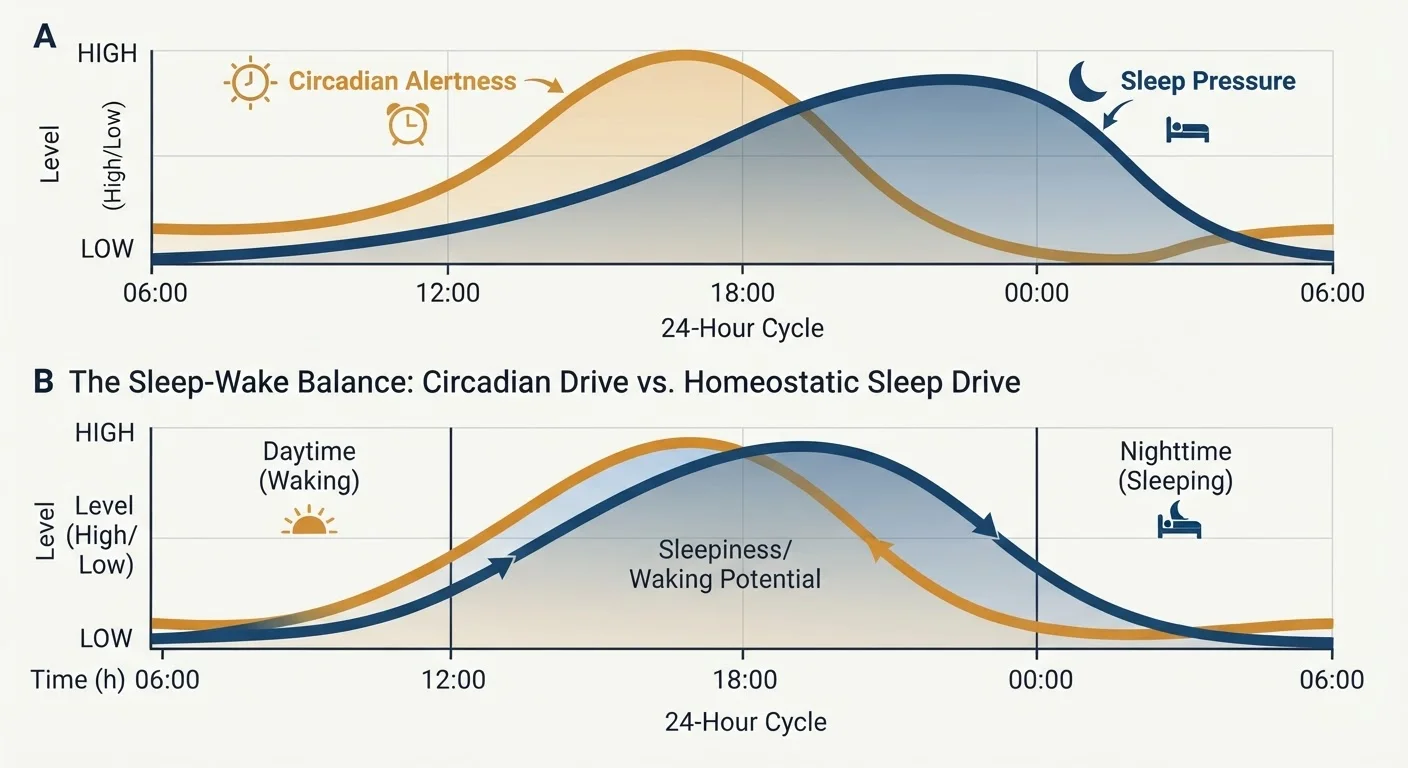
The two-process model is a scientific framework explaining that your urge to sleep is governed by two separate biological systems working together. The first is sleep pressure (Process S), which builds steadily the longer you stay awake. The second is the circadian drive (Process C), your internal 24-hour biological clock that promotes alertness or sleepiness at predictable times of day. Sleep occurs most effectively when these two processes align — when sleep pressure is high and circadian drive is promoting rest.
First proposed by Alexander Borbély in 1982, the model has been repeatedly validated in chronobiology research and remains the dominant framework for understanding sleep-wake regulation in clinical sleep medicine.
How Two Systems Govern Your Sleep
Every night when you fall asleep, you are experiencing the outcome of a competition — and a cooperation — between two distinct biological systems. Sleep researchers call this the two-process model, and it is one of the most useful frameworks in sleep science for understanding why you feel sleepy when you do, why some sleep feels restorative and some does not, and why your schedule matters as much as your bedtime.
The model was formalized in a landmark 1982 paper by Swiss sleep researcher Alexander Borbély, who identified two interacting processes: Process S (sleep pressure) and Process C (circadian drive). Neither alone determines when you sleep — it is their combined interaction that does.
For a deeper look at how your circadian rhythm regulates far more than sleep, the underlying biology is worth understanding on its own terms.
Process S: Sleep Pressure Builds While You Are Awake
Process S is the homeostatic side of the equation. From the moment you wake up, sleep pressure begins accumulating. The primary biological mechanism behind this is adenosine, a naturally occurring chemical compound that builds up in the brain as a byproduct of neural activity. The longer your neurons are active, the more adenosine accumulates — and the stronger your drive to sleep becomes.
During sleep, your brain clears adenosine efficiently. This is why a full night of quality sleep leaves you feeling restored: the biochemical debt of the previous day has been paid. Shortened or fragmented sleep clears adenosine incompletely, and you carry residual sleep pressure into the next day.
Caffeine's mechanism of action is directly tied to this system. Rather than generating energy, caffeine temporarily blocks adenosine receptors, suppressing the perception of sleepiness. It does not reduce actual sleep pressure — once caffeine is metabolized, that pressure reasserts itself.
Timing Your Nap to Protect Nighttime Sleep
If you need to nap, earlier is better. A short nap of 20–30 minutes before 2 p.m. gives your brain a brief adenosine reset without substantially reducing the sleep pressure you will need that evening. Late or long naps work against your nighttime sleep drive.
Late naps — particularly those taken after 3 p.m. — reduce sleep pressure prematurely and can make it significantly harder to fall asleep at your intended bedtime, even if the nap felt necessary.
Process C: Your Circadian Clock Promotes Alertness on a Schedule
While sleep pressure rises passively as you stay awake, your circadian system actively works to keep you alert during daylight hours. Process C is governed by your suprachiasmatic nucleus (SCN), a small region in the brain's hypothalamus that functions as a master circadian pacemaker, running on an approximately 24-hour cycle.
The circadian system promotes alertness by suppressing sleepiness — particularly during the morning and early-to-mid afternoon — and then withdrawing that alerting signal in the evening, allowing sleep pressure to take over. This is why most people feel a wave of sleepiness in the late evening even if they have not been awake an unusually long time: the circadian gate for sleep is opening.
Light is the primary environmental signal that calibrates Process C. Morning light exposure reinforces the alerting phase; evening darkness allows melatonin secretion to signal the onset of the sleep window. Managing light exposure throughout the day is one of the most evidence-supported ways to keep your circadian system well-calibrated. For more on this biology, see how light exposure shapes your sleep biology.
Why the Interaction Between Both Processes Matters
The two-process model's most powerful insight is that sleep quality depends on the alignment of both systems. The ideal sleep window opens when sleep pressure is high and the circadian clock is simultaneously signaling rest. When these two conditions converge, sleep onset is fast, sleep architecture is healthy, and you wake feeling genuinely restored.
Misalignment, however, creates familiar problems. If you fall asleep too early, before the circadian gate fully opens, sleep may be shallow or interrupted. If you stay up past your biological window — as many people do on screens — the circadian alerting signal eventually reasserts itself in the morning before sleep pressure is fully cleared.
Shift work, jet lag, and irregular sleep schedules all disrupt this interplay in ways that compound over time. Why your internal clock matters more than your bedtime hour is a related concept that follows directly from this framework. Your circadian rhythm shapes energy, mood, and metabolism across the entire day — not just sleep.
This article is for informational purposes only and is not a substitute for professional medical advice. If you have concerns about your sleep health, consult a qualified healthcare provider.