

Key Takeaways
Option A
REM Sleep
The brain's nightly memory lab and emotional reset.
Best for: Consolidating memories, processing emotions, and supporting cognitive performance.
Option B
Deep Sleep (Slow-Wave Sleep)
The body's primary physical restoration window.
Best for: Cellular repair, immune reinforcement, and physical recovery.
If you're focused on mental sharpness and learning retention
REM Sleep
REM is the stage most closely linked to memory consolidation and emotional processing — both are critical for cognitive performance the next day.
If physical recovery and immune health are your priority
Deep Sleep (Slow-Wave Sleep)
Growth hormone secretion and tissue repair peak during deep sleep, making it the body's primary physical restoration window.
If you want to support overall health and wellbeing
Both stages equally
Neither stage is optional — a full, uninterrupted night of sleep is the only reliable way to obtain adequate amounts of both.
How Sleep Stages Are Organized Each Night
Sleep is not a uniform state of unconsciousness. Your brain and body cycle through a structured sequence of stages roughly every 90 minutes throughout the night — a pattern researchers call sleep architecture. Understanding this architecture is the foundation for appreciating what REM and deep sleep each contribute. For a detailed breakdown of these cycles, see The Architecture of a Night's Sleep.
Each cycle includes lighter stages (N1 and N2), a period of deep sleep (also called slow-wave sleep or N3), and a period of REM (rapid eye movement) sleep. The balance shifts across the night: deep sleep dominates early cycles, while REM periods grow longer in the hours before waking. Both stages are present in a healthy night — which is exactly why total sleep duration matters as much as sleep quality.
| Criterion | REM Sleep | Deep Sleep (Slow-Wave Sleep) |
|---|---|---|
| Brain activity | High — near-waking levels | Low — slow delta waves |
| Primary function | Memory consolidation, emotional processing | Physical repair, immune support |
| When it peaks | Second half of the night | First half of the night |
| Growth hormone release | Minimal | Peak secretion occurs here |
| Muscle tone | Actively suppressed (atonia) | Reduced but present |
| Dreaming | Vivid dreaming most common | Rare or abstract if present |
| What disrupts it most | Short sleep, alcohol, stress | Fragmented sleep, sleep disorders |
What Deep Sleep Actually Does
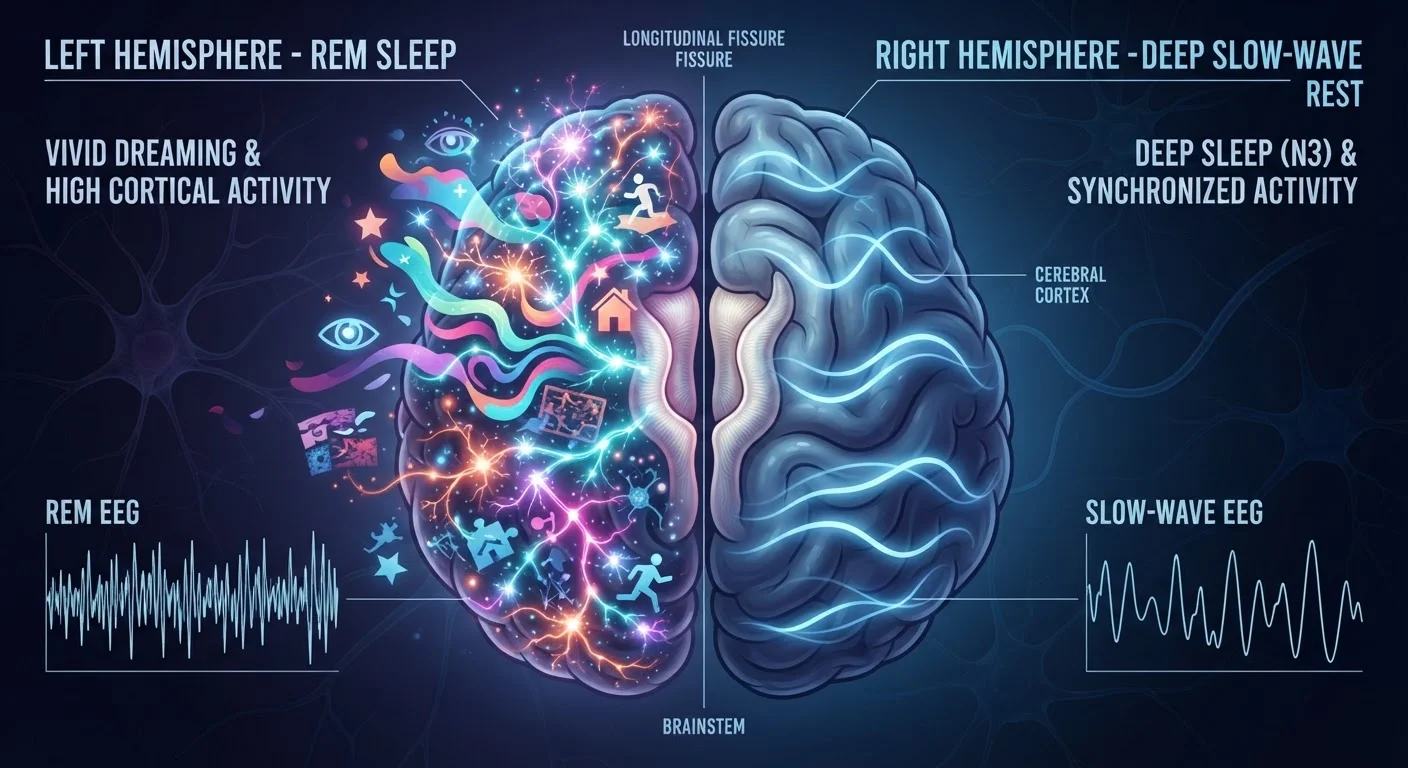
During deep sleep, brain activity slows to large, synchronized waves called delta waves — the slowest pattern recorded during sleep. This neurological quieting enables a cascade of restorative physical processes. The pituitary gland releases the majority of its nightly growth hormone during this stage, supporting tissue repair and muscle recovery. Cerebrospinal fluid flow also increases, helping clear metabolic byproducts that accumulate in the brain during waking hours.
Immune function is closely tied to deep sleep as well. Research has consistently shown that inadequate deep sleep is associated with impaired immune responses. Blood pressure drops, breathing slows, and the body enters what amounts to its deepest physical restoration mode. Deep sleep is most concentrated in the first half of the night, which is one reason that even a few hours of sleep — though not sufficient — still delivers some restorative value. For more on these nightly processes, see What Happens in Your Body During a Full Night of Sleep.
~20%
Of total sleep spent in REM
In healthy adults, REM sleep typically accounts for roughly 20–25% of total nightly sleep time, according to sleep physiology research.
~13–23%
Of total sleep spent in deep sleep
Healthy adults spend approximately 13–23% of the night in slow-wave (deep) sleep, with the proportion declining with age.
90 min
Average sleep cycle duration
A complete sleep cycle — from light sleep through deep sleep and REM — takes roughly 90 minutes and repeats four to six times per night.
What REM Sleep Actually Does
REM sleep looks almost nothing like deep sleep on a brain scan. During REM, neural activity surges to levels resembling wakefulness — while voluntary muscle movement is actively suppressed by the brainstem, a mechanism that prevents physical acting-out of dreams. This stage is where vivid dreaming most commonly occurs, but dreaming is a byproduct rather than the purpose.
The primary functions of REM sleep center on the brain. Memory consolidation — particularly for procedural skills, emotional memories, and complex associations — is strongly linked to REM. The stage also plays a key role in emotional regulation: research suggests that REM sleep helps the brain reprocess emotionally charged experiences in a neurochemical environment lower in norepinephrine, potentially reducing their emotional intensity over time. People who consistently miss REM sleep often report difficulty concentrating, mood instability, and impaired problem-solving. Because REM is concentrated in the second half of the night, it is disproportionately affected by cutting sleep short.
Why You Cannot Choose One Over the Other
It can be tempting to treat REM and deep sleep as competing priorities — but that framing misses the point. Both stages are embedded in the same repeating sleep cycle; you cannot selectively extend one without the context of a full night's sleep. Attempting to "bank" extra deep sleep through early bedtimes or more REM through late wake times disrupts the natural balance the architecture is designed to deliver.
Conditions that fragment sleep — including sleep apnea, insomnia, and even alcohol consumption — typically suppress both stages, though the mechanisms differ. Alcohol, for example, is a well-documented REM suppressant even as it may initially deepen early-night sleep. A healthcare provider is the appropriate resource if you suspect a sleep disorder is affecting your stage distribution. For a broader look at the science of physical restoration during sleep, Sleep Architecture: What Actually Happens Inside Your Body Each Night explores how each phase contributes to recovery. It's also worth noting that rest and sleep serve genuinely different roles — neither replaces the other.
This article is for general informational and educational purposes only and does not constitute medical advice. If you have concerns about your sleep health, consult a qualified healthcare professional.