

Key Takeaways
Sleep-Immune Connection
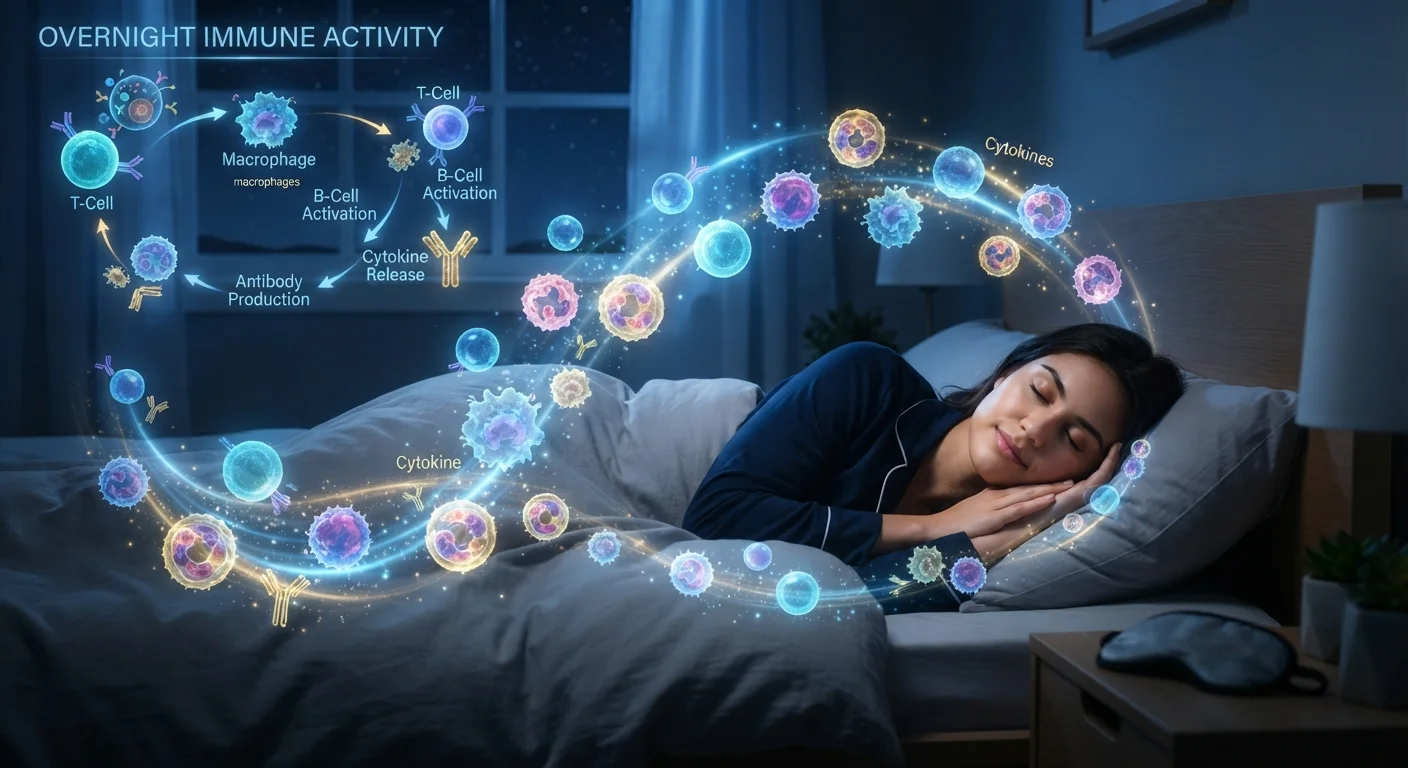
The sleep-immune connection refers to the well-documented relationship between sleep quality and duration and the body's ability to defend itself against pathogens. While you sleep, your immune system performs essential maintenance: producing and deploying key immune cells, releasing protective proteins called cytokines, and consolidating immunological memory. Disrupting or shortening sleep consistently weakens these processes, leaving the body less prepared to fight off infections.
Research shows that sleep supports both innate immunity (the body's fast, non-specific first response) and adaptive immunity (the targeted response that builds long-term protection, including vaccine-generated antibodies).
What Your Immune System Does While You Sleep
Sleep might look like downtime, but for your immune system, it's one of the most productive periods of the day. During sleep — particularly during slow-wave (deep) sleep — the body ramps up production of cytokines, small signaling proteins that coordinate immune responses and help control inflammation. Some cytokines are only produced in significant quantities during sleep, making rest a non-negotiable part of immune readiness.
Natural killer (NK) cells and T cells, both central players in identifying and destroying infected or abnormal cells, also become more active and effective overnight. This is also when the body consolidates immunological memory — essentially filing away information about past pathogens so future responses are faster and more targeted. To understand the full picture of what happens during each sleep stage, see our guide to sleep architecture.
“Sleep is the single most effective thing we can do to reset our brain and body health each day — including our immune system. Sleep is not an optional lifestyle luxury; it is a non-negotiable biological necessity.”
— Matthew Walker, Professor of Neuroscience and Psychology, University of California, Berkeley, and sleep researcher
The Cost of Cutting Sleep Short
A landmark study published in Sleep journal found that adults who slept fewer than 6 hours per night were significantly more likely to develop a cold after exposure to a rhinovirus compared to those sleeping 7 hours or more. This isn't a subtle effect — sleep deprivation measurably impairs both the speed and strength of immune responses.
Chronically short sleep is associated with reduced levels of protective antibodies, lower NK cell activity, and elevated baseline inflammation — a state sometimes called "inflammaging" when it persists over time. Elevated inflammatory markers, including interleukin-6 (IL-6) and C-reactive protein (CRP), have been observed in consistently sleep-deprived individuals, which over time may contribute to broader health risks beyond just catching the occasional cold.
4.2×
Higher cold risk with less than 6 hours sleep
A study published in Sleep (2015) found adults sleeping under 6 hours were 4.2 times more likely to develop a cold after virus exposure versus those sleeping 7+ hours.
~50%
Potential reduction in vaccine antibody response
Research on hepatitis and influenza vaccines has shown that sleep-deprived participants can produce roughly half the antibody levels of well-rested controls.
7–9 hrs
Recommended nightly sleep for most adults
The CDC and American Academy of Sleep Medicine recommend 7–9 hours of sleep per night for adults to support overall health, including immune function.
Sleep Timing, Circadian Rhythm, and Immune Timing
It's not just how long you sleep — when you sleep also influences immune function. The body's internal clock, known as the circadian rhythm, coordinates the timing of immune cell activity throughout a 24-hour cycle. Certain immune processes, including the peak release of melatonin (which has antioxidant and immune-modulating properties) and the natural surge in NK cell activity, are timed to occur during nighttime sleep hours.
Shift workers and people with highly irregular sleep schedules — who regularly sleep out of sync with natural light-dark cycles — tend to show altered immune profiles, including reduced vaccine efficacy and higher rates of respiratory infections. This is one reason why sleep consistency can be as important as sleep quantity. Learn more about why your body clock matters and how aligning your schedule can support both rest and resilience.
Sleep, Vaccines, and Immune Memory
One of the clearest demonstrations of sleep's immune role comes from vaccine research. Studies examining the hepatitis A, hepatitis B, and influenza vaccines have found that participants who were sleep-deprived around the time of vaccination produced significantly fewer antibodies than well-rested counterparts. In some cases, antibody levels fell below the threshold considered protective.
This occurs because sleep is when the adaptive immune system — the branch responsible for building targeted, long-term defenses — consolidates its response to new information, including the antigens introduced by vaccines. Getting adequate rest in the nights before and after vaccination is a practical, evidence-backed way to support the immune response. For a broader understanding of how the immune system builds and maintains these defenses, our plain-language immune system overview provides useful context.
Practical Steps to Support Sleep and Immunity
Supporting immune function through sleep doesn't require any supplements or specialized interventions. The fundamentals of good sleep hygiene align closely with the conditions the immune system needs to function well:
- Prioritize consistent sleep and wake times, even on weekends, to reinforce circadian rhythm alignment.
- Aim for 7–9 hours of total sleep per night, the range supported by public health guidance for most adults.
- Limit alcohol and caffeine in the hours before bed, as both disrupt sleep architecture and reduce time spent in restorative deep sleep.
- Keep your bedroom cool, dark, and quiet to promote uninterrupted sleep cycles.
- Manage stress actively, as elevated cortisol from chronic stress directly suppresses immune cell activity and fragments sleep.
Physical activity also plays a supporting role — regular moderate exercise is linked to better sleep quality and more robust immune responses. Explore the relationship between exercise timing and sleep recovery for practical guidance. For more on building lasting sleep routines, visit our Better Sleep Habits hub.
This article is for general informational and educational purposes only and is not a substitute for professional medical advice, diagnosis, or treatment. Always consult a qualified healthcare provider with questions about your health or any medical condition.